
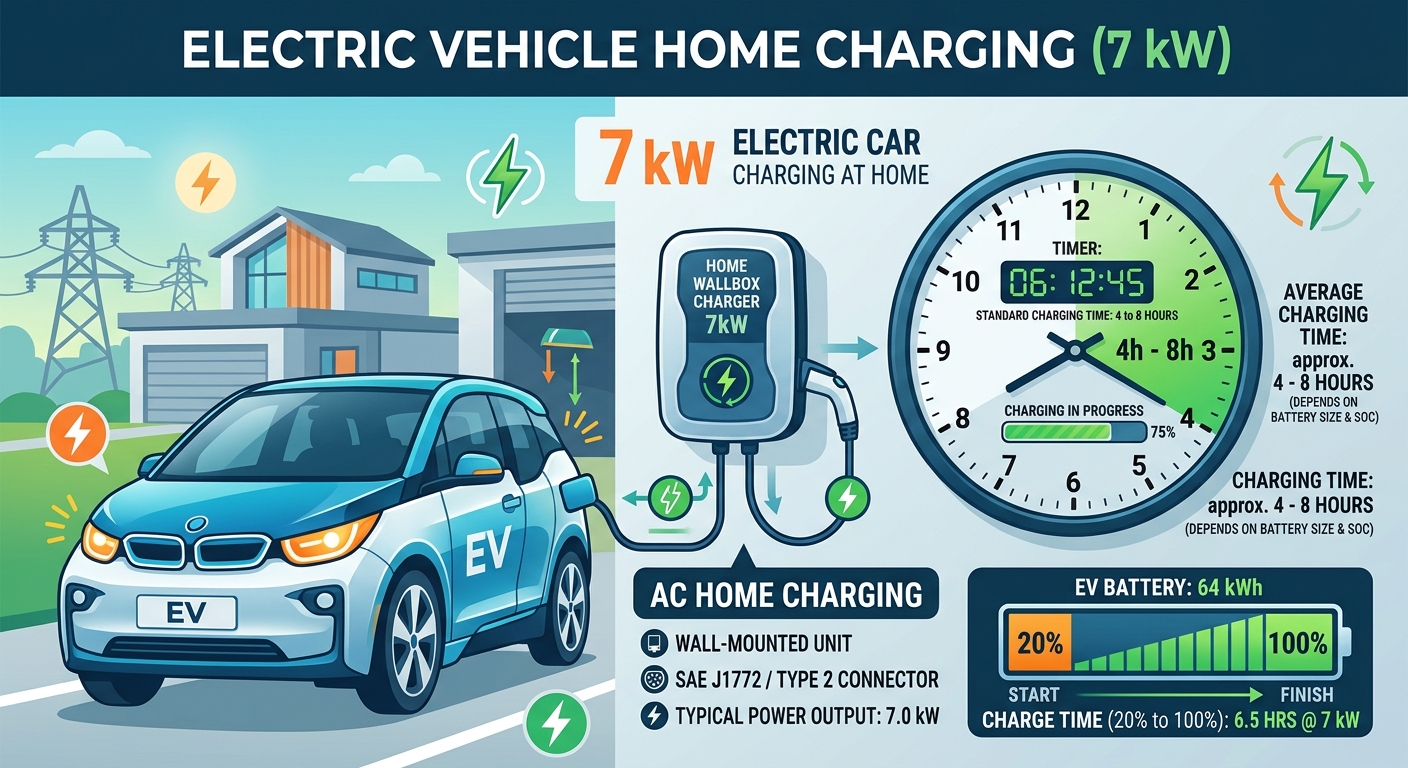
Transitioning to electric vehicle (EV) ownership brings quiet acceleration, zero daily tailpipe emissions, and low-cost overnight refueling. Operating over a high-voltage 240-volt single-phase branch circuit, installing a 7 kW (or 7.68 kW) Level 2 home wallbox is the global benchmark for residential EV charging. It provides a reliable 20 to 30 miles of driving range per hour. However, when drivers plan their daily routines and overnight charging schedules, a crucial practical question arises: How long does a 7 kW charger take to charge an electric car?
The short answer is: a 7 kW charger typically takes 4 to 8 hours to charge an electric car from 20% to 80% (or 6 to 10+ hours for a full 0% to 100% refill), depending on the vehicle’s battery pack capacity and internal onboard charger limits.
Understanding how a 7 kW charger interacts with battery chemistry, charging curves, and electrical continuous duty rules under National Electrical Code (NEC Article 625) standards helps you optimize overnight charging and maximize battery longevity.
For complete hardware reviews, installer guides, and panel load calculators, visit EV Charger Advisor.
1. Key Factors Affecting 7 kW Charging Speed
While 7 kW represents the maximum power output of the wallbox, the actual time spent plugged in depends on four key technical variables:
A. Battery Pack Size (kWh Capacity)
EV batteries range from compact 40 kWh packs in urban hatchbacks to massive 100 kWh+ packs in long-range sedans and SUVs. Replenishing a larger battery naturally takes more time at a fixed 7 kW power delivery rate.
B. Vehicle Onboard Charger Limit (AC/DC Conversion)
An EV’s charging speed is governed by its internal onboard AC-to-DC converter:
-
If your vehicle’s onboard charger is rated at 7.6 kW or higher (standard on most modern EVs), it will absorb the full output of the 7 kW wallbox.
-
If your vehicle’s onboard charger is capped at 3.6 kW or 6.6 kW (common on plug-in hybrids or older EVs), the car will throttle the charging speed, extending the session duration regardless of the wallbox’s 7 kW rating.
C. State of Charge (SoC) & The Lithium Charging Curve
Charging from 20% to 80% is fast and linear. However, the final 20% (from 80% to 100%) takes significantly longer as the vehicle’s Battery Management System (BMS) slows power input to balance cell voltages and prevent heat degradation.
D. Ambient Temperature & Thermal Conditioning
Extreme cold or high summer heat forces the vehicle to spend a portion of incoming power on battery thermal conditioning, slightly reducing net energy delivered directly to battery storage.
To learn more about how charger power levels and wire sizes compare, check out our guide on EV charging types.
2. Electrical Circuit Requirements for a 7 kW Charger
Installing a 7 kW wallbox requires proper continuous electrical sizing inside your main service panel:
-
Continuous Load 125% Rule (NEC 625.42): A standard 32-Amp continuous output charger operating at 240 Volts delivers $7.68\text{ kW}$ ($240\text{V} \times 32\text{A} / 1000$). Sizing the overcurrent protection device requires multiplying continuous current by 1.25 ($32\text{A} \times 1.25 = \mathbf{40\text{A breaker}}$).
-
Conductor Sizing: A dedicated 40A circuit requires a minimum of #8 AWG copper wire (THHN/THWN-2 rated) or #6 AWG for long conduit runs to prevent voltage drop.
-
Hardwiring vs. Plug-In: Hardwiring directly into a junction box provides maximum thermal stability and avoids the need for expensive upstream 240V GFCI circuit breakers.
To explore Wi-Fi-enabled smart wallboxes engineered with integrated load management features, read our guide on smart chargers.
Step-by-Step Mathematical Example: 7.68 kW Charging Time Calculation
Let us calculate the net charging time to replenish a 60 kWh EV battery pack from 20% to 80% State of Charge (adding 36 kWh of net energy) using a 32-Amp / 240-Volt Level 2 Charger ($7.68\text{ kW}$ gross output) operating at 90% AC/DC conversion efficiency ($\eta = 0.90$).
Given Parameters:
-
Total Battery Capacity: $60 \text{ kWh}$
-
Target Energy Replenishment ($E_{\text{net}}$): $60 \text{ kWh} \times (0.80 – 0.20) = \mathbf{36 \text{ kWh}}$
-
Charger Continuous Amperage ($I$): $32 \text{ Amps}$
-
Supply Voltage ($V$): $240 \text{ Volts}$
-
System Efficiency ($\eta$): $90\% \quad (0.90)$
Calculation 1: Gross Power Output of the 7 kW Charger ($P_{\text{gross}}$)
Calculation 2: Net Power Delivered to Battery Cells ($P_{\text{net}}$)
Calculation 3: Net Charging Session Time ($T$)
Result Breakdown: Supplying 36 kWh of usable energy (20% to 80% charge) to a 60 kWh battery using a 32A / 240V charger takes 5 hours and 12 minutes, fitting perfectly within standard overnight sleeping hours.
Comparison Table: 7 kW Charging Times by EV Battery Size
| EV Battery Capacity | Miles of Range Added | Time for 20% to 80% Charge | Time for 0% to 100% Full Charge | Dedicated Breaker & Wire |
| 40 kWh (Compact EV) | ~140 Miles | ~3.5 Hours | ~5.8 Hours | 40A Breaker / #8 AWG Copper |
| 60 kWh (Mid-Range Sedan) | ~210 Miles | ~5.2 Hours | ~8.6 Hours | 40A Breaker / #8 AWG Copper |
| 75 kWh (Long-Range SUV) | ~260 Miles | ~6.5 Hours | ~10.8 Hours | 40A Breaker / #8 AWG Copper |
| 100 kWh (Large Truck/SUV) | ~320 Miles | ~8.7 Hours | ~14.4 Hours | 40A Breaker / #8 AWG Copper |
Summary & Key Takeaways
-
4 to 8 Hours Average: A 7 kW charger replenishes a typical EV battery (20% to 80%) in 4 to 8 hours, making it ideal for overnight home charging.
-
20 to 30 Miles of Range per Hour: Delivering roughly 7.68 kW gross power adds 20 to 30 miles of range for every hour spent plugged in.
-
Requires a 40A Circuit: Sizing a continuous 32A / 7.68 kW charger requires a dedicated 40A double-pole circuit breaker and #8 AWG copper wire under NEC 125% continuous duty rules.
-
Efficient & Gentle: AC charging at 7 kW keeps thermal stress minimal, preserving lithium-ion battery longevity compared to frequent DC fast charging.













Leave a Reply