
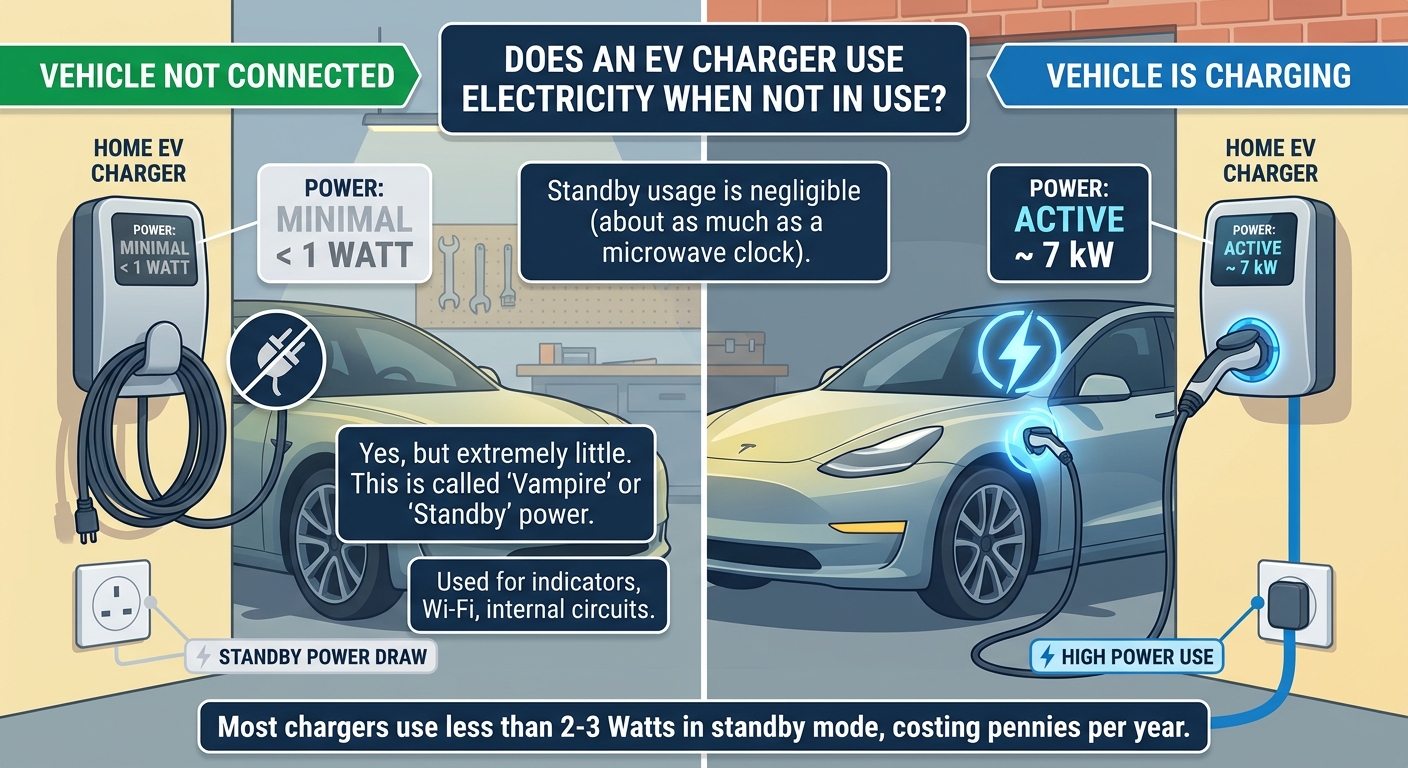
Installing a residential Level 2 electric vehicle (EV) charging station provides reliable, high-speed refueling at home, supplying 20 to 44 miles of driving range per hour over a 240-volt single-phase branch circuit. Because EV chargers remain permanently connected to a dedicated electrical circuit, homeowners frequently evaluate their overall energy consumption and utility bills. A common concern among EV owners is: Does an EV charger use electricity when not in use?
The short answer is: yes, an EV charger uses a small amount of electricity when it is not actively charging a vehicle. This continuous power draw—known as standby power, phantom load, or vampire draw—typically consumes between 1 and 5 watts per hour depending on whether the unit is a basic charger or a Wi-Fi-enabled smart wallbox.
Under National Electrical Code (NEC Article 625) safety standards and ENERGY STAR efficiency guidelines, modern EV charging stations are engineered to minimize idle power draw, ensuring that standby energy consumption remains negligible compared to active vehicle charging sessions.
For complete hardware reviews, installer guides, and panel load calculators, visit EV Charger Advisor.
1. Why Do EV Chargers Draw Standby Power?
When an EV charger is plugged into a vehicle or sitting idle in its holster, internal components require continuous low-voltage electricity to perform background operations:
A. Standby Functions in Standard (“Dumb”) Chargers
-
Control Board & Status LEDs: Low-voltage microcontrollers run continuously to monitor ground safety loops, control pilot signals, and illuminate LED status indicators.
-
Safety Relay Standby: Internal contactors and GFCI monitoring circuits remain powered in a ready state to detect vehicle plugging and safely energize the high-voltage circuit.
-
Power Draw: Standard non-networked chargers typically consume 1 to 2 Watts per hour in idle mode.
B. Standby Functions in Smart Chargers
-
Wi-Fi & Cellular Connectivity: Integrated Wi-Fi, Bluetooth, or cellular modules maintain continuous communication with cloud servers and mobile apps.
-
Smart Features & Monitoring: Current Transformer (CT) clamp monitoring, scheduled Time-of-Use (TOU) tracking, over-the-air (OTA) firmware readiness, and solar surplus integration require active background processing.
-
Power Draw: Feature-rich smart wallboxes typically consume 2 to 5 Watts per hour in idle mode.
To learn more about how charger power levels and wire sizes compare, check out our guide on EV charging types.
2. Annual Energy & Financial Impact of Standby Power
Calculating the total energy consumption of standby power demonstrates its minimal financial footprint over a full year:
A. Annual Standby Energy Consumption Calculation
Assuming an average smart charger draws 3 Watts in standby mode for 20 hours per day (with 4 hours of active charging):
-
Daily Standby Consumption: $3 \text{ Watts} \times 20 \text{ Hours} = 60 \text{ Watt-hours (0.06 kWh / day)}$
-
Annual Standby Consumption: $0.06 \text{ kWh/day} \times 365 \text{ Days} = \mathbf{21.9 \text{ kWh / Year}}$
B. Annual Standby Cost
At an average U.S. residential electricity rate of $0.16 per kWh:
-
Total Annual Cost: $21.9 \text{ kWh} \times \$0.16 = \mathbf{\$3.50 \text{ per Year}}$
For comparison, a single active 11.52 kW charging session transferring 45 kWh consumes more energy in 4 hours than the charger draws in standby mode over two full years.
To explore Wi-Fi-enabled smart wallboxes engineered with integrated load management features, read our guide on smart chargers.
3. ENERGY STAR Efficiency Standards & Reduction Strategies
Modern EV charging hardware is regulated to enforce strict idle energy limits:
-
ENERGY STAR Certification: Certified EV chargers must meet rigorous standby efficiency criteria, limiting idle power draw to less than 2 to 3 Watts depending on network capabilities.
-
Hardwired vs. Plug-In Standby Efficiency: Both hardwired and plug-in (NEMA 14-50) wallboxes draw similar standby power. However, hardwired installations maintain stable control board grounding and protection against transient voltage spikes.
-
Should You Disconnect Your Charger? Turning off the breaker or unplugging the charger to eliminate standby draw is unnecessary and discouraged. Frequent switching or plugging wears down circuit breakers and receptacle contacts, creating safety risks that far outweigh a $3 annual savings.
Comparison Table: EV Charger Standby Consumption
| Charger Category | Features Active During Standby | Typical Idle Power Draw | Estimated Annual Idle Energy | Estimated Annual Idle Cost ($0.16/kWh) |
| Standard (“Dumb”) EVSE | Status LEDs, safety relays, control board | 1.0 – 2.0 Watts | 7.3 – 14.6 kWh | $1.17 – $2.34 / Year |
| ENERGY STAR Smart EVSE | Wi-Fi connectivity, app sync, TOU timers | 2.0 – 3.0 Watts | 14.6 – 21.9 kWh | $2.34 – $3.50 / Year |
| High-Performance Smart EVSE | Wi-Fi/Cellular, CT solar tracking, display screen | 3.0 – 5.0 Watts | 21.9 – 36.5 kWh | $3.50 – $5.84 / Year |
Summary & Key Takeaways
-
Minimal Standby Power: EV chargers draw a negligible 1 to 5 Watts of standby power when not actively charging a vehicle.
-
Purpose of Standby Draw: Idle electricity powers Wi-Fi modules, status LEDs, safety relays, and background smart monitoring features.
-
Negligible Financial Impact: Average standby energy costs between $1.50 and $5.00 per year, representing a tiny fraction of total home electricity use.
-
Keep Hardware Connected: Do not switch off circuit breakers or unplug wallboxes to stop standby draw, as constant cycling accelerates mechanical wear on electrical components.













Leave a Reply