
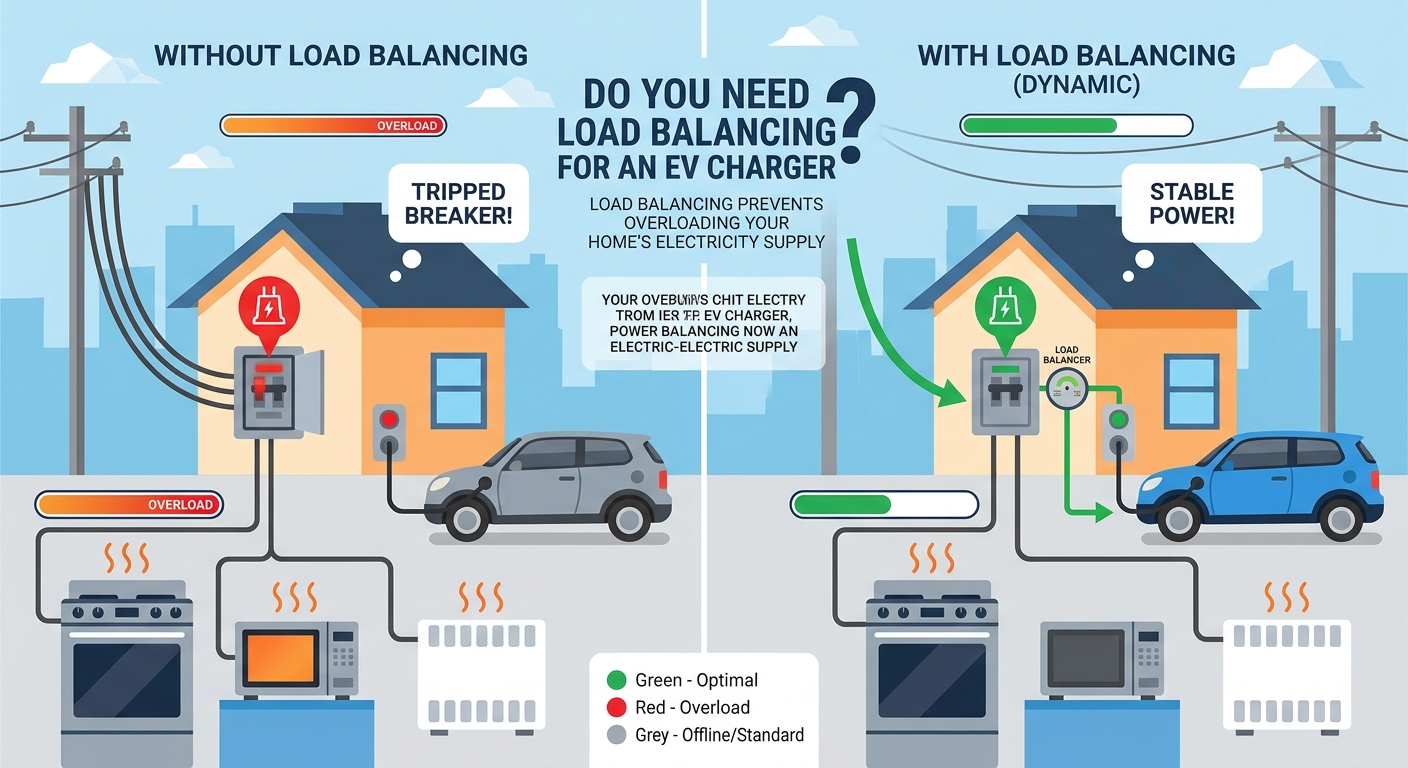
Installing a residential Level 2 electric vehicle (EV) charging station is the most efficient way to fuel your car at home, restoring 20 to 44 miles of driving range per hour over a high-voltage 240-volt single-phase branch circuit. However, as modern homes add heavy electrical draws—such as heat pumps, electric water heaters, hot tubs, and induction cooktops—main electrical distribution panels can quickly reach their maximum load capacity. When planning a Level 2 installation, homeowners and installers often face a critical question: Do you need load balancing for an EV charger?
The short answer is: you do not always need load balancing for an EV charger. If your electrical panel has sufficient physical amperage capacity (headroom) to support a dedicated 40A to 60A circuit under National Electrical Code (NEC Article 220) load calculations, a standard unmanaged charger will work fine. However, load balancing becomes essential if your panel is constrained (e.g., 100A or 125A panels) or if you are installing multiple EV chargers on a single service.
Under NEC Article 625.42, implementing an Electric Vehicle Energy Management System (EVEMS) or dynamic load balancing allows you to install a high-power charger safely without undergoing a costly $2,500–$5,000 main electrical service upgrade.
For complete hardware reviews, installer guides, and panel load calculators, visit EV Charger Advisor.
1. When Do You Need EV Load Balancing?
Evaluating whether your installation requires dynamic load balancing depends on three primary structural scenarios:
A. Scenario 1: Older or Capacity-Constrained Electrical Panels (100A or 125A)
-
The Problem: Standard continuous 48-Amp Level 2 chargers require a dedicated 60-Amp double-pole circuit breaker ($11.52\text{ kW}$). On a standard 100-Amp main panel, running central air conditioning alongside an electric oven and an EV charger can cause main breaker trips.
-
The Solution: Installing dynamic load balancing uses Current Transformer (CT) clamp sensors to monitor live panel usage. When household demand spikes, the system automatically throttles the EV charger down; when home loads drop, it restores full charging speed.
B. Scenario 2: Installing Multiple EV Chargers (Multi-EV Households)
-
The Problem: Adding two 48-Amp chargers would require 120 Amps of total breaker capacity—exceeding the entire capacity of even a 150A or 200A service panel.
-
The Solution: Static or dynamic load sharing connects both wallboxes over local Wi-Fi or RS-485 communication lines, dynamically splitting available circuit capacity (e.g., sharing a single 50A breaker between two vehicles) to prevent panel overloads.
C. Scenario 3: Ample Service Headroom (200A or 400A Panels)
-
When It Is NOT Needed: If your home features a modern 200A or 400A service panel with minimal heavy electrical appliances and passing NEC 220 load calculations, you do not need load balancing. A standard unmanaged Level 2 charger can be installed directly.
To learn more about how charger power levels and wire sizes compare, check out our guide on EV charging types.
2. Hardware & Electrical Safety Code Standards (NEC 625.42)
Integrating load management equipment requires strict compliance with national safety codes:
-
NEC Article 625.42 (EVEMS Exemption): Standard electrical codes require adding EV chargers at 125% of continuous load rating to service calculations. However, Article 625.42 allows approved EVEMS equipment to cap peak demand, legally bypassing main panel upgrades.
-
Dedicated Circuit Wiring (NEC 125% Continuous Duty Rule): High-amperage 48A continuous wallboxes require heavy #6 AWG copper wire (THHN/THWN-2) and a 60A double-pole breaker.
-
Hardwired Reliability: Direct hardwiring ensures uninterrupted communication between the CT sensors and wallbox, eliminating thermal degradation associated with plug-in receptacles.
To explore Wi-Fi-enabled smart wallboxes engineered with integrated load management features, read our guide on smart chargers.
Step-by-Step Mathematical Example: Panel Load Calculation With vs. Without Load Balancing
Let us analyze a home with a 100-Amp Main Service Panel ($240\text{V}$ single-phase supply = $24.0\text{ kW}$ total capacity) operating under an 80% NEC Continuous Limit of 80 Amps ($19.20\text{ kW}$ max safe panel load) considering a 48-Amp Level 2 EV Charger ($11.52\text{ kW}$ output).
Given Parameters:
-
Main Panel Rating ($I_{\text{panel}}$): $100 \text{ Amps (24,000 Watts at 240V)}$
-
NEC 80% Safe Load Limit ($I_{\text{safe}}$): $100\text{A} \times 0.80 = \mathbf{80 \text{ Amps (19,200 Watts)}}$
-
Existing Household Peak Load ($I_{\text{house}}$): $45.0 \text{ Amps (10,800 Watts)}$
-
Unmanaged EV Charger Draw ($I_{\text{EV}}$): $48.0 \text{ Amps (11,520 Watts)}$
Calculation 1: Total Load WITHOUT Load Balancing (Unmanaged Charger)
Conclusion: Without load balancing, the installation violates NEC safety limits by 13 Amps, requiring a $3,000+ panel upgrade.
Calculation 2: Total Load WITH Dynamic Load Balancing (EVEMS Installed)
The EVEMS continuously measures real-time load ($45.0\text{A}$) and dynamically throttles the charger to match available headroom ($I_{\text{headroom}}$):
Calculation 3: Off-Peak Nighttime Charging Recovery
When household loads drop overnight to 8.0 Amps ($1,920\text{W}$):
Because 72A exceeds the charger’s maximum 48A hardware capacity, the EVEMS automatically scales charging back up to full speed:
Result Breakdown: Dynamic Load Balancing automatically throttles charging draw down to 8.40 kW during peak household usage to prevent breaker trips, restoring full 11.52 kW speed when home electricity demand falls overnight.
Comparison Table: Do You Need Load Balancing? Decision Matrix
| Installation Scenario | Main Panel Rating | Load Balancing Needed? | Primary Technical Reason |
| Single EV / Modern Home | 200A or 400A | NO | Ample panel headroom available |
| Single EV / Older Home | 100A or 125A | YES (Highly Recommended) | Prevents panel overload & saves $3k+ upgrade |
| Multiple EVs / Shared Circuit | Any Panel Size | YES (Mandatory) | Safely splits fixed circuit capacity across wallboxes |
| Solar-Smart Integration | Any Panel Size | YES (Optional for Solar) | Matches charging output to real-time solar PV surplus |
Summary & Key Takeaways
-
Not Always Mandatory: You do not need load balancing if your service panel has sufficient capacity (e.g., 200A+) to pass NEC 220 load calculations.
-
Saves Panel Upgrade Costs: On 100A or 125A panels, adding an EVEMS with CT clamps avoids expensive main electrical service upgrades.
-
Essential for Multi-EV Setups: Load sharing allows multiple chargers to share a single branch circuit safely without tripping main breakers.
-
Follow NEC Article 625.42: Installing certified load management satisfies electrical codes while maintaining continuous 48A ($11.52\text{ kW}$) overnight charging speeds.













Leave a Reply