
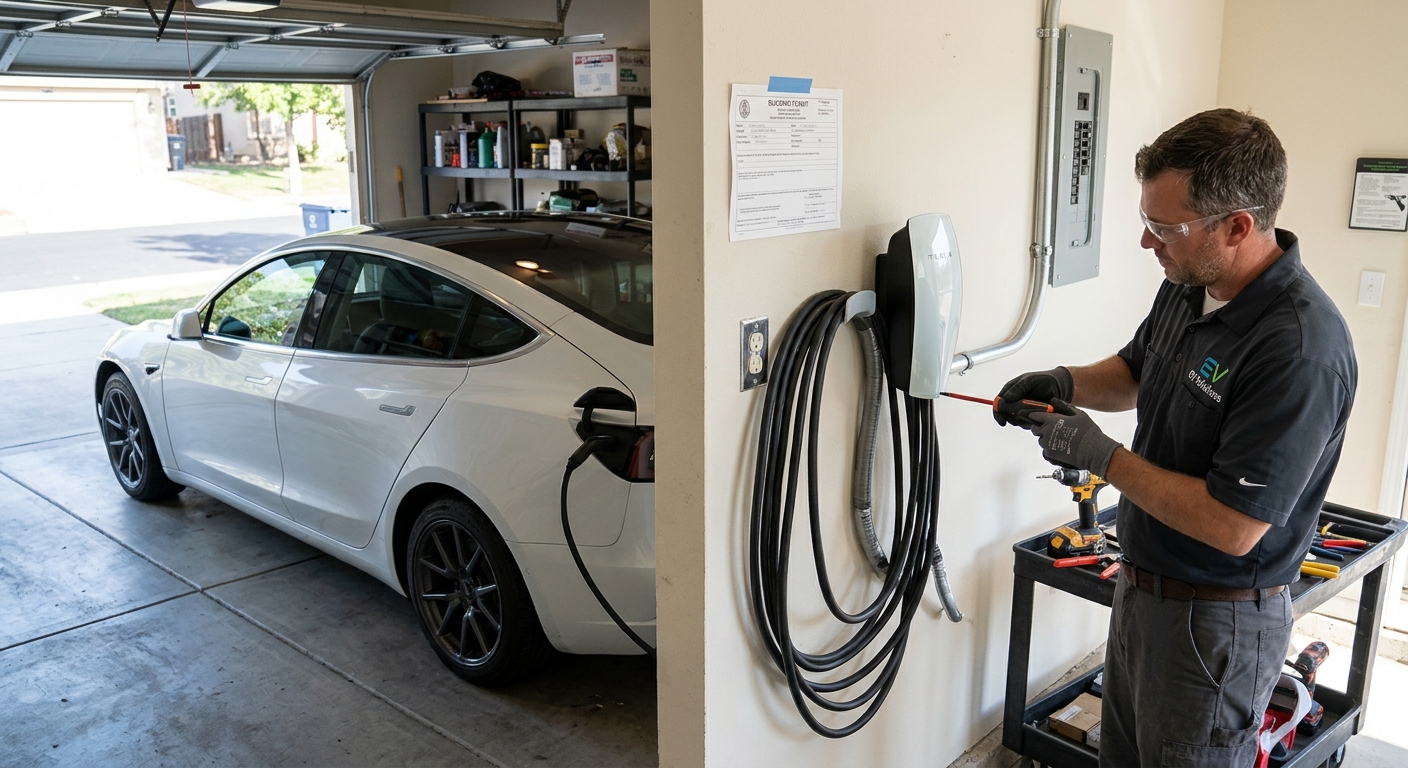
Upgrading to home electric vehicle (EV) charging delivers quiet daily driving, zero tailpipe emissions, and low-cost overnight fueling. Operating on a dedicated high-voltage 240-volt single-phase branch circuit, installing a Level 2 wallbox provides 20 to 44 miles of driving range per hour. However, because high-amperage EV chargers run at maximum current continuous draw for hours, property owners and installers must satisfy strict building regulations. A primary legal and safety question arises: Do you need a certificate for an EV charger?
The short answer is: yes, you need an Electrical Installation Certificate (EIC) or local compliance certificate along with approved building permits for any dedicated Level 2 hardwired or high-amperage EV charger installation.
Under National Electrical Code (NEC Article 625) standards and international wiring regulations, an installation certificate signed by a certified, licensed electrician serves as legal proof that your charger was installed safely, properly grounded, and tested without overloading your main electrical service panel.
For complete hardware reviews, installer guides, and panel load calculators, visit EV Charger Advisor.
1. Why an Electrical Certificate Is Mandatory
An Electrical Installation Certificate (EIC) is not just a receipt; it is an official legal and technical document verifying electrical safety and regulatory compliance:
A. Homeowner Insurance & Warranty Protection
-
Insurance Validity: Insurance providers frequently request proof of certified electrical work in the event of home fire or electrical damage claims. An uncertified installation can lead to denied claims.
-
Manufacturer Warranty Safeguards: Major EV wallbox brands require professional installation sign-off and valid compliance records to honor hardware warranties.
B. Property Sales & Title Documentation
-
Real Estate Handover: When selling a home, home inspectors and buyers’ solicitors request compliance certificates for high-voltage circuit additions (like 60A EV charger circuits).
-
Building Code Sign-Off: Verifies that local electrical permits were pulled, inspected, and closed by local municipal inspectors.
To learn more about how charger power levels and wire sizes compare, check out our guide on EV charging types.
2. What Information Must Be on an EV Charger Certificate?
A complete EV charger installation certificate records five core technical field groups:
-
Site & Installer Identity: Property address, customer name, date of completion, licensing credentials, and installer signature.
-
Charger Unit Identity: Exact manufacturer make, model, and physical serial number taken from the nameplate.
-
Circuit & Breaker Parameters: Dedicated feeder panel reference, double-pole breaker size (e.g., 60A for 48A output), wire gauge (#6 AWG copper), and continuous load ratings.
-
Settings-As-Left: Documented continuous current limits (e.g., set to 48A, 40A, or dynamic load management EVEMS limits) configured at commissioning.
-
Electrical Inspection & Test Data: Earth loop impedance ($Z_s$), insulation resistance values, and Type B residual current device (RCBO) trip test results.
To explore Wi-Fi-enabled smart wallboxes engineered with integrated load management features, read our guide on smart chargers.
Step-by-Step Mathematical Example: Inspection Compliance & Voltage Drop Math
Let us calculate the breaker size, continuous charging output, and percentage voltage drop ($\Delta V$) for a hardwired 48-Amp Level 2 EVSE ($240\text{V}$ single-phase supply) running 75 feet ($22.86\text{ m}$) on #6 AWG Copper Wire ($R = 0.000491 \Omega/\text{ft}$) to include on the official installation certificate.
Given Parameters:
-
Continuous EVSE Current ($I$): $48 \text{ Amps}$
-
Nominal Line Voltage ($V$): $240 \text{ Volts}$
-
One-Way Conduit Distance ($L$): $75 \text{ feet}$
-
Conductor Resistance ($R_{\text{wire}}$): $0.000491 \Omega \text{ per foot}$
Calculation 1: Dedicated Breaker Sizing (NEC 125% Continuous Duty Rule)
Calculation 2: Continuous Gross Power Output ($P_{\text{gross}}$)
Calculation 3: Voltage Drop ($\Delta V$) Math
For a single-phase 240V circuit ($2 \times L = 150\text{ ft}$ total conductor loop path):
Calculation 4: Percentage Voltage Drop (%)
Result Breakdown: Documented on the certificate, a 60A breaker paired with #6 AWG copper wire delivers 11.52 kW of power while operating at a safe 1.47% voltage drop—well below the 3.0% maximum NEC threshold limit.
Comparison Table: EV Charger Installation Certificate & Permit Requirements
| Installation Scenario | Electrical Permit Required? | Installation Certificate Needed? | Minimum Required Documentation |
| Level 1 (120V Standard Plug) | NO (Existing Outlet) | NO | Manufacturer User Manual |
| Level 2 NEMA 14-50 Plug-In | YES (New 240V Outlet) | YES | Electrical Permit + GFCI Test Record |
| Level 2 Hardwired Wallbox | YES (Dedicated Circuit) | YES | Signed EIC Certificate + Code Inspection |
| Commercial EV Charging Hub | YES (Comprehensive Site Plan) | YES | Full EIC + DISCO Grid Utility Sign-Off |
Summary & Key Takeaways
-
Certificates Are Essential: Dedicated Level 2 EV charger installations require an Electrical Installation Certificate (EIC) and local municipal permit sign-off.
-
Protects Insurance & Warranties: Signed compliance documents preserve home insurance coverage and validate manufacturer hardware warranties.
-
Documents Circuit Parameters: A complete certificate details charger serial numbers, #6 AWG wire gauge, 60A breaker ratings, and software settings-as-left.
-
Guarantees NEC Compliance: Sizing continuous continuous loads at 125% ensures long-term safety and code compliance.













Leave a Reply