
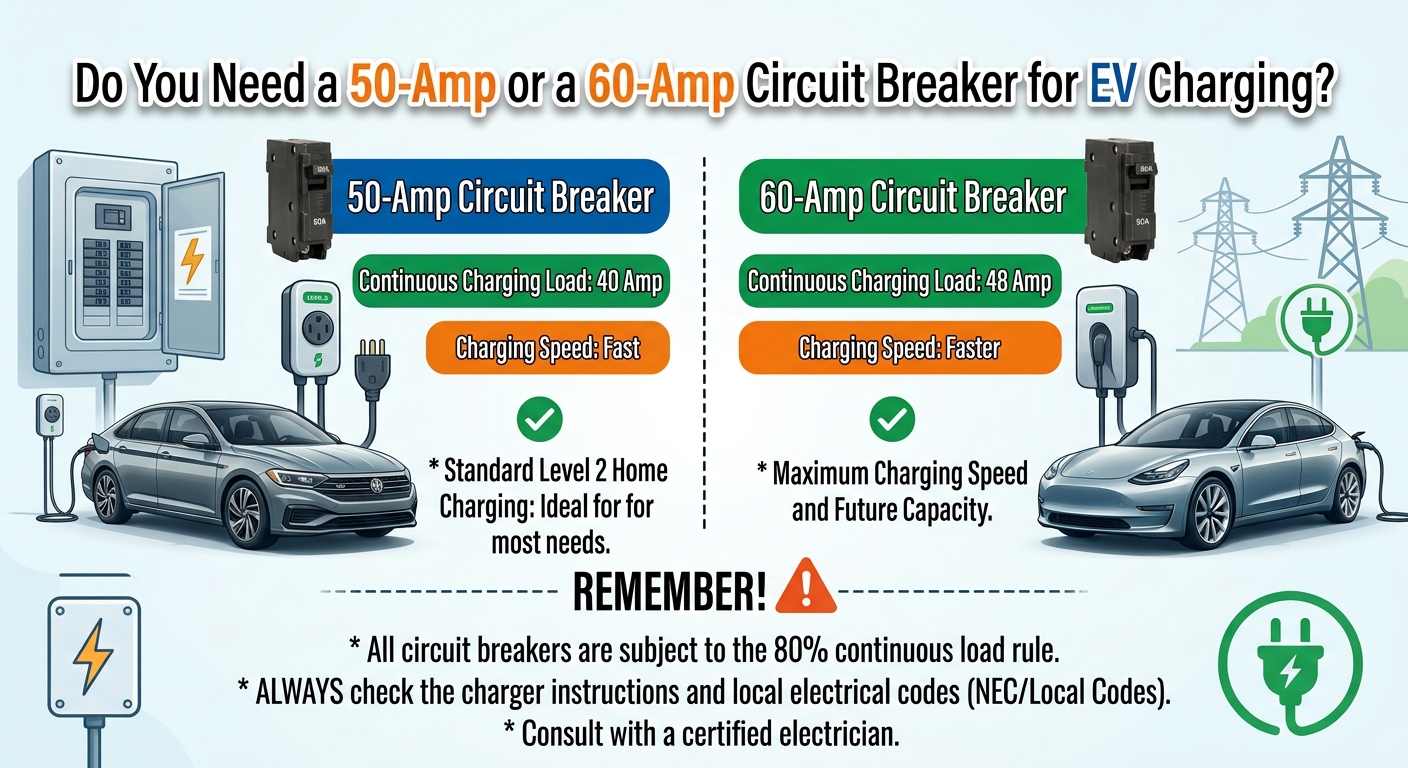
When upgrading your home’s electrical infrastructure to support a Level 2 electric vehicle (EV) charger, selecting the proper circuit breaker is one of the most critical steps in the planning process. Operating on a 240-volt single-phase branch circuit, Level 2 wallboxes deliver anywhere from 25 to 44+ miles of driving range per hour. However, homeowners, DIYers, and installers frequently face a key choice: Do you need a 50-amp or 60-amp circuit breaker for an EV charger?
The short answer is: you need either a 50-amp or 60-amp circuit breaker, depending on your Level 2 EV charger’s maximum continuous output and the National Electrical Code (NEC) 80% rule, which requires continuous loads to run at no more than 80% of the breaker’s rated capacity (or sized at 125% of the charger’s draw).
Understanding how continuous load rules dictate breaker sizing, wire selection, and installation methods (plug-in vs. hardwired) ensures your installation remains safe, compliant, and cost-effective.
For complete load calculators, hardware reviews, and installation breakdowns, visit EV Charger Advisor.
1. The NEC Continuous Load Rule: 80% Sizing Math
Under NEC Article 625, electric vehicle charging stations are classified as continuous loads—meaning the equipment draws maximum rated current continuously for 3 hours or longer during a charging cycle.
To prevent thermal fatigue, nuisance tripping, and insulation degradation over time, the NEC mandates that branch circuit breakers and conductors must be sized to 125% of the continuous draw (or conversely, the continuous load cannot exceed 80% of the circuit breaker’s faceplate rating):
How the 50A vs. 60A Breaker Math Breaks Down:
-
50-Amp Circuit Breaker: Delivers a maximum continuous output of 40 Amps ($9.60\text{ kW}$ at $240\text{V}$) ($50\text{A} \times 0.80 = 40\text{A}$).
-
60-Amp Circuit Breaker: Delivers a maximum continuous output of 48 Amps ($11.52\text{ kW}$ at $240\text{V}$) ($60\text{A} \times 0.80 = 48\text{A}$).
To learn more about how charger power levels and wire sizes compare, check out our guide on EV charging types.
2. Plug-In Outlets vs. Hardwired Wallboxes: The Breaker Limit Factor
Your physical installation choice directly dictates whether you should install a 50-amp or 60-amp circuit breaker:
Option A: 50-Amp Circuit Breaker (Standard for Plug-In Receptacles)
-
Maximum Allowed for Plug-In: Standard 240V heavy-duty outlets—such as NEMA 14-50 or NEMA 6-50 receptacles—are rated for a maximum of 50 Amps. Under electrical code, you cannot connect a plug-in receptacle to a 60-amp breaker.
-
Continuous Draw Cap: Plugs into a 50A outlet must cap their continuous output at 40 Amps ($9.6\text{ kW}$).
-
GFCI Protection Mandate: Under NEC 625.54, all EV charger receptacles installed in garages, basements, or outdoor areas must be protected by an expensive double-pole GFCI circuit breaker ($100–$180).
Option B: 60-Amp Circuit Breaker (Standard for Hardwired Stations)
-
Maximum Output Unlocked: Direct hardwiring (connecting copper wires straight into the wallbox unit) allows you to step up to a 60-amp circuit breaker, delivering full 48 Amps continuous ($11.52\text{ kW}$) output.
-
No External GFCI Required: Because hardwiring eliminates the exposed wall socket, NEC code permits using a standard, non-GFCI double-pole breaker ($20–$35). The wallbox’s built-in internal GFCI circuit handles shock protection automatically.
-
Faster Recovery: Adds up to 44 miles of driving range per hour, recharging large EV battery packs significantly faster than a 50A plug-in setup.
To explore Wi-Fi-enabled smart wallboxes that support dynamic app management, read our guide on smart chargers.
Step-by-Step Mathematical Example: 50A vs. 60A Performance & Wire Sizing
Let us perform a mathematical side-by-side comparison of power delivery, charging speed, and wire gauge requirements for a 50A circuit setup versus a 60A circuit setup when restoring 60 kWh of energy into an electric vehicle.
Given Parameters:
-
Energy Required: $60 \text{ kWh}$
-
Operating Line Voltage: $240 \text{ Volts}$
-
Onboard AC-to-DC Conversion Efficiency: $90\%$ ($0.90$)
Calculation 1: 50-Amp Breaker Performance (40A Continuous Draw / 9.6 kW)
-
Required Wire Gauge: #6 AWG NM-B Romex Cable (rated for $55\text{A}$ at $60^\circ\text{C}$) or #6 AWG THHN copper wire.
Calculation 2: 60-Amp Breaker Performance (48A Continuous Draw / 11.52 kW)
-
Required Wire Gauge: #6 AWG THHN / THWN-2 Copper Wire in Conduit (rated for $65\text{A}$ at $75^\circ\text{C}$ terminals) or #4 AWG Romex Cable (under NEC 334.80, #6 Romex is capped at $55\text{A}$ and cannot be used on a 60A breaker).
Result Breakdown: Stepping up to a 60A breaker hardwired setup reduces total charging time by over 1 hour per full charge cycle compared to a 50A setup.
Comparison Table: 50-Amp Breaker vs. 60-Amp Breaker Configurations
| Feature | 50-Amp Circuit Breaker | 60-Amp Circuit Breaker |
| Max Continuous Draw (80% Rule) | $40 \text{ Amps } (9.60\text{ kW})$ | 48 Amps ($11.52\text{ kW}$) |
| Primary Connection Type | Plug-In (NEMA 14-50 Outlet) or Hardwired | Direct Hardwired Only |
| Panel GFCI Requirement | Mandatory GFCI Breaker ($100 – $180) | Standard Breaker ($20 – $35) |
| Added Range per Hour | $28 – 34 \text{ miles/hr}$ | 36 – 44 miles/hr |
| Compatible Wire (Romex) | #6 AWG Romex | #4 AWG Romex (#6 Romex not allowed) |
| Compatible Wire (Conduit) | #6 AWG THHN | #6 AWG THHN Copper in Conduit |
Summary & Key Takeaways
-
Both Sizes Work: Select a 50-amp breaker for 40A continuous charging or a 60-amp breaker for 48A continuous charging.
-
Use 50A Breakers for Plug-In Outlets: Plug-in NEMA 14-50 receptacles are capped at a 50A breaker ($40\text{A}$ continuous load) and require a panel GFCI breaker.
-
Use 60A Breakers for Hardwiring: Direct hardwiring unlocks full 48A ($11.52\text{ kW}$) speeds on a 60A breaker and uses standard, lower-cost double-pole breakers.
-
Watch Your Wire Type: #6 AWG NM-B Romex is rated for 50A breakers only. For a 60A breaker, you must use #6 AWG THHN copper wire in conduit or step up to #4 AWG Romex.













Leave a Reply