
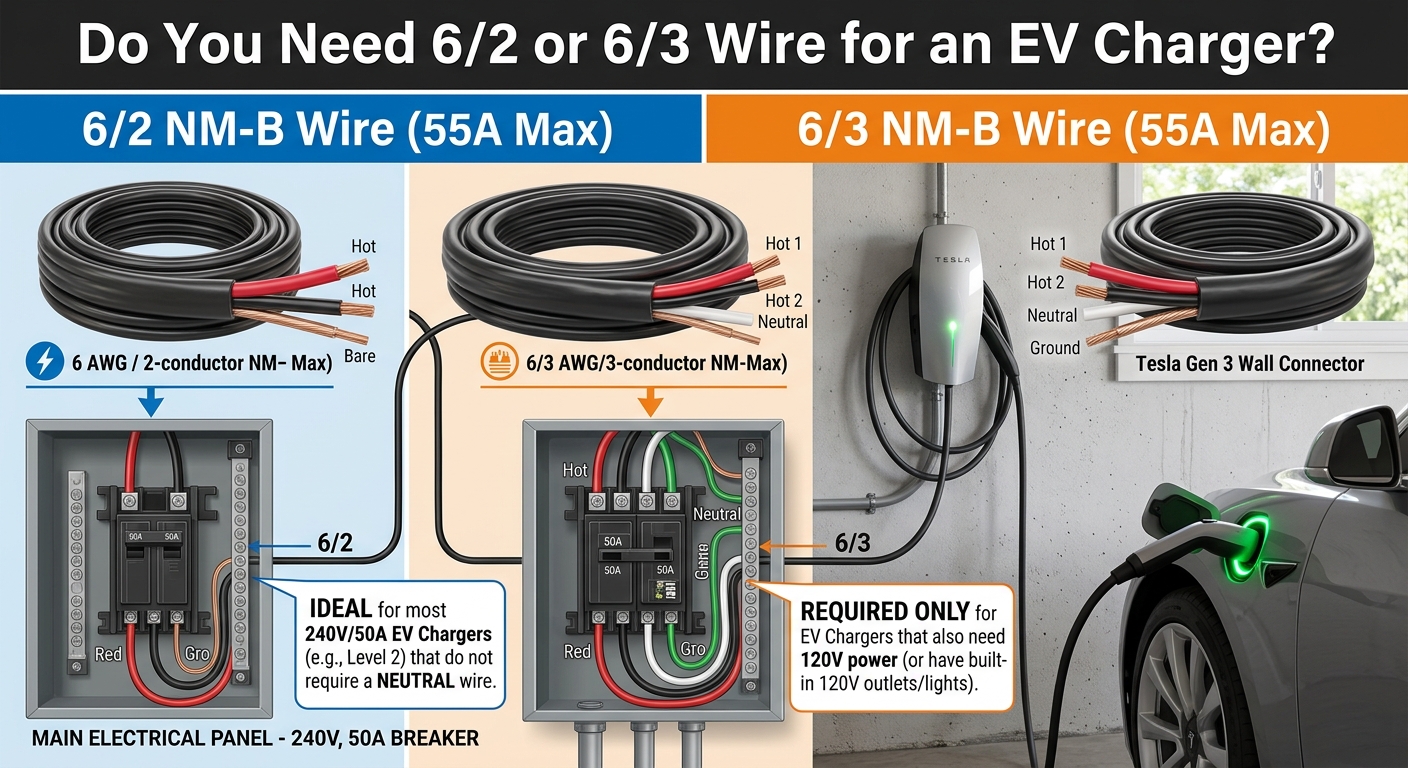
Setting up a high-power Level 2 home electric vehicle (EV) charger requires choosing the correct electrical wiring to connect your main breaker panel to your charging station. Operating on a 240-volt dedicated circuit, a Level 2 wallbox demands continuous electrical current for hours at a time. During initial material selection, homeowners, DIYers, and installers frequently ask: Do you need 6/2 or 6/3 wire for an EV charger?
The short answer is: you need 6/2 wire for a hardwired EV charger, and 6/3 wire if you are installing a 240V plug-in receptacle like a NEMA 14-50.
Understanding the fundamental technical difference between 6/2 (two insulated conductors plus a bare ground) and 6/3 (three insulated conductors plus a bare ground) ensures you do not waste money buying unnecessary copper wire while keeping your installation strictly compliant with the National Electrical Code (NEC).
For complete load calculators, wiring charts, and hardware reviews, visit EV Charger Advisor.
1. Decoding Wire Anatomy: 6/2 vs. 6/3 Explained
Before selecting wire for your installation, it helps to understand what the numbers mean under standard electrical wiring conventions (such as Non-Metallic Building Cable, commonly known as NM-B or Romex):
Understanding 6/2 Wire (Two-Conductor + Ground)
-
Conductor Count: Contains 2 insulated circuit conductors (one Black hot leg and one Red hot leg) plus 1 bare copper grounding wire.
-
Total Current-Carrying Conductors: 2 Hot Legs.
-
Voltage Delivered: Pure 240-Volt single-phase AC power.
-
Neutral Wire Present? No Neutral Wire.
Understanding 6/3 Wire (Three-Conductor + Ground)
-
Conductor Count: Contains 3 insulated circuit conductors (one Black hot leg, one Red hot leg, and one White neutral leg) plus 1 bare copper grounding wire.
-
Total Current-Carrying Conductors: 2 Hot Legs + 1 Neutral Leg.
-
Voltage Delivered: 120/240-Volt dual-voltage power.
-
Neutral Wire Present? Yes, Neutral Wire Included.
To learn more about how charger power levels and plug styles compare, check out our guide on EV charging types.
2. Why Hardwired EV Chargers Only Require 6/2 Wire
Electric vehicle onboard AC-to-DC converters operate strictly on pure 240-volt single-phase alternating current. The internal charging circuitry inside the car and wallbox does not utilize 120-volt control logic, meaning hardwired EV chargers do not use a neutral conductor.
The Hardwired Advantage:
-
Line 1 (Hot): Provides $120\text{V}$ relative to ground.
-
Line 2 (Hot): Provides $120\text{V}$ relative to ground ($240\text{V}$ potential difference across Line 1 and Line 2).
-
Equipment Ground: Connects directly to the chassis ground terminal for safety fault protection.
Because there is zero $120\text{V}$ power requirement, running a neutral wire to a hardwired station is completely redundant. Purchasing 6/2 NM-B wire instead of 6/3 NM-B wire saves roughly 25% to 35% on raw copper wire costs per foot.
3. Why Plug-In NEMA 14-50 Outlets REQUIRE 6/3 Wire
If you choose to install a plug-in Level 2 charger using a NEMA 14-50 wall socket, the National Electrical Code (NEC Article 406) strictly requires a 4-prong receptacle containing:
-
Line 1 (Hot Leg 1)
-
Line 2 (Hot Leg 2)
-
Neutral Leg (Required for 120V pin)
-
Ground (Safety Earth)
The Danger of Omitting the Neutral on Outlets
Even though your EV charger might not draw current from the neutral pin, standard NEMA 14-50 receptacles are rated for general 120/240V appliances (like RVs or electric ranges). Leaving the neutral pin unconnected inside the outlet box violates NEC code and creates severe shock hazards if another high-draw device is plugged into that socket in the future.
To explore Wi-Fi-enabled smart wallboxes that support automated energy scheduling, read our guide on smart chargers.
Step-by-Step Mathematical Example: Ampacity & Continuous Load Sizing
Let us perform an NEC load calculation to size the circuit breaker, continuous output, and wire gauge for a homeowner installing a hardwired charger pulling 40 Amps continuous power.
Given Parameters:
-
Continuous EV Charging Draw ($I$): $40 \text{ Amps}$
-
Operating Line Voltage ($V$): $240 \text{ Volts}$
Calculation 1: Calculating Required Breaker Size (NEC 125% Rule)
Under NEC Article 625, EV charging is a continuous load, requiring branch circuit conductors and breakers to be sized for 125% of continuous draw:
Calculation 2: Usable Charging Power Output
Calculation 3: Evaluating Wire Thermal Ratings (NM-B vs. THHN in Conduit)
Under NEC Article 310, conductors must be evaluated by insulation temperature columns:
-
#6 AWG NM-B (Romex) Cable: Limited to the $60^\circ\text{C}$ temperature column under NEC 334.80. #6 AWG Romex is rated for $55\text{ Amps}$, making it perfectly safe for a 50-Amp circuit breaker.
-
#6 AWG THHN / THWN-2 Copper Wire (In Conduit): Evaluated under the $75^\circ\text{C}$ column, rated for $65\text{ Amps}$, allowing it to be used on a 60-Amp circuit breaker ($48\text{A} / 11.52\text{ kW}$ output).
Result Breakdown: Hardwiring a 40A continuous charger on a 50A breaker uses 6/2 NM-B wire or two #6 THHN conductors + ground, delivering $9.60\text{ kW}$ of continuous power ($28\text{–}34\text{ miles/hr}$).
Comparison Table: 6/2 Wire vs. 6/3 Wire for EV Charging
| Specification | 6/2 Copper Wire | 6/3 Copper Wire |
| Internal Conductors | 2 Hot Legs + 1 Ground | 2 Hot Legs + 1 Neutral + 1 Ground |
| Voltage Delivered | $240 \text{ Volts}$ | $120 / 240 \text{ Volts}$ |
| Primary EV Application | Direct Hardwired Wallbox | Plug-In NEMA 14-50 Receptacle |
| Max Continuous Power (Romex 50A) | $40 \text{ Amps } (9.60\text{ kW})$ | $40 \text{ Amps } (9.60\text{ kW})$ |
| Relative Material Cost | Lower Cost ($\approx 30\%$ savings) | Higher Cost (Extra copper neutral) |
| NEC Code Compliance | Compliant for hardwired stations | Mandatory for 4-prong wall outlets |
Summary & Key Takeaways
-
Hardwired Chargers Use 6/2 Wire: Hardwired Level 2 wallboxes operate on pure $240\text{V}$ power without a neutral, requiring only two hot conductors and a ground (6/2 wire).
-
Plug-In Outlets Require 6/3 Wire: Installing a NEMA 14-50 outlet requires a neutral leg to complete the 4-prong socket configuration, requiring 6/3 wire.
-
Save Money with 6/2 Hardwiring: Hardwiring with 6/2 wire eliminates the extra neutral conductor, reducing copper cable costs while providing a safer, direct connection.
-
Watch Thermal Limits: #6 AWG Romex cable is rated for 50A breakers ($40\text{A}$ draw). If you want maximum $48\text{A}$ charging speed on a 60A breaker, use #6 AWG THHN copper wire in conduit or #4 AWG Romex.













Leave a Reply