
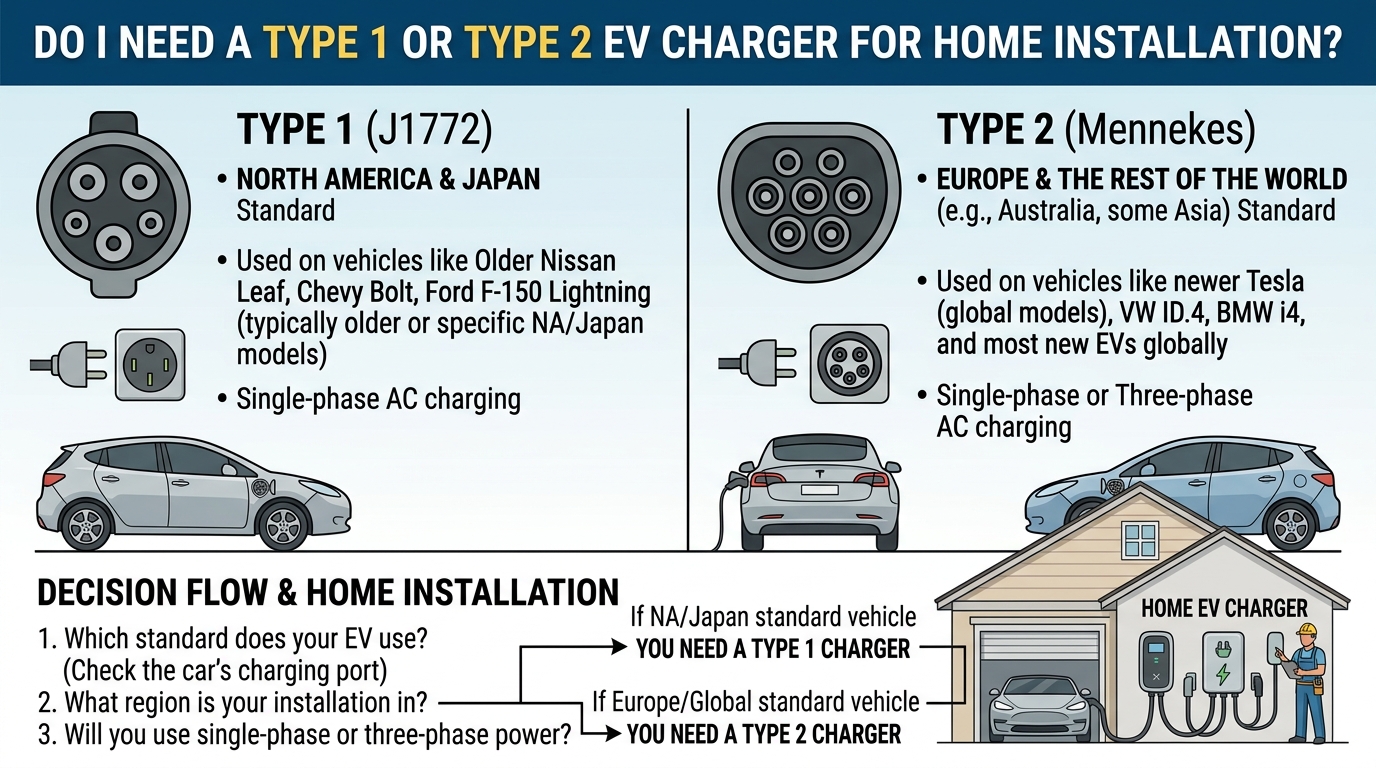
Upgrading to an electric vehicle (EV) delivers smooth driving performance, low maintenance demands, and convenient home refueling. When setting up a residential charging station, drivers are frequently confronted with technical connector terminology and ask a fundamental question: Do I need a Type 1 or Type 2 EV charger for home installation?
The short answer is: the connector type you need depends primarily on your geographical location and your vehicle’s inlet design. In North America, home Level 2 charging relies on either the Type 1 (SAE J1772) plug or the Tesla/NACS (SAE J3400) connector. In Europe, the UK, and Australia, Type 2 (Mennekes) is the universal standard for single-phase and three-phase home AC charging.
Understanding physical plug pinouts, AC power delivery capabilities, and regional electrical standards under National Electrical Code (NEC Article 625) ensures you select the correct wallbox hardware and cable configuration for your garage or driveway.
For complete hardware reviews, installer guides, and panel load calculators, visit EV Charger Advisor.
1. Regional Connector Standards: Type 1 vs. Type 2 Breakdown
Vehicle manufacturers and regional electrical grids dictate connector design standards across global markets:
A. Type 1 (SAE J1772) — North American AC Standard
-
Physical Pinout: 5-pin single-phase connector featuring a mechanical latch on top.
-
Geographic Usage: North America (United States, Canada) and parts of Asia.
-
Electrical Capacity: Designed exclusively for single-phase AC electricity up to 80 Amps at 240 Volts ($19.2\text{ kW}$ max output).
-
NACS Transition: While non-Tesla vehicles in North America historically used Type 1 J1772 inlets, major automakers are transitioning to the NACS (J3400) connector. Passive adapters allow seamless cross-compatibility between Type 1 and NACS chargers.
B. Type 2 (Mennekes / EN 62196-2) — European & Global AC Standard
-
Physical Pinout: 7-pin connector without a manual top latch; locking is managed electronically by the vehicle.
-
Geographic Usage: Europe, United Kingdom, Australia, New Zealand, and South America.
-
Electrical Capacity: Supports both single-phase AC ($230\text{V}$) up to 32A ($7.4\text{ kW}$) and three-phase AC ($400\text{V}$) up to 32A ($22\text{ kW}$).
To learn more about how charger power levels and wire sizes compare, check out our guide on EV charging types.
2. Key Electrical Requirements for Home Level 2 Installation
Regardless of whether your wallbox utilizes a Type 1 or Type 2 connector, the electrical branch circuit requirements follow strict safety guidelines:
-
Dedicated Branch Circuit (NEC 125% Rule): EV chargers draw continuous current for hours. Under NEC Article 625, overcurrent protection must be sized to 125% of continuous load:
-
48-Amp Continuous Charger ($11.52\text{ kW}$): Requires a dedicated 60-Amp double-pole circuit breaker paired with #6 AWG copper wire.
-
32-Amp Continuous Charger ($7.68\text{ kW}$): Requires a dedicated 40-Amp double-pole circuit breaker paired with #8 AWG copper wire.
-
-
Hardwiring vs. Plug-In Outlets: Hardwiring your Type 1 or Type 2 wallbox directly into a main panel eliminates socket contact heating, supports full 48A continuous output, and bypasses the need for expensive upstream 240V GFCI circuit breakers.
To explore Wi-Fi-enabled smart wallboxes engineered with integrated load management features, read our guide on smart chargers.
Step-by-Step Mathematical Example: Single-Phase vs. Three-Phase Power Delivery
Let us calculate the AC charging time to add 50 kWh of net energy to an EV battery using a Single-Phase Type 1 / Type 2 setup ($240\text{V} / 32\text{A}$ continuous) versus a European Three-Phase Type 2 setup ($400\text{V} / 16\text{A}$ continuous per phase) operating at 90% efficiency ($\eta = 0.90$).
Given Parameters:
-
Target Net Energy Replenishment ($E_{\text{net}}$): $50 \text{ kWh}$
-
Conversion Efficiency ($\eta$): $90\% \quad (0.90)$
-
Gross Energy Required ($E_{\text{gross}}$): $50 / 0.90 = \mathbf{55.56 \text{ kWh}}$
Calculation 1: Single-Phase Level 2 Power & Time ($240\text{V} / 32\text{A}$ Continuous)
Calculation 2: European Three-Phase Type 2 Power & Time ($400\text{V} / 16\text{A}$ Continuous)
For three-phase AC power ($P = \sqrt{3} \times V_{\text{line}} \times I$):
Result Breakdown: While a standard 32A single-phase Type 1/Type 2 setup takes 7 hours and 14 minutes to add 50 kWh, a three-phase 16A Type 2 installation reduces charging time to 5 hours and 1 minute—a 30.7% speed increase.
Comparison Table: Type 1 vs. Type 2 Home Charger Parameters
| Technical Feature | Type 1 (SAE J1772 / NACS) | Type 2 (Mennekes / EN 62196) |
| Primary Region | North America & Japan | Europe, UK, Australia |
| Pin Configuration | 5 Pins (Single-Phase AC) | 7 Pins (Single & Three-Phase AC) |
| Max Single-Phase Output | $19.2\text{ kW}$ (80A @ 240V) | $7.4\text{ kW}$ (32A @ 230V) |
| Max Three-Phase Output | Not Supported | $22.0\text{ kW}$ (32A @ 400V) |
| Latch Mechanism | Mechanical thumb latch on cable | Automatic electronic locking by vehicle |
| Recommended Breaker (48A) | 60A Double-Pole (#6 AWG Copper) | 60A Single-Phase or 3-Phase Breaker |
Summary & Key Takeaways
-
North America Uses Type 1 / NACS: In North America, residential Level 2 wallboxes feature Type 1 (J1772) or NACS (J3400) plugs for single-phase 240V electrical supplies.
-
Europe & Australia Use Type 2: Type 2 (Mennekes) is the standard in Europe and Australia, offering compatibility with both single-phase and three-phase residential connections.
-
Adapters Bridge Compatibility: Inexpensive, passive UL-listed adapters allow Type 1 chargers to plug into NACS vehicles and vice versa.
-
Follow NEC 125% Breaker Sizing: Sizing a 48A continuous charger requires a dedicated 60A double-pole circuit breaker and heavy #6 AWG copper wire.













Leave a Reply