
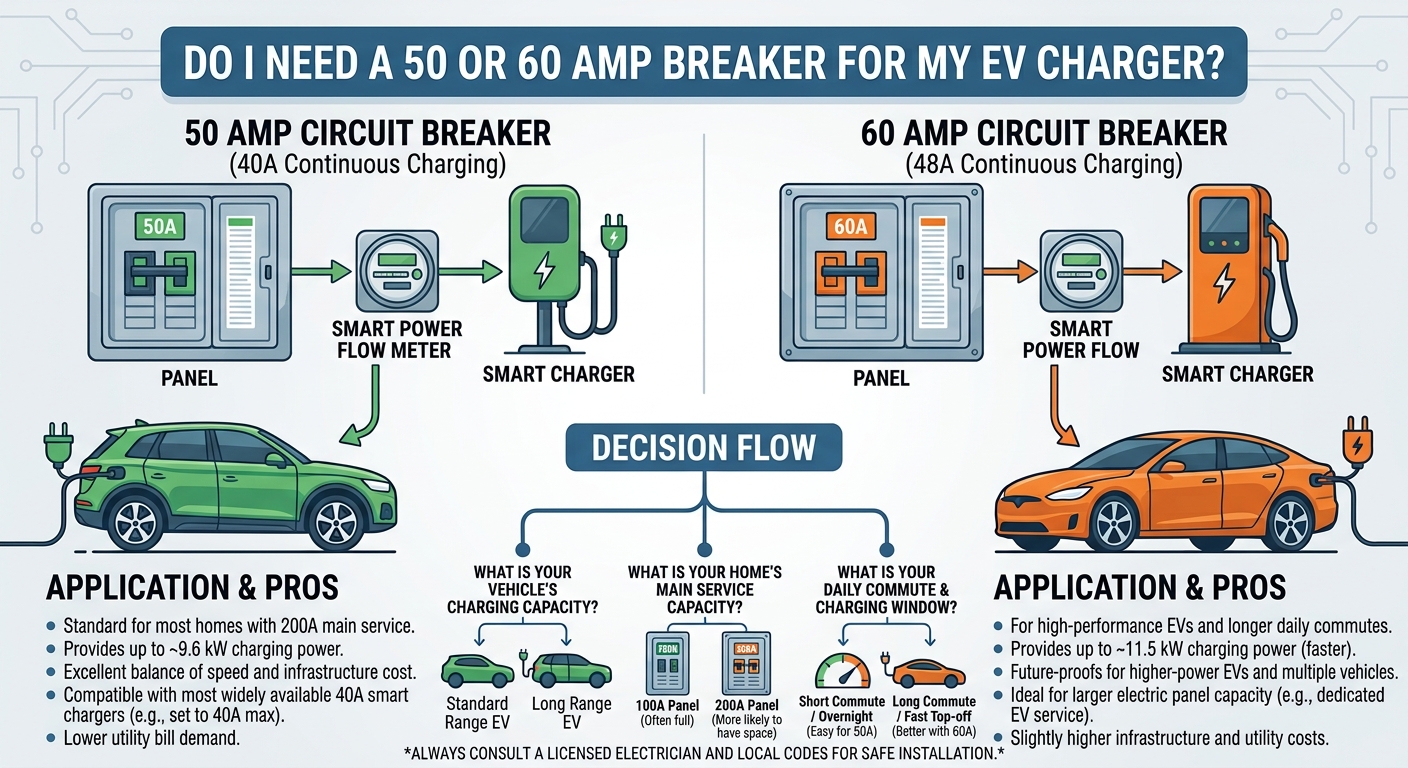
When installing a Level 2 home EV charger, choosing between a 50-amp and a 60-amp circuit breaker is one of the most important decisions you and your electrician will make. Both breaker sizes deliver rapid, full-overnight charging for modern electric vehicles, but they differ significantly in continuous power output, installation requirements, safety code mandates, and total cost.
The choice depends directly on whether you plan to install a plug-in charger (NEMA 14-50 outlet) or a hardwired wallbox:
-
Choose a 50-Amp Circuit Breaker if: You are installing a plug-in Level 2 charger using a standard NEMA 14-50 receptacle. Under National Electrical Code (NEC) safety standards, a 50A circuit supports a continuous charging rate of 40 Amps ($9.6\text{ kW}$ output).
-
Choose a 60-Amp Circuit Breaker if: You want maximum residential charging speed ($11.5\text{ kW}$) and choose to hardwire your charger directly. Under NEC rules, a 60A circuit supports a continuous charging rate of 48 Amps.
Understanding how breaker sizes translate to continuous amperage, wiring choices, and charging speed ensures a safe, optimized home setup.
For comprehensive hardware reviews, wire gauge charts, and installer guides, visit EV Charger Advisor.
The NEC 80% Continuous Load Rule Explained
The fundamental principle governing circuit breaker selection for EV charging is the National Electrical Code (NEC Article 625) continuous load rule. Electric vehicle charging draws full power for hours at a time, generating constant thermal build-up inside breakers and conduits.
To prevent circuit breakers from overheating and tripping unnecessarily during long charging sessions, the NEC mandates that branch circuits be rated for 125% of the charger’s continuous draw—or conversely, an EV charger must draw no more than 80% of the circuit breaker’s rated capacity:
1. The 50-Amp Circuit Breakdown
-
Circuit Breaker Rating: $50 \text{ Amps}$
-
Maximum Continuous Load (80% Rule): $50\text{A} \times 0.80 = \mathbf{40 \text{ Amps}}$
-
Power Delivered @ 240V: $\frac{240\text{V} \times 40\text{A}}{1000} = \mathbf{9.60 \text{ kW}}$
-
Added Driving Range: Adds roughly 28 to 34 miles of range per hour.
2. The 60-Amp Circuit Breakdown
-
Circuit Breaker Rating: $60 \text{ Amps}$
-
Maximum Continuous Load (80% Rule): $60\text{A} \times 0.80 = \mathbf{48 \text{ Amps}}$
-
Power Delivered @ 240V: $\frac{240\text{V} \times 48\text{A}}{1000} = \mathbf{11.52 \text{ kW}}$
-
Added Driving Range: Adds roughly 36 to 44 miles of range per hour.
To learn more about how charger power levels and plug styles compare, check out our guide on EV charging types.
Plug-In (50A) vs. Hardwired (60A): Critical Code & Cost Differences
Beyond adding roughly 8 to 10 extra miles of range per hour, moving up from a 50A breaker to a 60A breaker alters how your system is wired and installed:
1. 50-Amp Circuits Feature NEMA 14-50 Plug Flexibility
A 50-amp circuit allows you to install a heavy-duty NEMA 14-50 receptacle. This plug-in setup lets you easily unplug the wallbox for portable use or taking with you if you move. However, modern NEC building codes require garage 240V outlets to feature a dedicated GFCI (Ground Fault Circuit Interrupter) breaker ($100–$150) and an industrial-grade receptacle ($75–$150) to handle heavy continuous heat cycles safely.
2. 60-Amp Circuits MUST Be Hardwired
There are no standard residential 240V wall plugs rated for a 60-amp circuit. Therefore, if you want to run a 48A charger on a 60A breaker, the wallbox must be hardwired (direct wire leads connected inside the unit). Hardwiring skips the expense of a NEMA outlet and GFCI breaker, eliminates socket thermal failure points, and complies with all outdoor weatherproofing codes.
To explore Wi-Fi-enabled smart chargers with adjustable amperage settings, read our guide on smart chargers.
Step-by-Step Mathematical Example: Charging Time Comparison
To compare performance, let us calculate the time needed to charge a 75 kWh battery pack from 20% to 90% (52.5 kWh needed) using a 50A breaker setup versus a 60A breaker setup.
Given Parameters:
-
Energy Needed: $52.5 \text{ kWh}$
-
Charging Efficiency: $90\%$ ($0.90$)
Calculation 1: Charging Time on a 50-Amp Breaker (40A / 9.6 kW Output)
Calculation 2: Charging Time on a 60-Amp Breaker (48A / 11.52 kW Output)
Result Breakdown: Moving from a 50A breaker to a 60A breaker shaves over an hour off your total charge time, making it ideal for large battery vehicles, light trucks, or households with two EVs sharing a single station.
Wire Gauge Requirements for 50A vs. 60A Breakers
Breaker size dictates the thickness (gauge) of copper building wire required inside your walls:
-
50-Amp Breaker Wire: Requires #6 AWG Copper Wire (whether using THHN conductors in conduit or NM-B Romex cable).
-
60-Amp Breaker Wire: Requires #6 AWG THHN Copper Wire inside conduit (rated at 75°C). Note: If using NM-B Romex cable, building codes require stepping up to thicker #4 AWG Copper Wire due to 60°C thermal limitations.
Comparison Table: 50 Amp vs. 60 Amp EV Charger Circuits
| Feature | 50-Amp Circuit Breaker | 60-Amp Circuit Breaker |
| Max Continuous Charging Draw | $40 \text{ Amps}$ | $48 \text{ Amps}$ |
| Usable Power Output @ 240V | $9.6 \text{ kW}$ | $11.52 \text{ kW}$ |
| Added Range per Hour | $28 – 34 \text{ miles/hr}$ | $36 – 44 \text{ miles/hr}$ |
| Connection Method | Plug-In (NEMA 14-50) or Hardwired | Hardwired Only |
| Copper Wire Size (THHN in Conduit) | #6 AWG Copper | #6 AWG Copper |
| GFCI Breaker Required? | Yes (For NEMA 14-50 Outlets) | Generally No (Hardwired) |
Summary & Key Takeaways
-
50-Amp Breakers Are Great for Plug-In Use: If you want plug-and-play flexibility with a NEMA 14-50 outlet, choose a 50A breaker ($40\text{A} / 9.6\text{ kW}$ output).
-
60-Amp Breakers Deliver Maximum Speed: If you want the fastest possible residential charge rate ($48\text{A} / 11.5\text{ kW}$ output), hardwire your wallbox on a 60A breaker.
-
Hardwiring Saves Outlet Costs: A 60A hardwired setup skips buying expensive industrial NEMA 14-50 sockets and dedicated GFCI circuit breakers.
-
Check Your Panel Capacity: Ensure your main service panel (e.g., 200A main panel) has sufficient spare ampacity before adding a 50A or 60A double-pole breaker.













Leave a Reply