
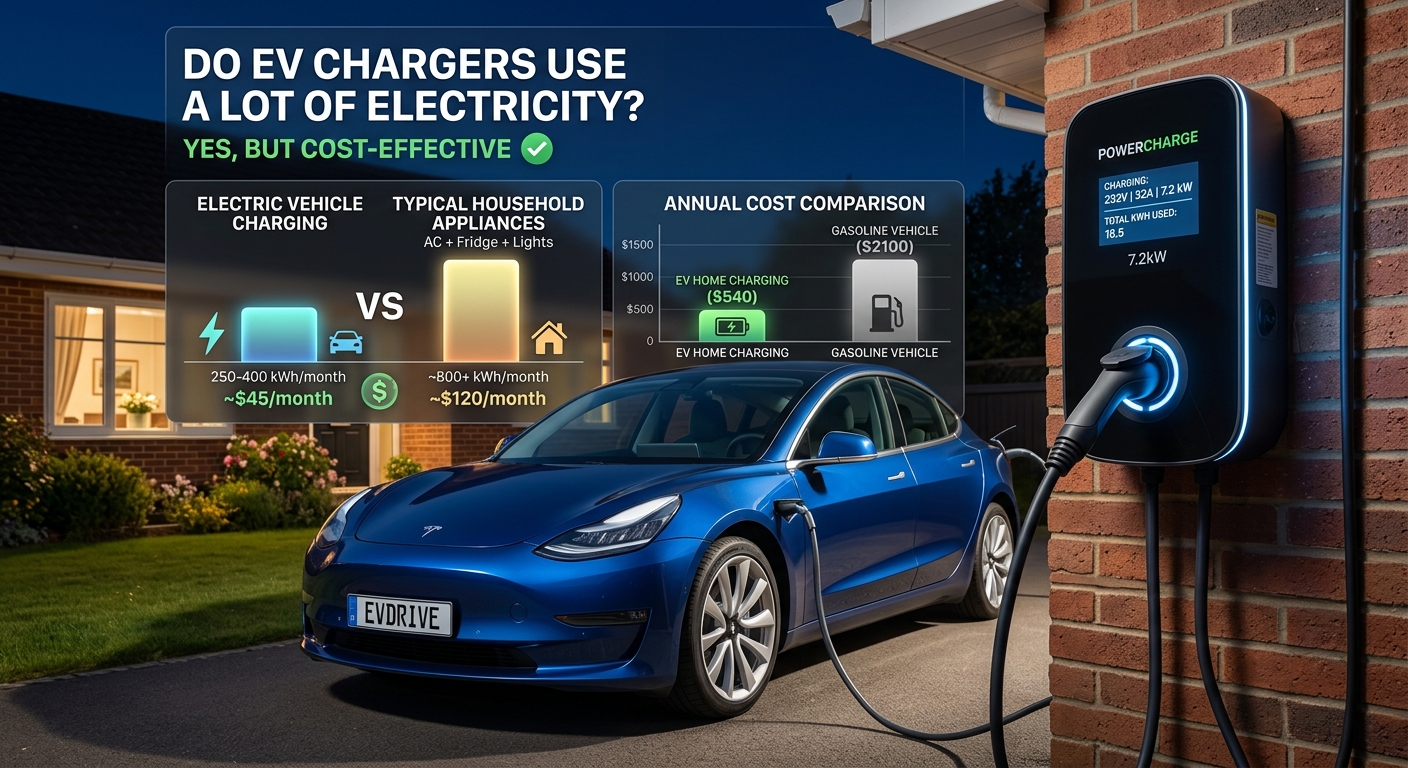
When transitioning to an electric vehicle (EV), one of the most common concerns for new and prospective owners is how home charging impacts continuous power draw and monthly utility bills. Electric vehicles carry large traction battery packs (typically ranging from 60 kWh to 100+ kWh), leading drivers to ask: Do EV chargers use a lot of electricity?
The short answer is: in terms of power draw (wattage), yes, an active EV charger draws a significant amount of electricity—similar to or greater than major continuous household appliances like an electric clothes dryer, water heater, or central air conditioner.
However, in terms of overall energy cost per mile, charging an EV is remarkably cheap compared to filling up a gasoline vehicle. While your active electrical load spikes when the car is plugged in, the total kilowatt-hours (kWh) consumed over a month translate to substantial net fuel savings.
For complete hardware guides, smart charging comparisons, and installation breakdowns, visit EV Charger Advisor.
Understanding EV Charger Power Draw: Level 1 vs. Level 2 vs. Level 3
To evaluate how much electricity an EV charger draws, it is essential to distinguish between instantaneous power draw measured in Kilowatts (kW) and total energy consumed measured in Kilowatt-Hours (kWh).
1. Level 1 Charger (Standard 120V Household Outlet)
-
Power Draw: $1.3 \text{ kW} – 1.9 \text{ kW}$ (12A to 16A continuous draw).
-
Household Equivalent: Similar to running a $1,500\text{W}$ space heater, microwave, or hair dryer continuously.
-
Energy Delivered: Adds roughly $3 \text{ to } 5 \text{ miles of range per hour}$.
2. Level 2 Charger (240V Dedicated Home Circuit)
-
Power Draw: $7.2 \text{ kW} – 11.5 \text{ kW}$ (30A to 48A continuous draw).
-
Household Equivalent: Equivalent to running an electric clothes dryer ($5,000\text{W}$) and an electric oven ($3,000\text{W}$) simultaneously.
-
Energy Delivered: Adds roughly $25 \text{ to } 37 \text{ miles of range per hour}$.
3. Level 3 / DC Fast Chargers (Public Commercial Stations)
-
Power Draw: $50 \text{ kW} – 350+ \text{ kW}$.
-
Household Equivalent: Draws as much instant power as an entire commercial building or 30 to 50 average homes combined. (Note: Level 3 chargers cannot be installed on standard residential electric panels).
To explore connector standards and regional wiring configurations, read our detailed guide on EV charging types.
Step-by-Step Mathematical Example: Monthly Electricity Consumption & Cost
To see how charger power draw translates into real-world monthly energy consumption and costs, let us calculate the electricity required for a driver covering 1,000 miles per month in an EV with an efficiency rating of 3.3 miles per kWh.
Given Parameters:
-
Monthly Driving Distance: $1,000 \text{ miles}$
-
Vehicle Efficiency: $3.3 \text{ miles per kWh}$
-
Average Home Electricity Rate: $0.16 \text{ per kWh}$
-
Discounted Off-Peak Electricity Rate: $0.08 \text{ per kWh}$
-
Equivalent Gasoline Car Fuel Economy: $30 \text{ MPG}$ at $\$3.50/\text{gallon}$
Calculation 1: Total Monthly Kilowatt-Hours (kWh) Required
Calculation 2: Monthly EV Electricity Cost (Standard Rate vs. Off-Peak)
Calculation 3: Cost Comparison Against Gasoline
Result Breakdown: Even though a Level 2 home charger draws $7.2\text{ kW} – 11.5\text{ kW}$ of power while active, the total monthly electricity increase ($303\text{ kWh}$) costs only $24.24 to $48.48, saving the driver over $90 per month compared to gas.
Why Level 2 Chargers Are More Efficient Than Level 1
While a Level 2 charger uses significantly higher instantaneous wattage than a Level 1 charger, it is actually 5% to 10% more energy-efficient.
When an electric vehicle charges, its internal onboard computers, cooling pumps, and thermal management systems must stay energized. This “overhead” power draw remains constant (typically consuming 200W to 500W) regardless of charging speed.
1. Level 1 Overhead Efficiency Loss
Because a Level 1 charger takes 30+ hours to complete a full charge, the vehicle’s onboard computers remain active for a prolonged duration, wasting energy as idle heat loss.
2. Level 2 Rapid Completion
A Level 2 charger finishes the charging session in 6 to 8 hours. By drastically shortening the duration the car’s computer systems must remain awake, less total energy is wasted, lowering overall kilowatt-hour consumption per charge.
To learn more about Wi-Fi-enabled wallboxes that manage dynamic charging schedules, read our guide on smart chargers.
Power Consumption Comparison Table: Appliance vs. EV Charger
| Device / Appliance | Typical Power Draw (Watts) | Continuous Operation | Est. Monthly Energy Use |
| Central Air Conditioner (3-Ton) | $3,500\text{ W} – 5,000\text{ W}$ | Intermittent ($8\text{ hrs/day}$) | $840\text{ kWh}$ |
| Electric Water Heater | $4,500\text{ W}$ | Intermittent ($3\text{ hrs/day}$) | $405\text{ kWh}$ |
| Level 2 Home EV Charger | $7,200\text{ W} – 11,500\text{ W}$ | $1.5\text{ hrs/day}$(Avg Daily Shift) \vert{} $300 – $400\text{ kWh}$ | |
| Electric Clothes Dryer | $5,000\text{ W}$ | Intermittent ($1\text{ hr/day}$) | $150\text{ kWh}$ |
| Refrigerator | $150\text{ W} – 400\text{ W}$ | Continuous ($24\text{ hrs/day}$) | $100\text{ kWh}$ |
Summary & Key Takeaways
-
High Instant Wattage: Level 2 home chargers draw 7.2 kW to 11.5 kW of power while actively charging, making them one of the heaviest electrical loads in a home.
-
Low Cost Per Mile: Despite high wattage, EV charging costs average $35 to $60 per month for daily driving, replacing $120 to $200+ in gas.
-
Higher Efficiency: Level 2 chargers are more energy-efficient than Level 1 chargers because they reduce the time vehicle electronics must stay awake during charging.
-
Schedule Off-Peak: Using smart charger scheduling during overnight off-peak utility hours reduces electricity costs by up to 50%.













Leave a Reply