
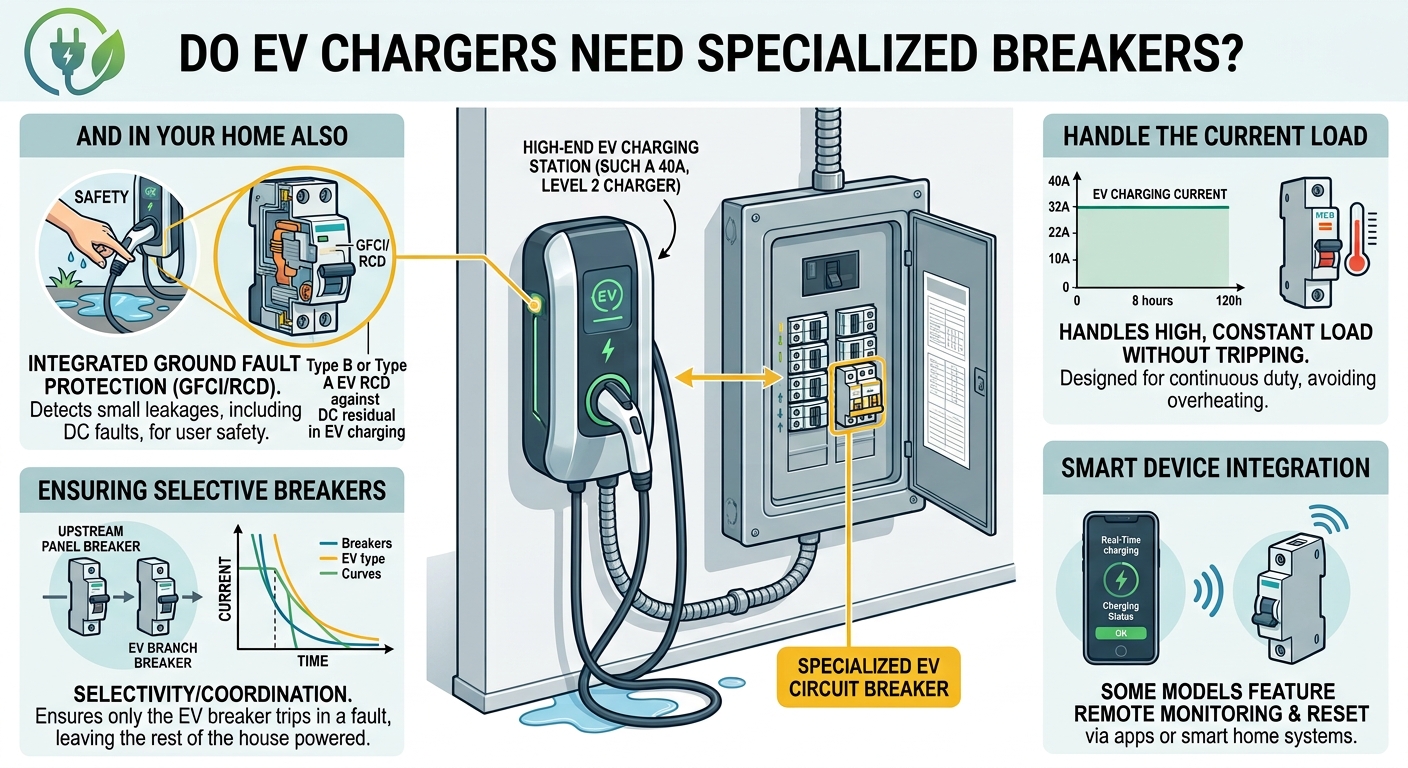
Setting up a Level 2 electric vehicle (EV) home charger is the best way to ensure your car is fully charged every morning. Because a Level 2 wallbox draws substantial electrical current continuously for hours at a time, installing one requires more than just picking any standard off-the-shelf circuit breaker from a hardware store. Electric vehicle owners and DIY installers frequently ask: Do EV chargers need special breakers?
The short answer is yes, EV chargers require specific types of circuit breakers designed to handle continuous electrical loads and meet modern safety protection codes.
Depending on whether your EV charging station is hardwired directly into your main panel or plugged into a 240-volt receptacle (such as a NEMA 14-50 outlet), National Electrical Code (NEC) standards dictate specific requirements for double-pole breaker sizing, GFCI protection type, continuous load derating, and panel compatibility.
For comprehensive load calculators, hardware reviews, and home installation guides, visit EV Charger Advisor.
Why EV Charging Requires Special Circuit Breakers
Standard household branch circuits—such as those powering living room lighting, televisions, or bedroom wall outlets—are designed for intermittent, non-continuous electrical loads. In contrast, electric vehicle charging demands continuous max-capacity power transfer over extended periods.
1. The NEC 125% Continuous Load Requirement (NEC Article 625)
Under NEC Article 625, EV charging is legally classified as a continuous load (drawing 100% rated capacity for 3 hours or longer). To prevent thermal fatigue, spring weakening, and nuisance tripping inside the breaker enclosure, the NEC mandates that the circuit breaker must be sized to 125% of the charger’s continuous draw (or conversely, the charger draw must be capped at 80% of the breaker faceplate rating).
2. Double-Pole 240V Configuration
Standard single-pole breakers feed $120\text{-volt}$ household receptacles using a single vertical space on a panel busbar. Level 2 EV chargers operate on single-phase $240\text{-volt}$ power, requiring a double-pole circuit breaker that connects across both $120\text{V}$ busbar legs simultaneously, occupying two adjacent vertical slots.
3. Physical Panel Type & Manufacturer Listing
Circuit breakers are not universally interchangeable. Your EV charger breaker must match the specific listing and busbar physical profile of your main panel brand (e.g., Square D QO, Square D Homeline, Eaton BR, Eaton CH, Siemens, or GE/ABB). Installing an unapproved or ill-fitting breaker creates loose busbar contact jaw tension, leading to severe electrical arcing and panel destruction.
To learn more about how charger power levels and wire sizes compare, check out our guide on EV charging types.
Plug-In Outlets vs. Hardwired Wallboxes: The GFCI Breaker Rule
The single most critical decision regarding “special breakers” comes down to whether your installation is plug-in or hardwired:
Scenario A: Plug-In EV Chargers (NEMA 14-50 or 6-50 Receptacles)
-
Special Breaker Required: Ground Fault Circuit Interrupter (GFCI) Double-Pole Breaker.
-
Code Mandate: Under NEC 625.54, all $150\text{V}$-to-ground or higher receptacles installed for EV charging in garages, outdoors, or basements MUST feature GFCI protection at the panel.
-
Cost Factor: A 50A GFCI double-pole breaker costs significantly more ($100–$180) than a standard non-GFCI breaker ($20–$35).
-
Nuisance Tripping Risk: Most smart EV chargers contain their own internal self-testing GFCI circuits. Plugging a smart charger into a circuit protected by an external GFCI breaker can cause “double-GFCI conflict,” leading to random charge interruptions overnight.
Scenario B: Hardwired Level 2 Wallboxes (Direct Conduit Cable Connection)
-
Standard Double-Pole Breaker Allowed: A regular, non-GFCI double-pole breaker ($20–$35).
-
Why Non-GFCI Breakers Work: Because the charging unit is permanently hardwired without an exposed wall plug, NEC code permits using a standard breaker. The wallbox’s built-in, internal GFCI circuit handles all shock protection automatically.
-
Maximum Speed Unlocked: Hardwiring permits using 60-Amp circuit breakers ($48\text{A} / 11.52\text{ kW}$ output), which exceed the 50A limit imposed on NEMA 14-50 wall sockets.
To explore Wi-Fi-enabled smart wallboxes that support dynamic app management, read our guide on smart chargers.
Step-by-Step Mathematical Example: Continuous Load Breaker Sizing
Let us calculate the required breaker size, power delivery, and continuous thermal safety limits for a homeowner installing a hardwired Level 2 charger pulling 40 Amps continuous current.
Given Parameters:
-
Continuous Vehicle Current Draw ($I$): $40 \text{ Amps}$
-
Operating Line Voltage ($V$): $240 \text{ Volts}$
Calculation 1: Calculating Required Breaker Rating (125% Continuous Rule)
Calculation 2: Calculating Gross Power Output Delivered
Calculation 3: Wire Gauge Selection (NEC Article 310 Thermal Rating)
Conductors supplying a 50A breaker must handle the thermal heat load without insulation breakdown:
-
THHN / THWN-2 Copper Wire in Conduit: Requires #6 AWG copper wire (rated up to $65\text{A}$ at $75^\circ\text{C}$ terminals).
-
NM-B Romex Cable: #6 AWG Romex (rated for $55\text{A}$ under the $60^\circ\text{C}$ column) can also be used for a 50A circuit.
Result Breakdown: Installing a 40A continuous charger requires a 50-Amp double-pole circuit breaker paired with #6 AWG copper wire, delivering $9.60\text{ kW}$ of continuous power ($28\text{–}34\text{ miles/hr}$).
Comparison Table: Breaker Types for EV Charger Installations
| Breaker Type | Average Cost | Installation Method | Required Code Application | Nuisance Trip Risk |
| Standard Double-Pole | $20 – $35 | Hardwired Wallbox | Permitted for direct hardwired units | Near Zero |
| GFCI Double-Pole | $100 – $180 | Plug-In Receptacle | Mandatory for all 240V EV outlets | Moderate (Dual-GFCI conflict) |
| 100% Continuous-Rated Breaker | $150 – $300 | High-Power Commercial | Specialty commercial EV stations | Low |
Summary & Key Takeaways
-
Special Code Sizing Required: EV chargers require double-pole $240\text{V}$ circuit breakers sized to 125% of continuous charger amperage.
-
Plug-In Outlets Need Expensive GFCI Breakers: Installing a NEMA 14-50 wall socket requires an expensive GFCI double-pole breaker ($100–$180) per NEC 625.54.
-
Hardwiring Eliminates GFCI Breaker Expenses: Hardwiring your Level 2 wallbox allows the use of a standard, inexpensive double-pole breaker ($20–$35) while avoiding double-GFCI trips.
-
Must Match Panel Brand: Always select a circuit breaker manufactured and listed specifically for your main panel enclosure brand to avoid hazardous loose electrical busbar connections.













Leave a Reply