
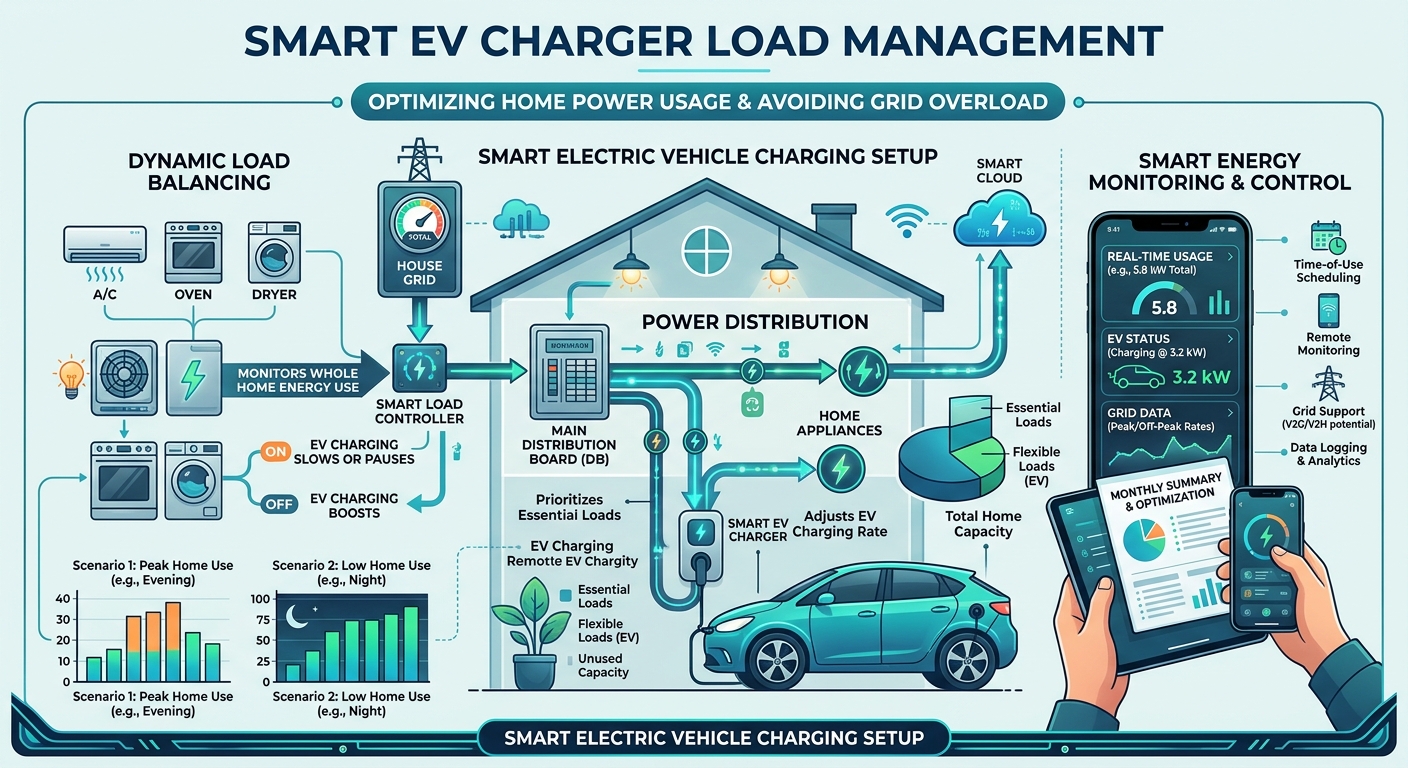
Transitioning to electric vehicle (EV) ownership brings immediate daily fuel savings, whisper-quiet performance, and zero local tailpipe emissions. Delivering 20 to 44 miles of driving range per hour over a high-voltage 240-volt single-phase branch circuit, home Level 2 wallboxes make daily battery replenishment effortless. However, when homeowners consult electricians about panel headroom limits or plan multi-EV garages, an essential technical question arises: Do EV chargers have built-in load management?
The short answer is: yes, some modern EV chargers feature built-in load management capabilities, while others rely on external hardware (such as Current Transformer CT sensor clamps) or cloud software to dynamically manage electrical demand.
Understanding the difference between internal software-based load management (power sharing between chargers) and external dynamic load management (monitoring total home energy consumption) ensures you select the right setup under National Electrical Code (NEC Article 625 / Article 750) guidelines.
For complete hardware reviews, installer guides, and panel load calculators, visit EV Charger Advisor.
1. Built-In vs. External Load Management: How They Differ
Not all load management systems operate the same way. Hardware manufacturers divide EV charging load management into three distinct categories:
A. Native Built-In Power Sharing (Charger-to-Charger)
-
How It Works: Built directly into the charger’s internal control board and firmware (e.g., Tesla Wall Connector Gen 3).
-
Operation: Multiple wallboxes communicate directly over a local Wi-Fi mesh network or RS-485 data line on a single shared circuit breaker. When one car plugs in, it receives maximum continuous power (48A / $11.52\text{ kW}$); when a second car plugs in, the internal control boards split the circuit capacity (24A / $5.76\text{ kW}$ each).
-
External Hardware Required: None.
B. External Dynamic Load Management (Home Panel Monitoring / EVEMS)
-
How It Works: Uses external hardware accessories (such as Current Transformer CT clamps or dedicated energy meters) installed inside your main service panel (e.g., Wallbox Power Boost, Emporia Vue 3, or Tesla Neurio meter).
-
Operation: The CT clamps measure total household appliance draw in real time and send signals to the wallbox. If home appliances (HVAC, water heater, dryer) draw heavy power, the EV charger throttles its output down instantly to prevent panel overloading.
-
External Hardware Required: Yes (CT clamps and data communication cables).
To learn more about how charger power levels and wire sizes compare, check out our guide on EV charging types.
2. Benefits of Built-In & Dynamic Load Management
Selecting an EV charger with integrated or expandable load management provides clear electrical and financial advantages:
-
Avoids Main Electrical Panel Upgrades ($1,500 – $5,000+): Dynamic load management allows property owners with older 100-Amp or 150-Amp panels to safely install a Level 2 wallbox without upgrading their main utility service.
-
Multi-EV Scalability: Multi-car households can add a second charger on an existing circuit without pulling new service lines or installing extra double-pole breakers.
-
Full NEC 625.42 Compliance: Automatic Load Management Systems (ALMS) satisfy NEC continuous load protection standards by keeping total demand strictly within safe breaker limits.
To explore Wi-Fi-enabled smart wallboxes engineered with integrated load management features, read our guide on smart chargers.
Step-by-Step Mathematical Example: Built-In Group Power Sharing Calculation
Let us analyze two smart hardwired Level 2 EV chargers equipped with built-in group load management sharing a single 60-Amp double-pole circuit breaker ($240\text{V}$ single-phase supply) operating at 90% AC/DC conversion efficiency to add 35 kWh of energy to each vehicle.
Given Parameters:
-
Dedicated Circuit Breaker Rating: $60 \text{ Amps}$
-
NEC 80% Safe Continuous Current Limit: $60\text{A} \times 0.80 = \mathbf{48 \text{ Amps Continuous Max}}$
-
Supply Voltage ($V$): $240 \text{ Volts}$
-
Target Energy Replenishment per EV ($E$): $35 \text{ kWh}$
-
System Conversion Efficiency ($\eta$): $90\% \quad (0.90)$
Calculation 1: Total Continuous Power Output on Shared Circuit ($P_{\text{total}}$)
Calculation 2: Power Split When BOTH EVs Are Plugged In Simultaneously
The internal firmware automatically divides the 48A limit into 24A per vehicle ($11.52\text{ kW} / 2$):
Calculation 3: Power Available When ONE EV Finishes & Second Charges Alone
Once Vehicle 1 completes charging, the internal load manager restores full 48A continuous output to Vehicle 2:
Result Breakdown: Built-in load management dynamically throttles power to 24A per car ($5.76\text{ kW}$) during simultaneous charging, and automatically restores 48A ($11.52\text{ kW}$) as soon as one vehicle finishes.
Comparison Table: Built-In vs. External Load Management Chargers
| Charger Model | Load Management Type | External Hardware Needed? | Primary Application |
| Tesla Wall Connector Gen 3 | Built-in Mesh Power Sharing | No (for multi-charger split) | Multi-EV group sharing on 1 circuit |
| Wallbox Pulsar Plus | Power Boost Dynamic EMS | Yes (CT Meter Module) | Panel load protection & solar matching |
| Emporia Pro EV Charger | PowerSmart Bundled EMS | Yes (Vue 3 CT Clamps included) | Budget-friendly panel overload protection |
| Basic Dumb Chargers | None | N/A (Cannot load manage) | Single EV on large, open 200A panel |
Summary & Key Takeaways
-
Yes, Select Wallboxes Have Built-In Systems: Many smart chargers include internal firmware for charger-to-charger power sharing over a single circuit.
-
Whole-Home Monitoring Requires CT Clamps: Dynamic panel load management (EVEMS) requires external CT clamps attached to your main electrical panel.
-
Saves Panel Upgrade Costs: Utilizing load management allows you to add Level 2 charging without upgrading 100A or 150A main panels.
-
NEC Article 625 Compliant: Automated power sharing and EVEMS hardware satisfy NEC continuous load rules.













Leave a Reply