
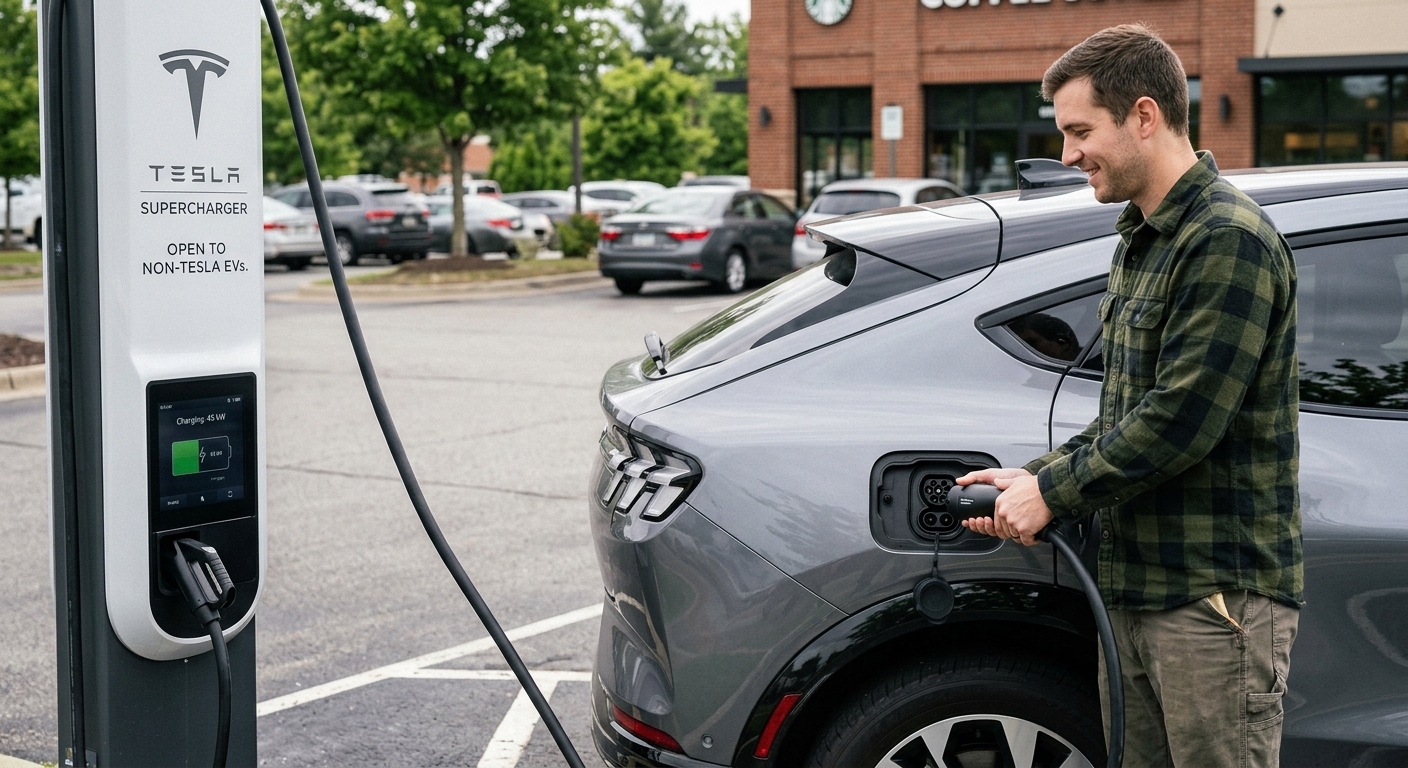
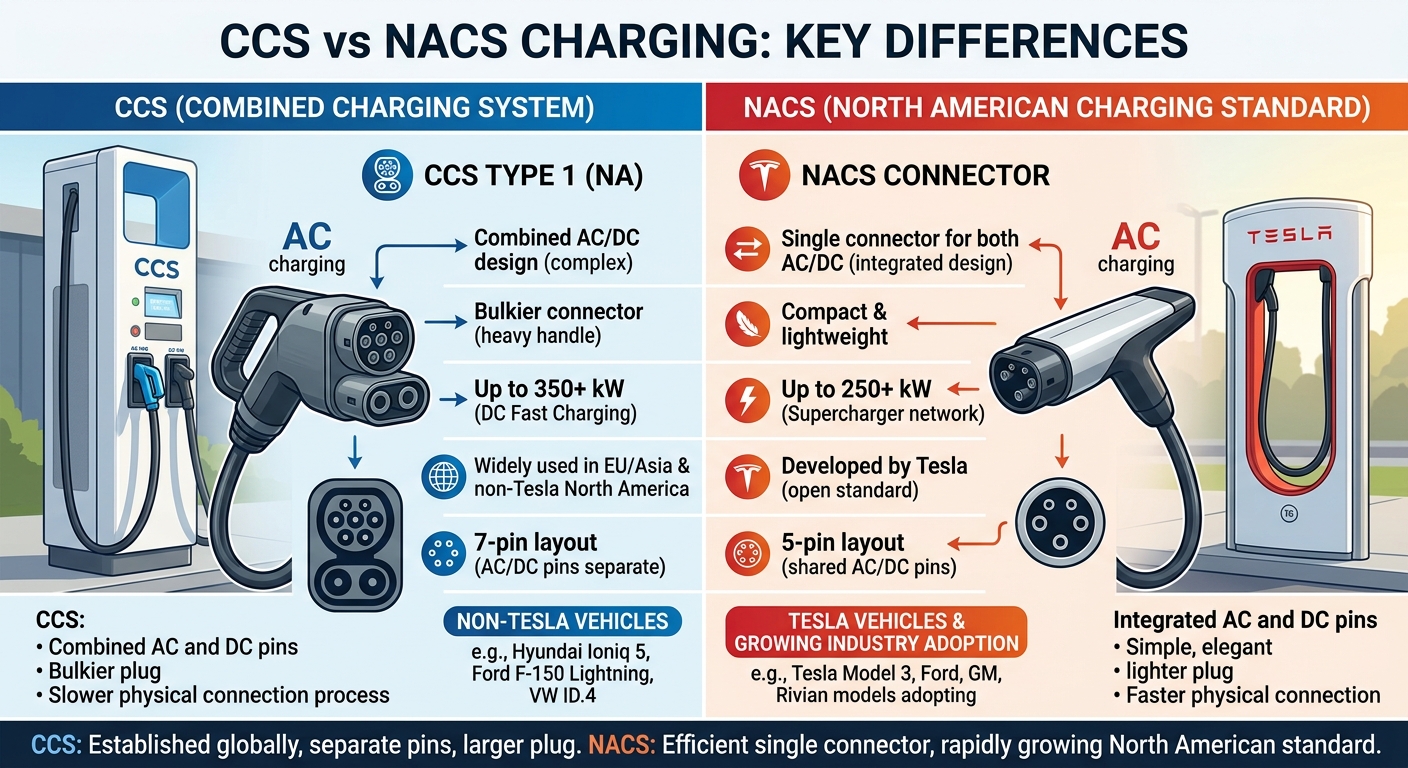
As the North American electric vehicle (EV) charging landscape unifies around the North American Charging Standard (NACS / SAE J3400), millions of drivers on the road still operate vehicles or charging stations built around the Combined Charging System (CCS1).
A central question for both current EV owners and prospective buyers is: Can you use NACS with CCS?
The short answer is yes. You can seamlessly use NACS connectors with CCS systems (and vice versa), provided you use the proper physical adapter and your vehicle supports the underlying digital communication protocols.
For complete guides on charging adapters, hardware specifications, and home setup reviews, visit EV Charger Advisor.
How NACS and CCS Cross-Compatibility Works
At a technical level, enabling cross-compatibility between NACS and CCS is relatively straightforward because both standards share the exact same underlying digital language: Powerline Communication (PLC) using the ISO 15118 (and legacy DIN 70121) protocol.
Because both hardware standards speak the same digital language, an adapter does not need to convert electronic data signals. Instead, it simply serves as a physical pin-routing bridge that connects the power and signal lines between the charger plug and the vehicle port.
To learn more about how connector formats compare globally, explore our comprehensive guide on EV charging types.
The Two Adapter Directions Explained
When using NACS with CCS, adapter direction is critical. The adapter must match both the specific cable plug at the charging station and the charging port on your car.
1. NACS-to-CCS Adapter (NACS Charger Cable → CCS Vehicle Port)
-
Purpose: Allows a vehicle equipped with a legacy CCS1 port (such as a Ford Mustang Mach-E, Rivian R1T, Hyundai IONIQ 5, or Chevrolet Bolt) to charge at NACS public fast-charging stations or Tesla Superchargers.
-
Function: Accepts the compact NACS plug at the back and converts it into a full CCS Combo 1 connector that plugs into the vehicle.
2. CCS-to-NACS Adapter (CCS Charger Cable → NACS Vehicle Port)
-
Purpose: Allows an EV equipped with a native NACS port (such as a Tesla Model 3/Y/S/X or newer 2025+ NACS-native vehicles) to charge at third-party CCS DC fast-charging networks like Electrify America, EVgo, or ChargePoint.
-
Function: Accepts the bulky CCS cable connector at the back and converts it into a sleek NACS plug that fits the vehicle port.
Step-by-Step Mathematical Example: Charging Performance via Adapter
A common misconception is that using a NACS-to-CCS adapter significantly reduces DC fast-charging performance. To demonstrate real-world impact, let us calculate the charging time for an EV with a 78 kWh battery pack (charging from 10% to 80% state of charge) at a high-power station using a heavy-duty rated adapter ($500\text{A}$ rating).
Given Parameters:
-
Total Energy Needed: $78 \text{ kWh} \times (0.80 – 0.10) = 54.6 \text{ kWh}$
-
Station Peak Rate: $250 \text{ kW}$
-
Average Effective Charge Rate (considering battery charge curve): $160 \text{ kW}$
-
Adapter Power Loss Efficiency: $99.5\%$ (negligible resistance loss across silver-plated copper pins)
Calculation: DC Fast-Charging Time Using an Adapter
Result Breakdown: High-quality certified adapters operate with over $99.5\%$ efficiency, allowing drivers to complete a $10\%-80\%$ charging session in under 21 minutes without performance bottlenecks.
Critical Hardware & Safety Requirements
Not all adapters are built equally. Delivering up to $1,000\text{V}$ and $500\text{A}$ of direct current requires rigorous safety engineering.
1. UL 2252 Safety Certification
When selecting an adapter for public DC fast charging, ensure the unit is tested and certified under UL 2252 (the standard for EV charging cable adapters). Certified adapters feature internal temperature sensors that automatically throttle or stop charging if thermal limits are exceeded.
2. Electronic & Mechanical Interlocking
Safe adapters feature mechanical latching pins that lock the station cable into the adapter before high-voltage power begins flowing, preventing dangerous disconnections while under heavy electrical load.
3. Vehicle ECU & Firmware Compatibility
For a CCS-to-NACS adapter to work on older vehicles, the car’s internal computer must have CCS communication enabled in its system software.
To explore smart charging options and home energy management, check out our guide on smart chargers.
Comparison Table: NACS vs. CCS Adapter Matrix
| Feature | NACS-to-CCS Adapter | CCS-to-NACS Adapter |
| Charger Cable Plug | NACS (Tesla Supercharger V3/V4) | CCS1 Public Cable |
| Vehicle Port | CCS1 Port | NACS Port |
| Charging Type | High-Power DC Fast Charging | High-Power DC Fast Charging |
| Max Voltage Rating | Up to $1,000 \text{ V DC}$ | Up to $1,000 \text{ V DC}$ |
| Max Amperage Rating | Up to $500 \text{ Amps}$ | Up to $500 \text{ Amps}$ |
| Safety Certification | UL 2252 / CSA C22.2 | UL 2252 / CSA C22.2 |
Summary & Key Takeaways
-
Full Interoperability: NACS and CCS are fully compatible using passive adapter hardware because both standards share ISO 15118 communication protocols.
-
Direction Matters: Match the adapter to your specific vehicle port and the charger station plug (NACS-to-CCS or CCS-to-NACS).
-
No Power Loss: Quality silver-plated copper adapters maintain ultra-fast charging speeds with zero noticeable power loss.
-
Safety First: Always use UL 2252 certified adapters with dual thermal management sensors for DC fast charging.





Leave a Reply