
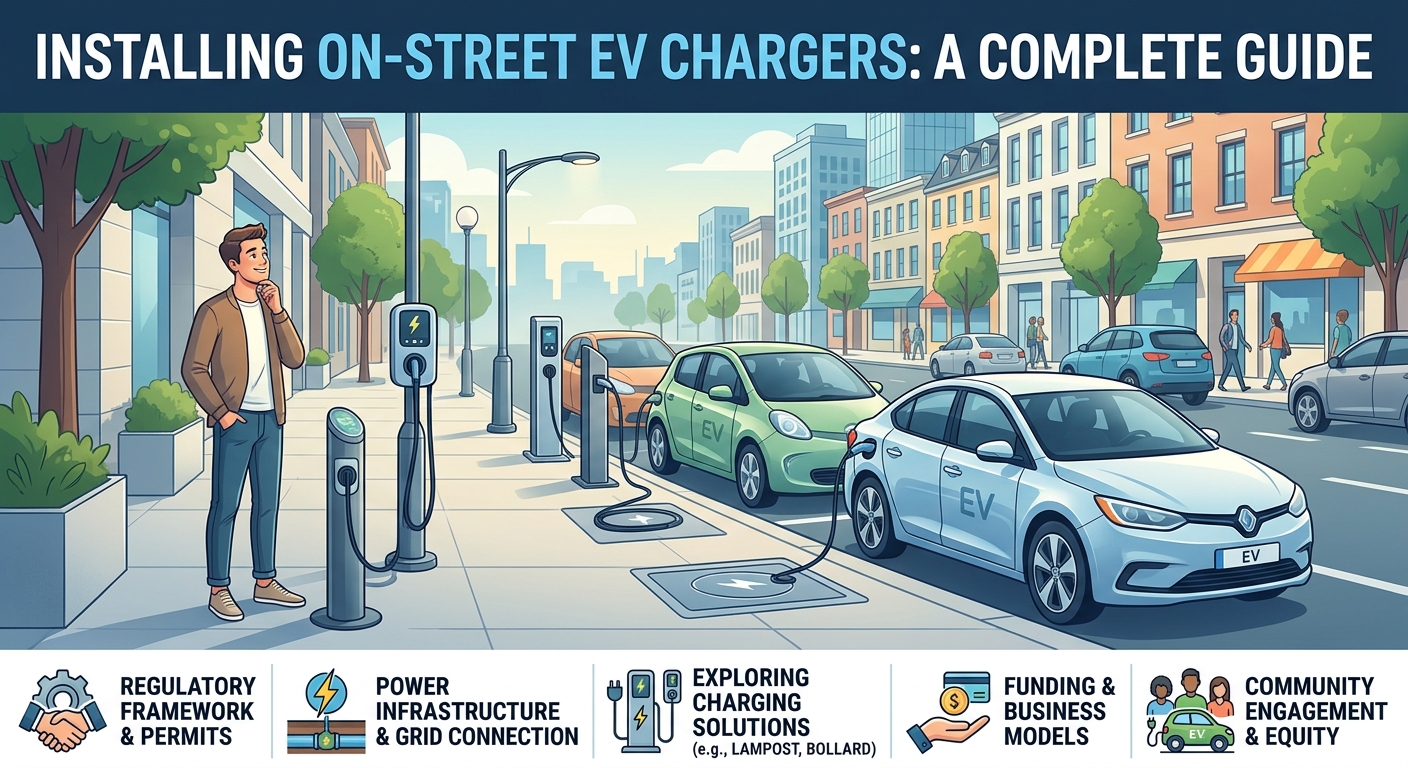
Transitioning to an electric vehicle (EV) offers massive daily fuel savings, quiet operation, and zero local tailpipe emissions. Delivering 20 to 44 miles of driving range per hour over a high-voltage 240-volt single-phase branch circuit, setting up a home Level 2 wallbox is the primary choice for homeowners with off-street garages or driveways. However, for residents living in terraced townhouses, urban row homes, or city apartments without private off-street parking, a fundamental question arises: Can you install an EV charger for on-street parking?
The short answer is: yes, you can install an EV charging solution for on-street parking, utilizing options ranging from council-approved flush pavement cable channels and overhead charging arms to municipal lamp post chargers and bollard installations.
Because trailing loose charging cables across public sidewalks presents severe trip hazards, public liability risks, and violations of municipal highway codes, urban EV drivers must rely on specific approved engineering solutions to charge safely at the curb.
For complete hardware reviews, installer guides, and panel load calculators, visit EV Charger Advisor.
1. Four Primary On-Street Charging Solutions
Navigating on-street parking charging depends on local municipal regulations and whether you can link to your private electricity meter:
A. Flush Pavement Cable Gullies / Channels
-
How It Works: A narrow, heavy-duty rubber or aluminum channel is recessed directly into the public pavement outside your front door. The charging cable sits flush inside the slot, allowing pedestrians, wheelchairs, and strollers to pass safely overhead while your car charges at the curb.
-
Power Source: Connected directly to your home’s main panel, giving you access to low residential off-peak tariffs.
-
Approval Required: Requires local municipal council or highways authority permit approval.
B. Overhead Charging Arms / Gantries
-
How It Works: A retractable overhead gantry arm mounts to your front property wall or fence post. When deployed, it suspends the charging cable 8 to 10 feet ($2.4\text{ m} – 3.0\text{ m}$) above the sidewalk, dropping down directly at your car’s charging port without touching the footpath.
-
Advantage: Completely eliminates sidewalk contact and trip liability.
C. Municipal Lamp Post Charging (Streetlight Retrofits)
-
How It Works: Local councils retrofit existing municipal streetlights with integrated Level 2 AC outlets ($3.7\text{ kW} – 7\text{ kW}$).
-
Usage: Residents plug in using a standard Mode 3 cable and pay via a mobile app or RFID card linked to municipal billing software.
D. Shared Curb / Gull-Wing Bollard Stations
-
How It Works: Pop-up or flush-ground charging bollards installed at dedicated residential permit parking bays, offering clean, unobtrusive streetscapes when not in use.
To learn more about how charger power levels and wire sizes compare, check out our guide on EV charging types.
2. Legal & Safety Regulations for On-Street Cable Crossing
Running an unshielded charging cable directly across a public sidewalk poses serious legal risks:
-
Pedestrian Hazards & Public Liability: In most jurisdictions, trailing loose cables across a public right-of-way constitutes a public nuisance and obstruction. If a pedestrian trips, the vehicle owner faces complete personal injury liability.
-
Municipal Code Compliance: Local councils strictly prohibit running extension cords across footpaths. Always secure a pavement gully permit or use overhead arms to ensure compliance with municipal accessibility laws (such as ADA or local highway regulations).
-
No Reserved Space Guarantee: Unless your local council designates a dedicated “EV-Only Charging Bay” outside your home, installing an on-street channel does not legally reserve the public street space in front of your house for your vehicle.
To explore Wi-Fi-enabled smart wallboxes engineered for curb solutions, read our guide on smart chargers.
Step-by-Step Mathematical Example: Pavement Channel Cable Length & Voltage Drop
When running a dedicated 32-Amp Level 2 charging circuit ($240\text{V}$ single-phase supply) from a front hallway panel, through an exterior wall, and across a 12-foot sidewalk to the curb (total one-way cable run = 75 feet / $22.86\text{ m}$), selecting #8 AWG Copper Wire ($R = 0.000778 \Omega/\text{ft}$) ensures low voltage drop ($\Delta V$).
Given Parameters:
-
Continuous Current Draw ($I$): $32 \text{ Amps}$
-
Nominal Line Voltage ($V$): $240 \text{ Volts}$
-
One-Way Cable Distance ($L$): $75 \text{ feet}$
-
Conductor Resistance ($R_{\text{wire}}$): $0.000778 \Omega \text{ per foot}$
Calculation 1: Voltage Drop ($\Delta V$) Math
For a single-phase $240\text{V}$ circuit ($2 \times L = 150\text{ ft}$ total conductor path):
Calculation 2: Percentage Voltage Drop (%)
Result Breakdown: A 1.55% voltage drop stays well below the 3% maximum NEC threshold limit, proving that a 75-foot curb-run circuit using #8 AWG copper conductors operates safely and efficiently.
Comparison Table: On-Street EV Charging Solutions
| Solution Option | Power Source | Council Approval Required? | Primary Benefit |
| Pavement Cable Channel | Home electricity meter | Yes (Highways permit) | Lowest charging cost (Home tariff) |
| Overhead Retractable Arm | Home electricity meter | Yes (Wall mount clearance) | Zero sidewalk trip hazard |
| Lamp Post Charger | Municipal grid | No (Council managed) | Zero upfront setup cost for driver |
| Loose Sidewalk Cable | Home electricity meter | PROHIBITED | High trip hazard & injury liability |
Summary & Key Takeaways
-
Yes, Solutions Exist: You can charge an EV for on-street parking using flush pavement channels, overhead retractable arms, or municipal streetlight chargers.
-
Never Trail Loose Cables: Running loose cables across public footpaths creates severe trip hazards and public liability risks.
-
Pavement Channels Use Home Rates: Flush pavement channels connect directly to your home panel, allowing you to charge at cheap residential off-peak rates.
-
Obtain Municipal Permits: Always consult your local council or highways department before installing cross-pavement infrastructure.













Leave a Reply