
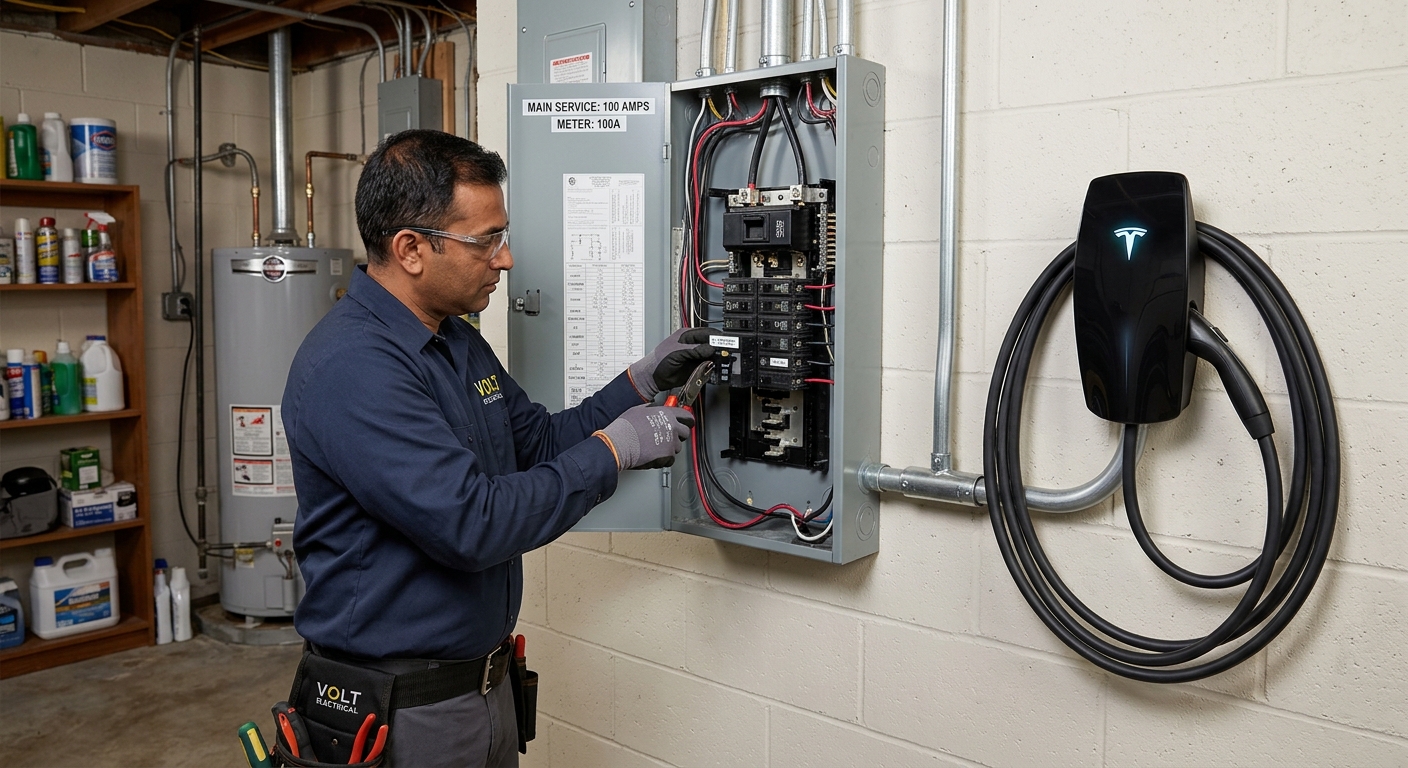
The Tesla Wall Connector (Gen 3 / Universal) is one of the most popular home charging stations on the market, capable of delivering up to 48 Amps ($11.5\text{ kW}$) of power on a 60-amp circuit. For Tesla and non-Tesla EV owners alike, installing this wallbox provides rapid overnight charging. However, many established homes and townhomes operate on a 100-amp electrical service.
Because a full 48A charging draw uses nearly half of a 100-amp panel’s entire capacity, homeowners frequently wonder: Can you install a Tesla Wall Connector on a 100-amp electrical service?
The short answer is yes, you can install a Tesla Wall Connector on a 100-amp electrical service, provided an electrician performs a proper load calculation and configures the charger to a lower amperage setting (such as 30A, 40A, or 50A) or uses load management.
Tesla engineered the Wall Connector specifically to accommodate homes with limited service panel headroom through Static Power Management (software de-rating) and Dynamic Power Management (Tesla energy meter integration).
For comprehensive hardware reviews, panel load calculators, and installer guides, visit EV Charger Advisor.
1. Static Power Management: De-Rating the Wall Connector
At its maximum setting, a Tesla Wall Connector requires a 60-amp double-pole breaker, delivering 48 Amps continuous draw ($11.52\text{ kW}$). In a 100A panel with air conditioning, an electric oven, or an electric water heater, adding a 60A breaker will violate National Electrical Code (NEC Article 220) load rules.
To solve this, Tesla’s commissioning software allows installers to program lower maximum output limits during setup:
| Circuit Breaker Size | Continuous Max Output (80% Rule) | Usable Power Output @ 240V | Added Range Per Hour (Model 3/Y) |
| 60 Amps (Max Setting) | $48 \text{ Amps}$ | $11.52 \text{ kW}$ | $36 – 44 \text{ miles/hr}$ |
| 50 Amps | $40 \text{ Amps}$ | $9.60 \text{ kW}$ | $28 – 34 \text{ miles/hr}$ |
| 40 Amps | $32 \text{ Amps}$ | $7.68 \text{ kW}$ | $22 – 28 \text{ miles/hr}$ |
| 30 Amps (Ideal for 100A Panels) | 24 Amps | $5.76 \text{ kW}$ | $16 – 22 \text{ miles/hr}$ |
| 20 Amps | 16 Amps | $3.84 \text{ kW}$ | $11 – 15 \text{ miles/hr}$ |
Setting the Tesla Wall Connector to a 30A breaker (24A continuous draw) or 40A breaker (32A continuous draw) allows the wallbox to fit comfortably into most 100A panels while still providing 160 to 220 miles of range during an 10-hour overnight charge.
To learn more about how charger power levels and wire sizes compare, check out our guide on EV charging types.
2. Dynamic Power Management: Full-Speed Charging Without Panel Upgrades
If you want the maximum 48-amp ($11.5\text{ kW}$) charging speed but cannot upgrade your 100A electrical service, Tesla offers Dynamic Power Management using a Tesla-approved power meter and current transformer (CT) clamps installed inside your main panel.
How Tesla Dynamic Load Balancing Works:
-
Real-Time Panel Monitoring: The approved energy meter measures the live amperage draw of your entire house.
-
Automated Amperage Throttling: When major household appliances turn on (e.g., central AC and oven drawing $60\text{A}$ combined), the Wall Connector automatically throttles its charging speed to prevent the 100A main breaker from tripping.
-
Full Speed at Night: Late at night, when home energy consumption drops to baseline levels ($5\text{A} – 10\text{A}$), the Wall Connector dynamically ramp up to its full 48 Amps ($11.5\text{ kW}$).
This eliminates the need for a $3,000 to $5,000 utility service upgrade while delivering maximum charging speeds during off-peak hours.
Step-by-Step Mathematical Example: Load Calculation on a 100A Panel
Let us perform an NEC Article 220 electrical load calculation for a 100A panel with a 13,200 Watt baseline load to determine the correct breaker configuration for a Tesla Wall Connector.
Given Parameters:
-
Main Panel Rating: $100 \text{ Amps @ 240V} = 24,000 \text{ Watts}$
-
Max Continuous Safety Threshold (80% Rule): $80 \text{ Amps} = 19,200 \text{ Watts}$
-
Calculated Household Baseline Load: $13,200 \text{ Watts} = 55 \text{ Amps}$
Calculation 1: Available Continuous Power Margin
Calculation 2: Maximum Safe Continuous Amperage Draw
Calculation 3: Determining Circuit Breaker & Wall Connector Configuration
Applying the NEC 125% continuous load rule:
Result Breakdown: The electrician configures the Tesla Wall Connector via software commissioning to a 30-Amp breaker setting (24A continuous draw). This delivers $5.76\text{ kW}$ of power ($18\text{-}22\text{ miles/hr}$) safely within the 100A service limit.
To explore Wi-Fi-enabled wallboxes with smart app management, read our guide on smart chargers.
Comparison Table: Tesla Wall Connector 100A Setup Options
| Installation Approach | Circuit Breaker | Continuous Output | Added Range per Hour | Hardware & Labor Setup |
| Static Software Derate (24A) | 30-Amp Breaker | $24 \text{ Amps} / 5.8 \text{ kW}$ | $16 – 22 \text{ miles/hr}$ | Lowest cost (Software adjustment only) |
| Static Software Derate (32A) | 40-Amp Breaker | $32 \text{ Amps} / 7.7 \text{ kW}$ | $22 – 28 \text{ miles/hr}$ | Low cost (If panel load permits) |
| Dynamic Power Management | 60-Amp Breaker | Dynamic ($0\text{A} – 48\text{A}$) | Up to $44 \text{ miles/hr}$ | Wall Connector + Energy Meter |
| Full 200A Service Upgrade | 60-Amp Breaker | 48 Amps / 11.5 kW | 36 – 44 miles/hr | Service upgrade ($3,000 – $6,000) |
Summary & Key Takeaways
-
Fully Compatible: You can safely install a Tesla Wall Connector on a 100-amp electrical service.
-
Use Static Power Management: Electricians can software-commission the Wall Connector down to a 30A or 40A breaker setting, providing excellent overnight range recovery.
-
Dynamic Power Management Unlocks Max Speed: Installing an approved Tesla energy meter allows 48A charging late at night without overloading your 100A panel.
-
Load Calculations Are Essential: Always have a licensed electrician perform an NEC Article 220 load calculation before selecting breaker sizes.













Leave a Reply