
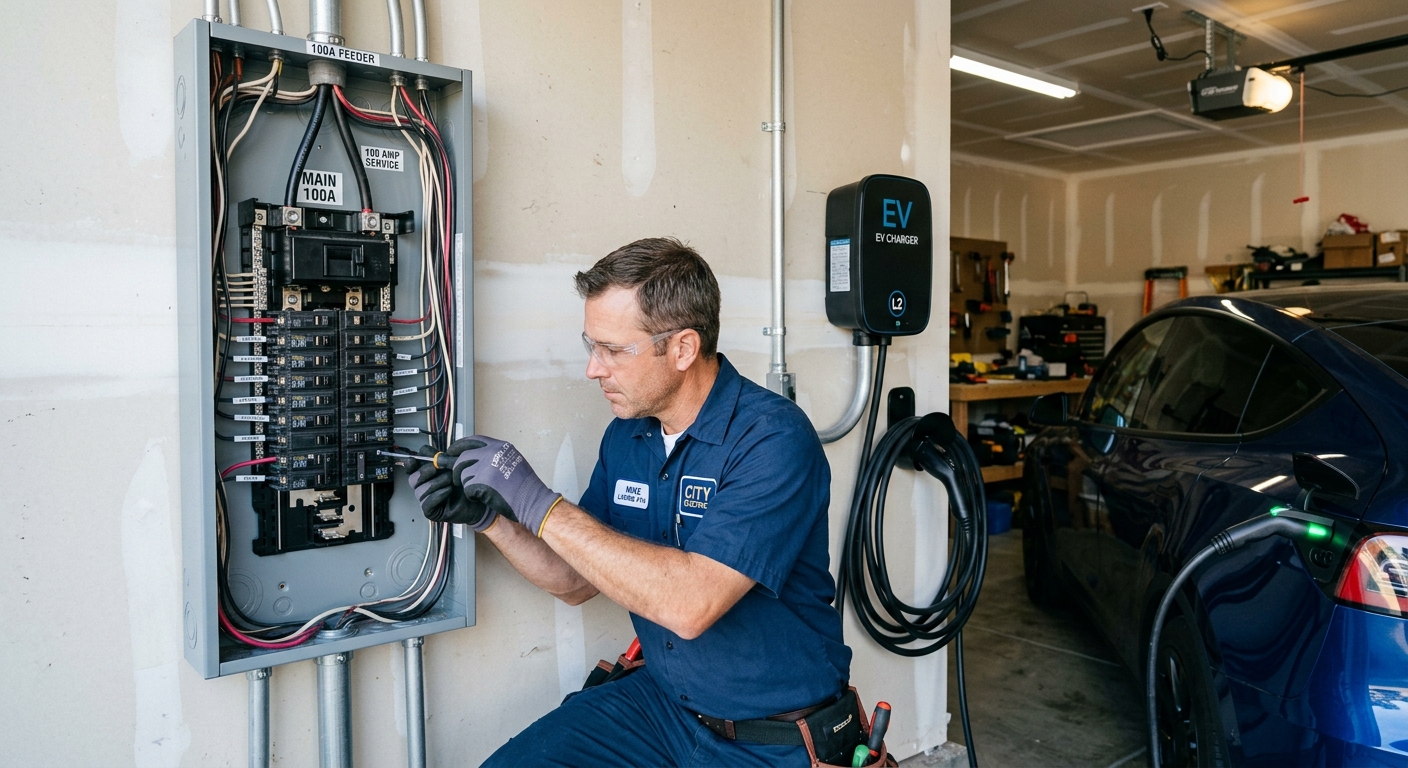
Upgrading your home infrastructure to support a Level 2 electric vehicle (EV) charger is the single best way to ensure rapid, hassle-free overnight charging. Operating on a $240\text{-volt}$ single-phase branch circuit, a Level 2 wallbox adds 20 to 44 miles of driving range per hour compared to a standard Level 1 trickle charger. However, millions of established homes, urban townhouses, and older properties operate on a 100-amp main electrical service panel.
Because adding a continuous $240\text{V}$ electrical load demands significant panel capacity, homeowners frequently ask: Can you install a Level 2 EV charger on a 100-amp service?
The short answer is: yes, you can install a Level 2 EV charger on a 100-amp electrical service without necessarily upgrading to a 200-amp panel, provided you use the right safety measures, perform a proper load calculation, and utilize smart energy management or charger de-rating.
Understanding how your household electrical demand interacts with National Electrical Code (NEC) load calculation rules allows you to safely charge your EV at home while avoiding a costly $3,000 to $6,000 utility panel upgrade.
For comprehensive load calculators, hardware reviews, and installation guides, visit EV Charger Advisor.
1. Navigating NEC Article 220: Panel Load Calculations
Before adding a dedicated circuit breaker for a Level 2 charger, a licensed electrician must conduct a formal electrical load calculation under National Electrical Code (NEC Article 220) rules.
A standard 100-amp electrical panel supplies a total maximum power envelope of 24,000 Watts ($24\text{ kW}$) at 240 Volts ($100\text{A} \times 240\text{V} = 24,000\text{W}$). Under standard electrical safety codes, continuous loads must not exceed 80% of total panel capacity, leaving a maximum continuous operating safety limit of 19,200 Watts ($80\text{ Amps}$).
How Home Appliance Profiles Impact Your 100A Panel:
-
Homes with Gas Appliances: Properties utilizing natural gas for space heating, water heating, and cooking typically have baseline electrical demands between 5,000W and 8,000W ($21\text{A} – 33\text{A}$). These panels easily support a 40A breaker ($32\text{A} / 7.68\text{ kW}$ continuous charging) without additional equipment.
-
All-Electric Homes: Properties relying on central electric heat pumps, electric water heaters, electric clothes dryers, and electric ranges often have baseline demand exceeding 15,000W ($62.5\text{A}$). Adding an unmanaged 48A or 40A charger will breach the 80A continuous threshold, triggering main breaker trips.
To learn more about how charger power levels and wire sizes compare, check out our guide on EV charging types.
Step-by-Step Mathematical Example: Load Sizing on a 100A Panel
Let us perform an NEC load calculation to determine the exact available margin and correct breaker configuration for a 100A panel operating with a $12,000\text{-Watt}$ ($50\text{-Amp}$) baseline household demand.
Given Parameters:
-
Main Service Rating: $100 \text{ Amps @ 240V} = 24,000 \text{ Watts}$
-
Max Continuous Safety Limit (80% Rule): $80 \text{ Amps} = 19,200 \text{ Watts}$
-
Baseline House Demand: $12,000 \text{ Watts} = 50 \text{ Amps}$
Calculation 1: Calculating Available Continuous Margin
Calculation 2: Calculating Maximum Safe Continuous Amperage
Calculation 3: Determining Required Circuit Breaker Size (125% Continuous Rule)
Under NEC Article 625, EV charging branch circuits must be sized for 125% of the continuous draw:
Result Breakdown: Configured to a 24-Amp continuous draw on a 30-Amp double-pole breaker, the charger safely delivers $5.76\text{ kW}$ of power—adding 18 to 22 miles of range per hour ($180 – 220\text{ miles}$ during a 10-hour overnight charge) safely within the 100A service limit.
3 Proven Safety Measures to Install Level 2 Charging on a 100A Service
If your panel load calculation reveals tight capacity margins, you can implement three code-compliant solutions to avoid spending thousands on a panel upgrade:
1. Software Amperage De-Rating / Adjustable Settings
Modern smart Level 2 wallboxes allow installers to program lower maximum output limits via internal DIP switches or commissioning software. Setting your wallbox to 16 Amps ($3.84\text{ kW}$ on a 20A breaker) or 24 Amps ($5.76\text{ kW}$ on a 30A breaker) fits comfortably into restricted panels while still delivering complete overnight battery replenishment.
2. Install an Electric Vehicle Energy Management System (EVEMS)
An EVEMS or smart load balancer uses current transformer (CT) clamps installed on your main panel feeders to monitor live household consumption in real time. If total household power draw surges when major appliances operate, the EVEMS automatically throttles or pauses EV charging, resuming full speed late at night when household energy consumption drops to baseline levels.
3. Smart Splitter Switches (Dryer / Oven Sharing)
If your garage or laundry room has an existing 240V socket (like a NEMA 10-30 or 14-30 dryer outlet), an automatic smart switch allows your dryer and EV charger to share the existing circuit safely. The smart switch automatically cuts power to the EV charger whenever the dryer is running, restoring charging power once the cycle finishes.
To explore Wi-Fi-enabled smart chargers that support dynamic energy management, read our guide on smart chargers.
Comparison Table: Level 2 Options on a 100-Amp Electrical Service
| Solution Pathway | Circuit Breaker | Continuous Output | Added Range per Hour | Service Upgrade Required? |
| Low-Amperage Set (16A) | 20-Amp Breaker | $16 \text{ Amps} / 3.84 \text{ kW}$ | $12 – 15 \text{ miles/hr}$ | No |
| Standard De-Rated Set (24A) | 30-Amp Breaker | 24 Amps / 5.76 kW | 18 – 22 miles/hr | No |
| Smart EVEMS Load Shedder | 40A / 50A Breaker | Dynamic ($0\text{A} – 40\text{A}$) | Up to $34 \text{ miles/hr}$ | No |
| Service Upgrade to 200A | 60-Amp Breaker | 48 Amps / 11.52 kW | 36 – 44 miles/hr | Yes ($3,000 – $6,000) |
Summary & Key Takeaways
-
Fully Permissible by Code: You can install a Level 2 EV charger on a 100-amp electrical service without upgrading your panel if an NEC Article 220 load calculation shows sufficient headroom.
-
24A Draw Is the Sweet Spot: Setting a wallbox to 24 Amps continuous on a 30A breaker provides excellent overnight range recovery ($18 – 22\text{ miles/hr}$) while protecting 100A panel capacity.
-
Smart EVEMS Eliminates Panel Upgrades: Dynamic load management systems automatically pause charging during peak household energy demand, unlocking fast charging without costly utility service work.
-
Gas vs. Electric Profile Matters: Homes using natural gas for heating and cooking have significantly more available panel capacity for Level 2 EV charging than fully electric homes.













Leave a Reply