
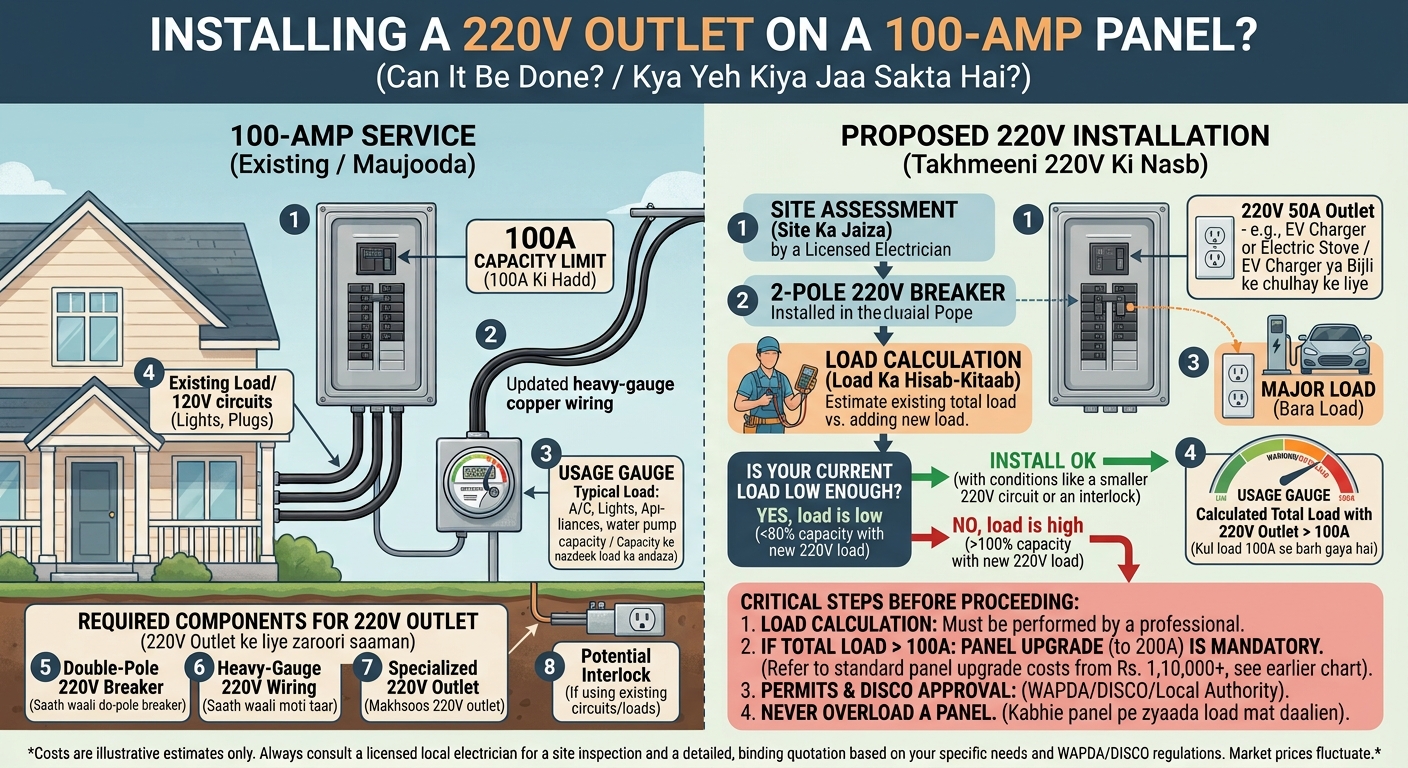
Upgrading your home to support a Level 2 electric vehicle (EV) charger requires access to a high-voltage 220V (or 240V in North America) dedicated electrical outlet. A 220V outlet allows a Level 2 wallbox to deliver 25 to 37 miles of range per hour, replenishing your battery fully overnight. However, for homes operating on an existing 100-amp electrical panel, homeowners frequently ask: Can you install a 220V outlet on a 100-amp electrical panel?
The short answer is yes, you can install a 220V (or 240V) outlet on a 100-amp electrical panel, provided your panel has physical space for a double-pole breaker and your home’s total electrical load does not exceed safety limits under National Electrical Code (NEC) guidelines.
Understanding breaker slot availability, panel load margins, and continuous load sizing allows you to add high-voltage Level 2 charging without causing nuisance breaker trips or incurring immediate panel replacement fees.
For comprehensive load calculators, hardware reviews, and installation guides, visit EV Charger Advisor.
1. Physical Panel Requirements: The Double-Pole Breaker
Unlike standard 110V or 120V household wall sockets that use a single slot on a breaker panel, a 220V/240V outlet requires a double-pole circuit breaker.
How a Double-Pole Breaker Works
A double-pole breaker bridges across both hot busbars inside your main electrical panel, combining two $120\text{V}$ legs to deliver $240\text{V}$ single-phase power:
-
Space Needed: Requires 2 adjacent vertical slots in your breaker box.
-
Amperage Ratings for EV Outlets: Typically range from 20 Amps to 50 Amps depending on whether you install a NEMA 6-20, NEMA 10-30, or NEMA 14-50 receptacle.
-
Space-Saving Solutions: If your 100A panel is physically full, an electrician can often consolidate older single-pole lighting circuits using tandem (twin) breakers to free up the 2 adjacent slots required for a 220V double-pole breaker.
To learn more about how charger power ratings and plug styles compare, check out our guide on EV charging types.
2. Electrical Load Capacity (NEC Article 220)
While finding physical slot space in a 100A panel is simple, verifying that your panel has sufficient amperage capacity is critical. A 100-amp main panel supplies a total maximum capacity of 24,000 Watts ($24\text{ kW}$) at 240 Volts ($100\text{A} \times 240\text{V} = 24,000\text{W}$).
Under NEC Article 220, continuous electrical loads must stay within 80% of total panel capacity, leaving a safe continuous working limit of 19,200 Watts ($80\text{ Amps}$).
Calculating Your Home’s Baseline Load Margin
An electrician calculates your total existing appliance demand:
-
Gas-Heated Home (Gas Water Heater, Furnace, Oven): Baseline demand usually sits around 5,000W to 8,000W ($21\text{A} – 33\text{A}$). A 100A panel in a gas-heated home easily supports a 40A double-pole breaker ($32\text{A} / 7.68\text{ kW}$ continuous EV draw).
-
Fully Electric Home (Electric Heat, Electric Dryer, Range): Baseline demand often exceeds 16,000W ($66\text{A}$). Adding an unmanaged 40A or 50A breaker to an all-electric 100A panel will exceed the 80A continuous threshold, risking main breaker tripping.
Step-by-Step Mathematical Example: Sizing a 220V Outlet on a 100A Panel
To see how much power a 220V outlet can draw on a 100A panel, let us calculate the available continuous capacity for a home with a 12,000 Watt baseline load.
Given Parameters:
-
Main Panel Rating: $100 \text{ Amps @ 240V} = 24,000 \text{ Watts}$
-
Safe Maximum Limit (80% Rule): $80 \text{ Amps} = 19,200 \text{ Watts}$
-
Calculated Baseline Demand: $12,000 \text{ Watts} = 50 \text{ Amps}$
Calculation 1: Available Panel Amperage Margin
Calculation 2: Selecting Continuous EV Charger Draw (80% Breaker Rule)
Under NEC Article 625, EV charging continuous load must not exceed 80% of the branch circuit breaker size:
Calculation 3: Usable Charging Power Output
Result Breakdown: Installing a 220V outlet on a 30-Amp double-pole breaker allows an EV charger to draw 24 Amps continuously ($5.76\text{ kW}$), providing 19 miles of range per hour safely within the 100A panel limit.
3 Ways to Install a 220V Outlet on a Tight 100A Panel
If your electrical panel load calculation shows limited spare capacity, consider these practical options:
1. Install a Low-Amperage 220V Outlet (NEMA 6-20 or NEMA 10-30)
Instead of installing a large 50A outlet, install a NEMA 6-20 receptacle (20A breaker / 16A continuous draw) or NEMA 10-30/14-30 receptacle (30A breaker / 24A continuous draw). A 16A or 24A 220V outlet delivers 12 to 20 miles of range per hour—4 to 5 times faster than a normal wall socket—while drawing minimal panel capacity.
2. Use an EV Energy Management System (EVEMS) / Smart Load Balancer
An EVEMS smart load balancer automatically measures real-time demand on your 100A panel. If household power draw rises when the oven or AC turns on, the device temporarily pauses or throttles the 220V outlet, resuming full charging speed when home energy usage drops.
3. Upgrade to a 200-Amp Main Panel
If you plan to install a high-amperage 50A or 60A circuit alongside central air conditioning and electric heating, upgrading your main service to 200 Amps provides complete headroom for uninhibited $48\text{A}$ ($11.5\text{ kW}$) Level 2 charging.
To explore Wi-Fi-enabled smart wallboxes that offer dynamic power management, read our guide on smart chargers.
Comparison Table: 220V Outlet Configurations on a 100A Panel
| Outlet Type | Breaker Size | Max Continuous Draw | Usable Power @ 240V | Added Range per Hour | Load Impact on 100A Panel |
| NEMA 6-20 | 20-Amp Double-Pole | $16 \text{ Amps}$ | $3.84 \text{ kW}$ | $12 – 15 \text{ miles/hr}$ | Very Low Impact |
| NEMA 14-30 | 30-Amp Double-Pole | $24 \text{ Amps}$ | $5.76 \text{ kW}$ | $18 – 22 \text{ miles/hr}$ | Moderate Impact |
| NEMA 14-50 | 50-Amp Double-Pole | $40 \text{ Amps}$ | $9.60 \text{ kW}$ | $28 – 34 \text{ miles/hr}$ | High Impact (Requires load margin) |
| Smart EVEMS 50A | 50-Amp Double-Pole | Dynamic ($0\text{A} – 40\text{A}$) | Up to $9.60 \text{ kW}$ | Up to $34 \text{ miles/hr}$ | Safe (Protected by EVEMS) |
Summary & Key Takeaways
-
Fully Permissible: You can install a 220V outlet on a 100-amp electrical panel if physical slot space and electrical load margins allow.
-
Double-Pole Breaker Required: A 220V outlet requires 2 adjacent vertical slots in your panel for a double-pole circuit breaker.
-
De-Rated Outlets Work Best: Installing a 20A or 30A double-pole breaker (supplying 16A or 24A continuous draw) provides fast overnight charging without overloading a 100A panel.
-
Smart EVEMS Saves Upgrade Costs: Installing a smart energy management system allows you to run high-amperage 220V charging safely without paying thousands for a 200A panel upgrade.













Leave a Reply