
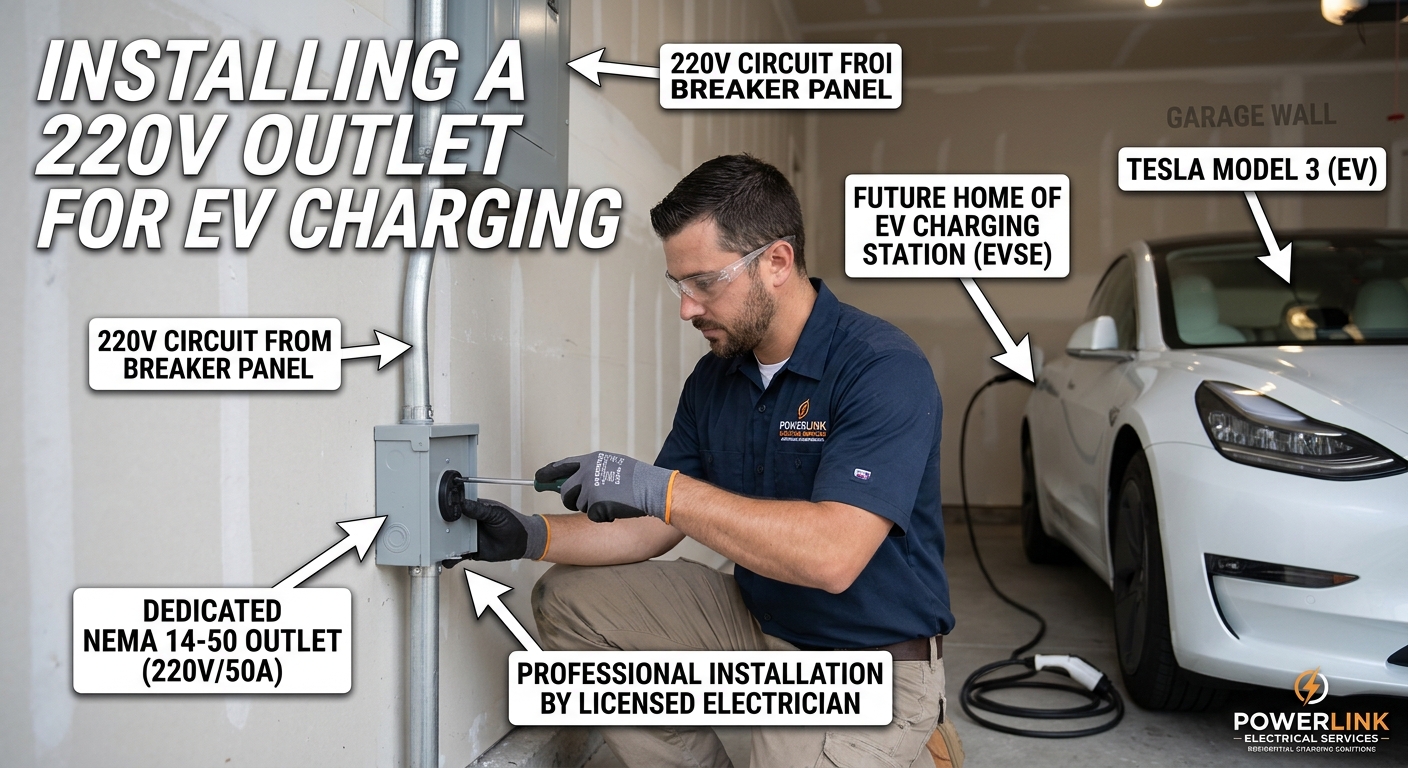
Transitioning to an electric vehicle (EV) brings quiet performance, responsive acceleration, and predictable home refueling. While standard 120-volt Level 1 wall outlets supply only 3 to 5 miles of range per hour, upgrading to a high-voltage 220V/240V single-phase circuit provides Level 2 home charging, delivering 20 to 44 miles of range per hour. When preparing a garage or driveway for an EV, homeowners routinely ask: Can you install a 220V outlet for an EV charger?
The short answer is: yes, you can install a 220V/240V outlet for an EV charger. In residential settings, this is usually accomplished by adding a dedicated 240-volt branch circuit terminating in a heavy-duty NEMA 14-50 or NEMA 6-50 receptacle.
However, because EV charging is a continuous electrical load that draws heavy current for hours, installing a 220V/240V receptacle requires strict adherence to National Electrical Code (NEC Article 625 / Article 210) standards regarding breaker sizing, wire conductor gauges, GFCI protection, and industrial-grade receptacles.
For complete hardware reviews, installer guides, and panel load calculators, visit EV Charger Advisor.
1. Choosing the Right 220V/240V Outlet: NEMA 14-50 vs. NEMA 6-50
Residential Level 2 plug-in chargers rely on two primary 240-volt receptacle configurations:
A. NEMA 14-50 Receptacle (Most Popular)
-
Pin Configuration: 4-prong outlet containing Hot 1, Hot 2, Neutral, and Ground.
-
Electrical Capacity: Sized for a 50-Amp circuit breaker. Applying the NEC 80% continuous duty rule limits continuous EV draw to 40 Amps ($9.60 \text{ kW}$ output).
-
Versatility: Highly flexible, compatible with almost all portable plug-in chargers, RV hookups, and workshop equipment.
B. NEMA 6-50 Receptacle (EV-Specific)
-
Pin Configuration: 3-prong outlet containing Hot 1, Hot 2, and Ground (no neutral wire).
-
Electrical Capacity: Sized for a 50-Amp circuit breaker (40A continuous draw / $9.60\text{ kW}$ output).
-
Advantage: Lower material cost during installation because it requires only three wire conductors instead of four.
C. Industrial-Grade Receptacles Are Mandatory
Standard builder-grade $10 range outlets are designed for appliances plugged in once per decade. Daily EV charging creates intense thermal expansion that can melt standard wall sockets. Always insist on industrial-grade receptacles (such as Hubbell or Bryant) with high-pressure screw terminals.
To learn more about how charger power levels and wire sizes compare, check out our guide on EV charging types.
2. National Electrical Code (NEC) Requirements for 240V Outlets
Installing a 220V/240V EV receptacle requires compliance with key electrical safety standards:
-
NEC Article 625.40 (Dedicated Branch Circuit): The outlet must be on its own dedicated branch circuit—it cannot share power with dryers, welders, or garage lights.
-
NEC 80% Continuous Duty Rule (NEC 625.42): EV charging is a continuous load. A 50A breaker allows a maximum continuous charge rate of 40 Amps.
-
NEC GFCI Protection (NEC 625.54): All 150V-to-ground 240V receptacles installed for EV charging require a 2-pole GFCI circuit breaker in the main distribution panel.
-
Hardwiring Alternative: Direct hardwiring to a 60A breaker supports faster 48A ($11.52\text{ kW}$) charging, eliminates receptacle thermal wear, and avoids costly GFCI breaker requirements.
To explore Wi-Fi-enabled smart wallboxes engineered with integrated load management features, read our guide on smart chargers.
Step-by-Step Mathematical Example: Circuit Sizing & Voltage Drop Math
Let us perform a technical calculation to determine the required circuit breaker rating, gross power delivery, percentage voltage drop ($\Delta V$), and session duration to add 42 kWh of energy to an EV using a NEMA 14-50 Outlet ($240\text{V}$ supply) on a 50-Amp Circuit running 50 feet ($15.24\text{ m}$) on #6 AWG Copper Wire ($R = 0.000491 \Omega/\text{ft}$) capped at 40 Amps continuous draw ($\eta = 0.90$).
Given Parameters:
-
Circuit Breaker Sizing: $50 \text{ Amps (Double-Pole)}$
-
Max Continuous Amperage ($I$): $50\text{A} \times 0.80 = \mathbf{40 \text{ Amps}}$
-
Supply Line Voltage ($V$): $240 \text{ Volts}$
-
One-Way Cable Distance ($L$): $50 \text{ feet}$
-
Conductor Resistance for #6 AWG Copper ($R_{\text{wire}}$): $0.000491 \Omega \text{ per foot}$
-
Target Net Energy Replenishment ($E_{\text{net}}$): $42 \text{ kWh}$
-
Conversion Efficiency ($\eta$): $90\% \quad (0.90)$
Calculation 1: Continuous AC Gross Power Output ($P_{\text{gross}}$)
Calculation 2: Net Power Delivered to Battery Cells ($P_{\text{net}}$)
Calculation 3: Voltage Drop ($\Delta V$) Math
For a single-phase 240V circuit ($2 \times L = 100\text{ ft}$ total conductor loop path):
Calculation 4: Required Charging Session Duration ($T$)
Result Breakdown: Installing a 220V/240V NEMA 14-50 outlet on a 50A breaker with #6 AWG copper wire delivers 42 kWh of energy in 4 hours and 52 minutes with a low 0.82% voltage drop.
Comparison Table: 220V/240V Outlet Specs vs. Hardwired Setup
| Feature / Metric | NEMA 14-50 Outlet | NEMA 6-50 Outlet | Dedicated Hardwired EVSE |
| Supply Voltage | 240V Single-Phase | 240V Single-Phase | 240V Single-Phase |
| Required Breaker | 50A Double-Pole | 50A Double-Pole | 60A Double-Pole |
| Max Continuous Draw | 40 Amps (80% Rule) | 40 Amps (80% Rule) | 48 Amps Continuous |
| Power Output (240V) | 9.60 kW | 9.60 kW | 11.52 kW |
| Conductor Wiring | #6 AWG (4 Wires) | #6 AWG (3 Wires) | #6 AWG Copper Wire |
| GFCI Breaker Required? | YES (NEC 625.54) | YES (NEC 625.54) | NO (Internal EVSE GFCI) |
Summary & Key Takeaways
-
Yes, Fully Permissible: Installing a 220V/240V NEMA 14-50 or 6-50 outlet is a standard method for powering Level 2 EV chargers.
-
Follow the 80% Rule: A 50A breaker caps continuous charging draw at 40 Amps ($9.60\text{ kW}$).
-
Use Industrial-Grade Outlets: High continuous thermal stress requires commercial-grade receptacles to avoid socket degradation.
-
Hardwiring Is Superior: Direct hardwiring on a 60A breaker supports maximum 48A ($11.52\text{ kW}$) speeds and avoids GFCI breaker trips.













Leave a Reply