
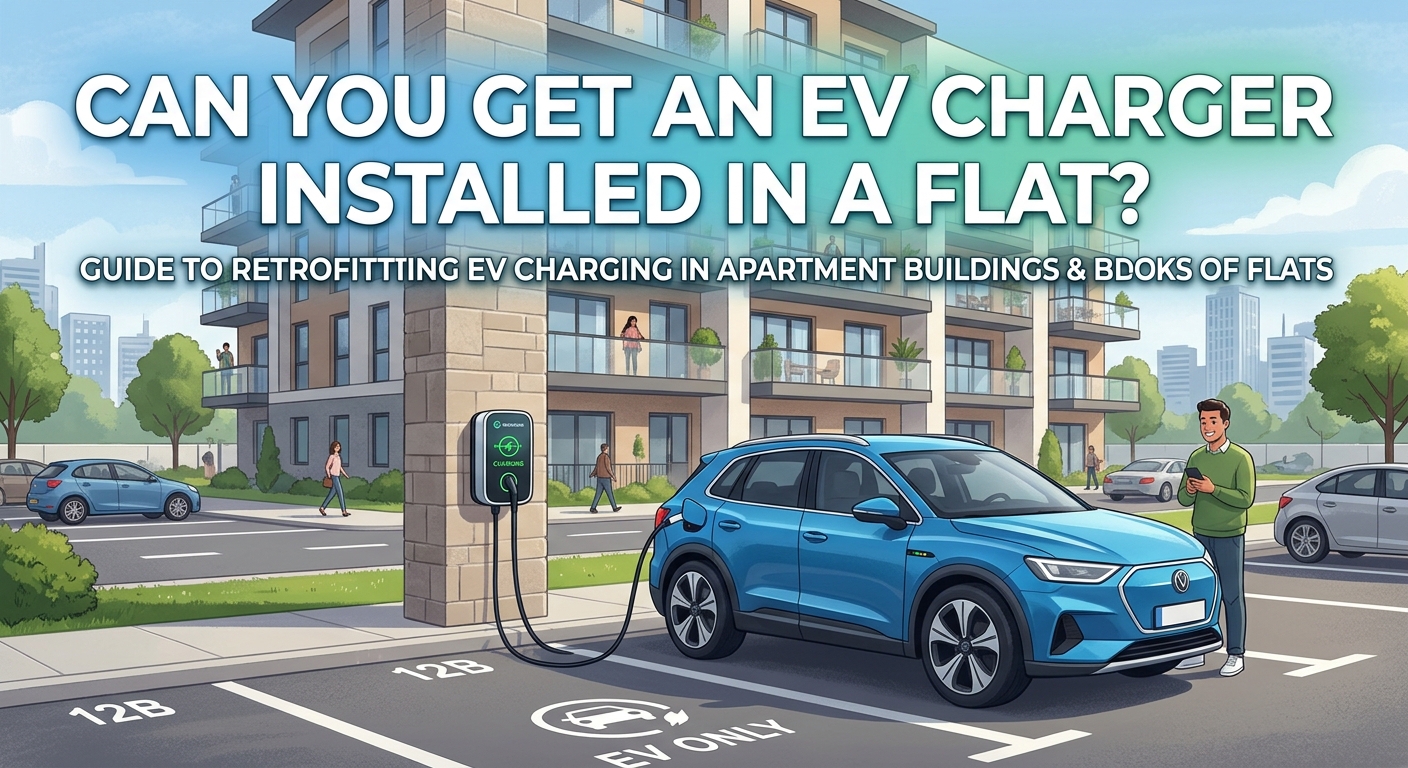
Transitioning to an electric vehicle (EV) is one of the most effective ways to lower daily commute costs while enjoying quiet, zero-emission transportation. Delivering 20 to 44 miles of driving range per hour over a high-voltage 240-volt single-phase branch circuit, setting up a home Level 2 wallbox transforms daily battery charging into an effortless overnight routine. However, for residents living in leasehold flats, block apartments, or multi-family urban complexes, a fundamental question arises: Can you get an EV charger installed in a flat?
The short answer is: yes, you can get an EV charger installed in a flat, provided you have a dedicated or deeded parking space, obtain necessary landlord or freeholder permissions, and establish a compliant electrical sub-metering connection.
Navigating shared building infrastructure, leasehold covenants, and multi-tenant electrical distribution requires a structured approach to ensure safety and full compliance with the National Electrical Code (NEC Article 625) and local highway or utility regulations.
For complete hardware reviews, installer guides, and panel load calculators, visit EV Charger Advisor.
1. Four Essential Steps to Install an EV Charger in a Flat
Installing charging hardware in a flat requires coordinating with building management, freeholders, and certified electrical contractors:
A. Verify Dedicated Parking Ownership
You must have a legally assigned, deeded, or demised parking bay associated with your flat’s lease agreement. Installing a private charger is generally not permitted in unallocated or shared visitor parking bays without building-wide community approval.
B. Obtain Freeholder & Managing Agent Approval
Submit a formal written proposal to your freeholder, landlord, or property management company. Include technical spec sheets for the wallbox, installer credentials, electrical safety certifications (UL / IEC 61851), and detailed wiring route diagrams showing how cable will pass through common areas.
C. Perform a Building Electrical Load Survey
A certified electrician must assess the central service distribution board or floor sub-panel to confirm that sufficient spare electrical capacity exists to handle a continuous 32-Amp or 48-Amp draw.
D. Establish Metering & Billing Architecture
The installer must establish how energy consumption is tracked:
-
Direct Feed from Flat Meter: Running a cable directly from your individual residential utility meter to your parking stall.
-
Common Service Panel with Smart Sub-Metering: Connecting to the block’s common service panel and using an integrated smart meter or RFID access app to bill usage directly to your personal account.
To learn more about how charger power levels and wire sizes compare, check out our guide on EV charging types.
2. Overcoming Shared Infrastructure Challenges: Dynamic Load Management (DLM)
The primary barrier to installing EV chargers in flat complexes is central panel capacity limits. If multiple residents turn on high-power Level 2 chargers simultaneously, total power demand can overload the building’s main transformer.
Modern block installations solve this using Dynamic Load Management (DLM):
-
Automatic Amperage Throttling: Smart wallboxes communicate over local Wi-Fi, Ethernet, or OCPP network protocols to measure real-time electrical draw across the building.
-
Balanced Energy Sharing: During peak household usage hours (e.g., 6 PM to 10 PM), the DLM system automatically scales individual charger outputs down to 16A or 24A. During off-peak overnight hours (12 AM to 6 AM), power scales back up to 32A or 48A, ensuring every car receives a full charge by morning without tripping main breakers.
To explore Wi-Fi-enabled smart wallboxes engineered with OCPP compatibility, read our guide on smart chargers.
Step-by-Step Mathematical Example: Voltage Drop on Long Flat Cable Runs
In multi-story flat developments, the central meter room is frequently located at a significant distance from an assigned underground or surface parking bay. Under NEC guidelines, branch circuit voltage drop ($\Delta V$) should stay below 3% to prevent efficiency loss and wire overheating.
Let us evaluate the voltage drop for a 32-Amp continuous Level 2 charger ($240\text{V}$ single-phase supply) running 140 feet ($42.67\text{ m}$) from a central meter room to a flat’s parking space using #8 AWG Copper Wire ($R = 0.000778 \Omega/\text{ft}$).
Given Parameters:
-
Continuous Current Draw ($I$): $32 \text{ Amps}$
-
Nominal Line Voltage ($V$): $240 \text{ Volts}$
-
One-Way Cable Distance ($L$): $140 \text{ feet}$
-
Conductor Resistance ($R_{\text{wire}}$): $0.000778 \Omega \text{ per foot}$
Calculation 1: Voltage Drop ($\Delta V$) Math
For a single-phase $240\text{V}$ circuit ($2 \times L = 280\text{ ft}$ total conductor path):
Calculation 2: Percentage Voltage Drop (%)
Result Breakdown: A 2.90% voltage drop stays safely under the 3% maximum NEC threshold limit, confirming that a 140-foot cable run using #8 AWG copper conductors operates safely and efficiently in a multi-story flat building.
Comparison Table: Flat EV Charger Setup Options
| Connection Setup | Metering Method | Freeholder Approval Complexity | Typical Installation Distance |
| Direct Meter Feed | Billed on flat’s main utility bill | Low to Moderate | Moderate (Requires conduit through common areas) |
| Sub-Panel + Smart DLM | Automated app / RFID sub-metering | Moderate (Requires block agreement) | Short to Long |
| Shared Community Bays | Pay-per-use app | High (Requires building-wide consensus) | Centralized parking area |
Summary & Key Takeaways
-
Yes, It Is Possible: You can get an EV charger installed in a flat provided you have an assigned parking space and obtain necessary landlord or freeholder consents.
-
Secure Written Permissions: Always submit a technical proposal and wiring route diagram to your freeholder or managing agent prior to starting work.
-
Use Dynamic Load Management: DLM technology prevents transformer overloads by dynamically sharing available electrical capacity across multiple active chargers.
-
Account for Cable Distances: Calculate voltage drop on long cable runs from the main meter room to parking stalls to select the correct wire size.













Leave a Reply