
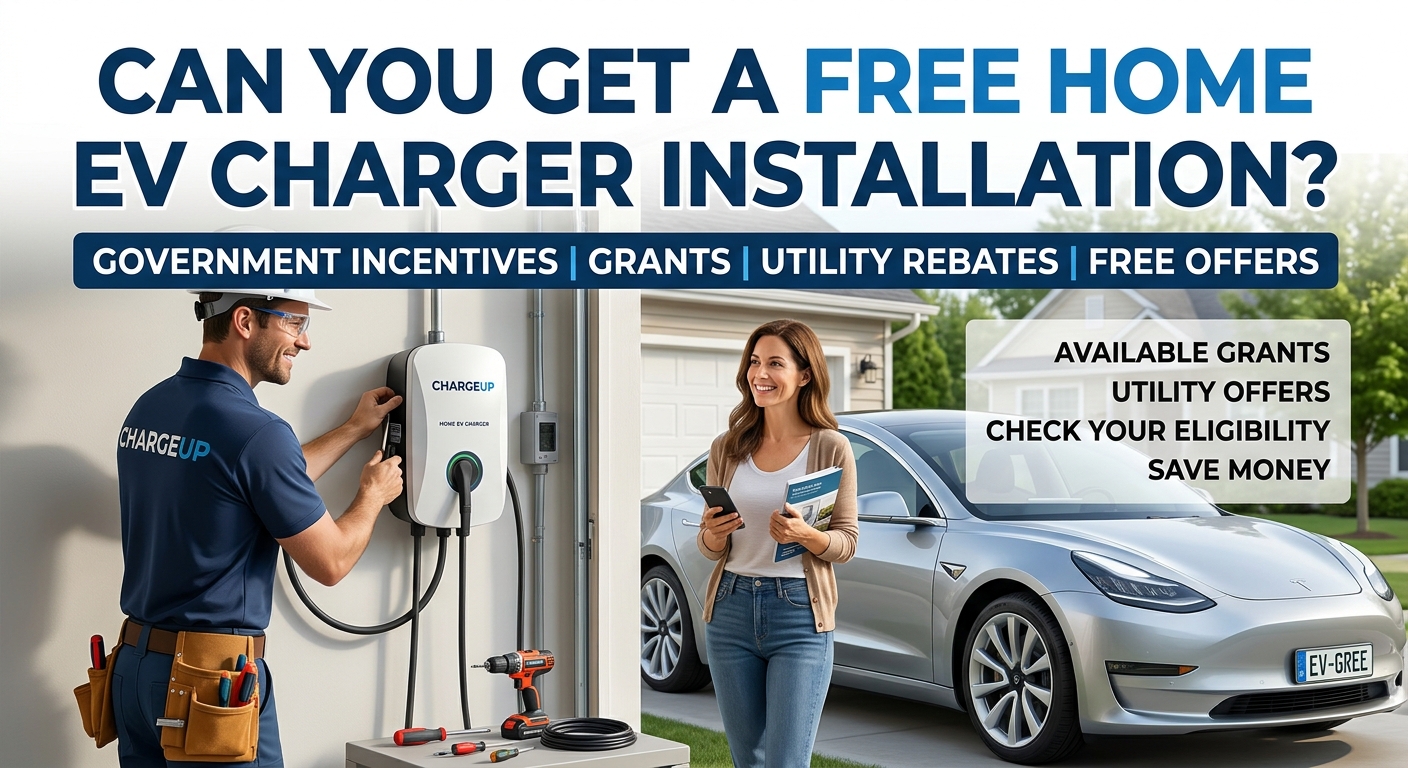
Switching to an electric vehicle (EV) delivers immediate savings on long-term fuel costs, whisper-quiet acceleration, and zero daily tailpipe emissions. Operating on a high-voltage 240-volt single-phase branch circuit, setting up a home Level 2 wallbox transforms daily battery charging into an effortless overnight habit, restoring 20 to 44 miles of driving range per hour. However, with hardware, wiring, and electrician labor fees typically ranging from $800 to $3,000+ ($1,000–$5,000 turnkey) or 350,000 to 600,000 PKR in Pakistan, prospective buyers frequently ask: Can you get a free home EV charger installation?
The short answer is: yes, you can sometimes get a free or fully offset home EV charger installation through manufacturer promotional bundles (like automaker charger offers), electric utility rebate programs, government grants, or dealer purchasing incentives.
By strategically stacking vehicle manufacturer promotions alongside local utility hardware and panel upgrade rebates, many EV buyers offset 100% of their upfront wallbox equipment and electrical installation expenses.
For complete hardware reviews, installer guides, and panel load calculators, visit EV Charger Advisor.
1. Four Ways to Secure Free or Zero-Cost EV Charger Installations
To achieve a zero-cost or heavily subsidized installation, leverage these four primary program types:
A. Automaker Purchase Promotions (Manufacturer Bundles)
Several major EV manufacturers bundle a complementary home Level 2 charger and standard electrical installation as a buying incentive when purchasing or leasing a new vehicle:
-
Automaker Bundles (e.g., Ford Power Promise, GM, Hyundai, Chevrolet): Many brands provide a free smart Level 2 wallbox and cover standard electrician installation fees (mounting, conduit runs, and breaker hookup) through approved installation networks (such as Qmerit).
B. Electric Utility Company Rebates & Grants
Local power utilities heavily incentivize home charging infrastructure to encourage off-peak charging schedules:
-
Turnkey Equipment & Installation Rebates: Utilities across North America and Europe offer direct cash-back rebates ranging from $500 to $2,500+ for installing qualifying smart Level 2 chargers and upgrading electrical panels.
-
Free Hardware via Managed Charging: Certain energy providers supply a free smart wallbox if you enroll in their “Bring Your Own Charger” (BYOC) or time-of-use (TOU) demand response programs, allowing them to shift charging load during peak grid hours.
C. State & Regional Government Subsidies
In addition to utility programs, regional air quality boards, state energy offices, and national governments offer grants (such as the SEAI grant in Ireland or regional state energy credits) that cover $300 to $1,500 in installation costs.
D. EV Subscription & Energy Plan Bundles
Energy suppliers in select markets offer bundled electricity tariffs that include a leased smart Level 2 wallbox with zero upfront installation costs, folding equipment expenses into a fixed monthly electricity tariff.
To learn more about how charger power levels and wire sizes compare, check out our guide on EV charging types.
2. What Is Typically Included in “Free Standard Installation”?
When an automaker or utility program advertises “free standard installation,” it is essential to understand what is covered versus potential out-of-pocket add-ons:
-
What “Standard Installation” Covers:
-
Mounting a Level 2 wallbox adjacent to an existing electrical panel.
-
Installing up to 15 to 20 feet of conduit and heavy copper wire (#8 or #6 AWG).
-
Adding a dedicated 40A or 50A double-pole circuit breaker.
-
Securing local electrical permits and municipal inspections.
-
-
What May Require Additional Out-of-Pocket Fees:
-
Main Service Panel Upgrades: Upgrading an old 100A panel to 200A service ($1,500–$3,000).
-
Long Wiring Runs: Running cable across basements, attics, or detached garages beyond the standard 20-foot limit.
-
Underground Trenching: Cutting asphalt or trenching through grass for driveway post mounts.
-
To explore Wi-Fi-enabled smart wallboxes engineered with app-locking features, read our guide on smart chargers.
Step-by-Step Mathematical Example: Stacking Rebates to Achieve Zero Net Cost
Let us perform a financial calculation demonstrating how stacking manufacturer offers, utility rebates, and off-peak savings can offset a $1,600 turnkey Level 2 installation.
Given Parameters:
-
Level 2 Charger Hardware Cost: $\$500$
-
Standard Electrician Installation Fee: $\$1,100$
-
Total Upfront Turnkey Cost: $\mathbf{\$1,600}$
-
Manufacturer Installation Credit: $-\$1,000$
-
Utility Smart Charger Rebate: $-\$500$
-
State/Regional Energy Grant: $-\$300$
Calculation 1: Net Upfront Out-of-Pocket Math
Calculation 2: Annual Commute Off-Peak Savings Math (12,000 Miles/Year)
Driving 12,000 miles/year at 3.3 miles/kWh requires 3,636.36 kWh. Charging at off-peak utility rates ($0.10/kWh) vs. public rates ($0.50/kWh) saves:
Result Breakdown: By properly stacking available manufacturer incentives, utility grants, and state programs, a homeowner can completely eliminate the $1,600 installation expense, achieving a 100% free installation while saving over $1,450 annually on fuel.
Comparison Table: Free Installation & Incentive Programs
| Incentive Source | Average Value | Requirements | Primary Advantage |
| Automaker Promotion | $1,000 – $1,500 (100% Free Standard Install) | New vehicle purchase/lease | Turnkey installation through certified network |
| Utility Smart Rebate | $200 – $2,500 | Enrolling in off-peak / TOU rates | Direct cash back or account credits |
| State / Regional Grant | $300 – $1,000 | Resident in eligible ZIP code / region | Stackable with utility programs |
| Energy Supplier Bundle | Free Hardware | 12 to 36-month electricity contract | $0 upfront hardware expense |
Summary & Key Takeaways
-
Yes, Free Installations Exist: You can secure a free home charger installation by taking advantage of automaker buying promotions, utility rebates, and regional energy grants.
-
Check Automaker Offers: Ask your car dealer about bundled home charging programs (like the Ford Power Promise or GM credits) before purchasing.
-
Stack Incentives: Combine utility hardware rebates, off-peak charging programs, and state incentives to cover both hardware and electrician fees.
-
Confirm “Standard” Limits: Verify what cable length and panel capacity are included in free standard installation offers to avoid surprise site fees.













Leave a Reply