
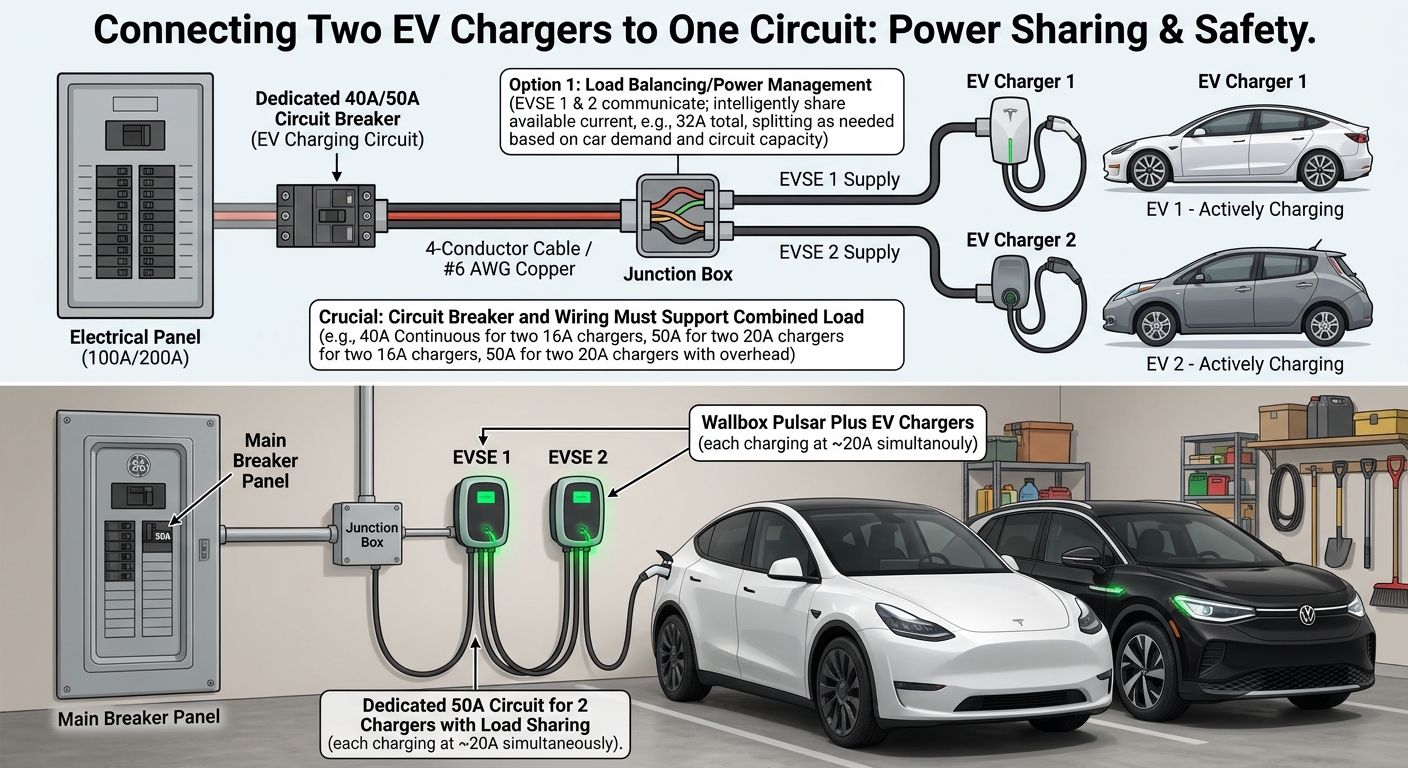
As multi-EV households become increasingly common, managing home electrical infrastructure effectively is a top priority for electric vehicle owners. Delivering 20 to 44 miles of driving range per hour over a high-voltage 240-volt single-phase branch circuit, installing Level 2 wallboxes makes daily battery replenishment effortless. However, as families add a second electric car to their driveway, a primary technical question arises: Can you connect two EV chargers to one electrical circuit?
The short answer is: yes, you can connect two EV chargers to a single electrical circuit, provided the setup uses a listed load-sharing (or power-sharing) system. Under National Electrical Code (NEC Article 625) standards, hardwired chargers engineered with smart power-sharing protocols can dynamically distribute a fixed circuit capacity between multiple vehicles without overloading the circuit breaker or electrical panel.
Connecting two standard, non-networked EV chargers to a single circuit without power sharing violates electrical codes and risks severe breaker tripping and fire hazards.
For complete hardware reviews, installer guides, and panel load calculators, visit EV Charger Advisor.
1. How EV Charger Power Sharing Works
To safely share a single circuit between two chargers without adding a costly new breaker or upgrading your main service panel, smart wallboxes utilize automated power management:
A. Dynamic Load Balancing (Master-Leader Protocol)
Two compatible wallboxes (such as two Tesla Wall Connectors, Wallbox Pulsar Pluses, or Emporia Chargers) are linked wirelessly via Wi-Fi/Bluetooth or wired via a RS485 data cable.
-
Single Vehicle Plugged In: The active charger draws the full safe continuous output of the circuit breaker (e.g., 48 Amps on a 60A breaker).
-
Second Vehicle Plugs In: The chargers communicate instantly, splitting the available amperage equally (e.g., 24 Amps to each vehicle).
-
One Vehicle Finishes Charging: As soon as one car completes its charge cycle or ramps down intake, the master wallbox redirects the remaining unused power to the second car, restoring it to maximum speed.
B. Dual-Port Level 2 Wallboxes
Instead of installing two distinct wallboxes, homeowners can install a single Dual-Port Level 2 EV Charger. These units feature one central hardwired junction box that routes internal power splitters to two output cables, handling internal load balancing automatically under UL/NEC safety listings.
To learn more about how charger power levels and wire sizes compare, check out our guide on EV charging types.
2. NEC Code Requirements for Multi-Charger Circuits
Before connecting multiple chargers to a single circuit, specific National Electrical Code (NEC) rules must be met:
-
NEC 625.40 Exception for Energy Management: NEC Article 625 strictly mandates that Level 2 EVSE outlets above 16A require individual branch circuits, unless an approved Automatic Load Management System (ALMS) or listed energy management system limits total continuous demand to the branch circuit rating.
-
The Continuous Load 125% Breaker Rule: EV charging is classified as a continuous load. The combined draw of both chargers must never exceed 80% of the circuit breaker rating. On a shared 60A breaker, maximum continuous output for both chargers combined is strictly capped at 48 Amps ($11.52\text{ kW}$).
-
No Dual Plug-In Outlets (NEMA Receptacles): You cannot plug two separate EV chargers into two NEMA 14-50 wall outlets on the same circuit. Power sharing requires direct hardwiring into listed smart chargers.
To explore Wi-Fi-enabled smart wallboxes engineered with integrated load management features, read our guide on smart chargers.
Step-by-Step Mathematical Example: Shared 60A Circuit Load Math
Let us calculate the power delivery, energy replenishment rate, and total charging time to add 40 kWh of energy to two identical EVs plugged into two power-sharing hardwired chargers connected to a single 60-Amp circuit breaker ($240\text{V}$ single-phase supply) operating at 90% efficiency.
Given Parameters:
-
Circuit Breaker Rating: $60 \text{ Amps}$
-
Max Allowed Continuous Combined Current (80% Rule): $60\text{A} \times 0.80 = \mathbf{48 \text{ Amps continuous limit}}$
-
Target Energy Replenishment per EV ($E$): $40 \text{ kWh}$
-
Nominal Supply Voltage ($V$): $240 \text{ Volts}$
-
Conversion Efficiency ($\eta$): $90\% \quad (0.90)$
Calculation 1: Total Available Power Output on Circuit ($P_{\text{total}}$)
Calculation 2: Power Split When BOTH Vehicles Charge Simultaneously
Each vehicle receives an equal 24-Amp share ($11.52\text{ kW} / 2$):
Calculation 3: Power Available When ONE Vehicle Charges Alone
The single active vehicle receives the full 48-Amp continuous output:
Result Breakdown: When two vehicles plug in simultaneously, power sharing splits the 48A limit into 24A each (5.76 kW), taking 7 hours and 43 minutes to replenish 40 kWh. As soon as one car finishes, the full 48A output restores to the remaining vehicle, doubling its speed.
Comparison Table: Standalone vs. Shared Circuit Multi-EV Setups
| Feature / Scenario | Dual Dedicated Circuits | Shared Circuit with Power Sharing |
| Circuit Breakers Needed | Two 50A or 60A Breakers | One Dedicated 60A Breaker |
| Max Power Output | 11.5 kW per vehicle simultaneously | 11.5 kW total split between vehicles |
| Panel Capacity Required | High (Requires 100A–120A total) | Moderate (Saves panel space) |
| Panel Upgrade Needed? | Often YES ($1,500–$3,000 extra) | Usually NO (Avoids service upgrades) |
| NEC Compliance | Standard NEC 625 | Compliant via NEC 625.40 exception |
Summary & Key Takeaways
-
Yes, with Smart Power Sharing: Two chargers can share one circuit safely using listed power-sharing wallboxes or dual-port chargers.
-
Prevents Electrical Overloads: Dynamic load balancing automatically throttles power between active vehicles to respect breaker continuous limits.
-
Avoids Costly Panel Upgrades: Power sharing enables multi-EV home charging without spending thousands on main electrical service panel upgrades.
-
Hardwiring Is Mandatory: NEC 625 rules require power-sharing setups to be permanently hardwired; sharing plug sockets is strictly non-compliant.













Leave a Reply