
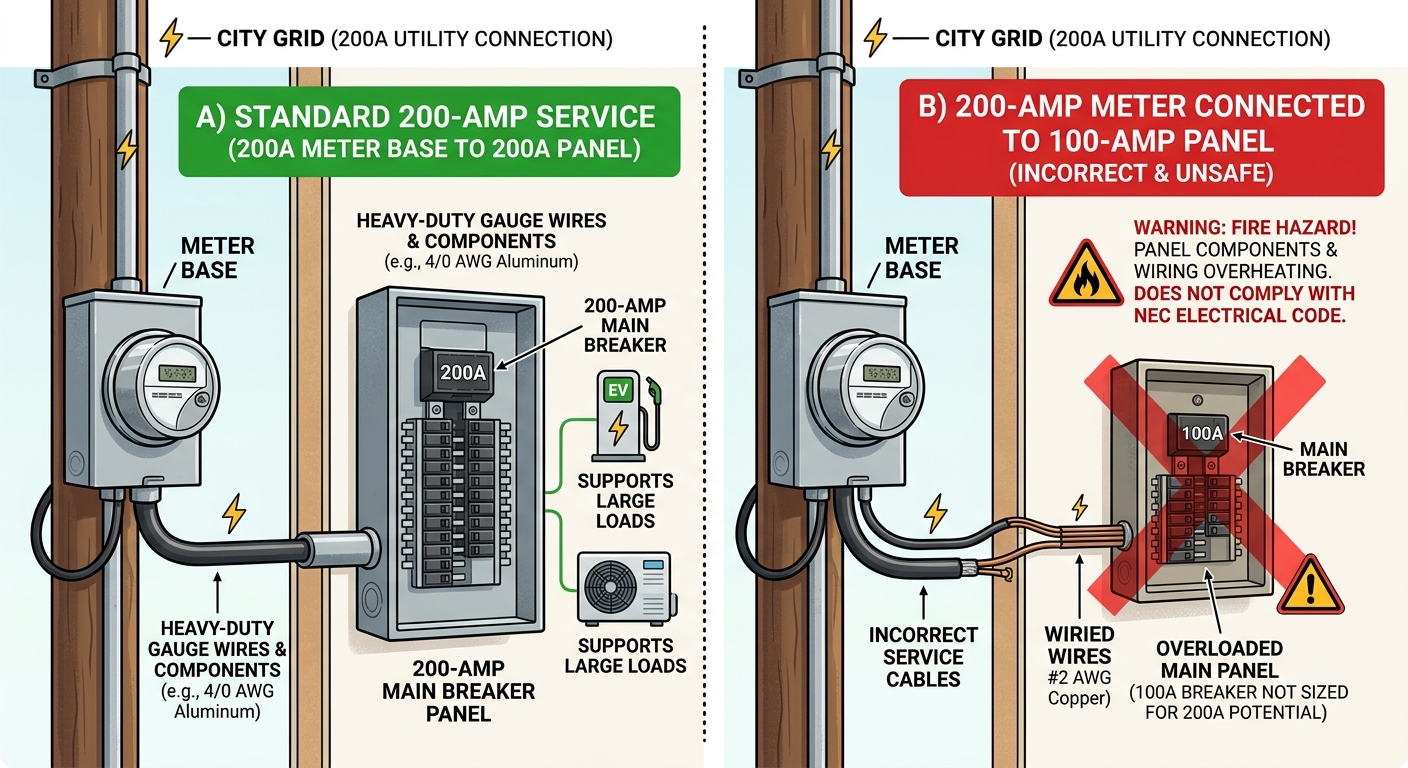
When planning a high-power residential upgrade—such as installing a Level 2 electric vehicle (EV) charger, electric heat pump, or induction range—homeowners often encounter electrical service compatibility questions. A common scenario during utility service line upgrades is: Can you connect a 200-amp service to a 100-amp electrical panel?
The short answer is yes, you can connect a 200-amp service line to a 100-amp electrical panel, provided the system uses a 100-amp main circuit breaker to limit the total current flowing into the panel.
While the utility company may feed heavy service conductors capable of carrying 200 Amps to your weatherhead or meter socket, the electrical panel itself—and its internal busbars—will be strictly protected by a 100-Amp main disconnect breaker. Understanding how service lines, main breakers, and panel busbars interact helps you plan home EV charger additions safely and cost-effectively.
For comprehensive load calculators, hardware reviews, and installation guides, visit EV Charger Advisor.
The Core Rule: Utility Service vs. Main Breaker Protection
To understand why this configuration is safe and code-compliant under the National Electrical Code (NEC Article 230), you must separate utility capacity from electrical panel protection:
1. Utility Service Lines & Meter Socket (200A Rated)
The electric utility company (such as LESCO, K-Electric, or regional power providers) can run heavy gauge feeder cables rated for 200 Amps from the transformer to your home’s exterior meter box. Having 200A service lines entering the meter socket provides “future-proofed” utility supply capacity.
2. The Main Circuit Breaker (100A Overcurrent Protection)
Even if 200 Amps of current are available at the meter, the main breaker positioned at the top of your 100A panel acts as a strict safety gatekeeper. If total electrical draw across all household branch circuits exceeds 100 Amps, the 100A main breaker automatically trips, preventing excess current from flowing into internal panel busbars rated for only 100 Amps.
3. Why This Matters for EV Charger Installation
Connecting a 200A utility line to a 100A panel does NOT automatically give your panel 200 Amps of usable branch capacity. Your usable power remains capped at 100 Amps ($24\text{ kW}$ at $240\text{V}$) until you physically replace the 100A panel enclosure and busbars with a certified 200A main panel.
To learn more about how charger power ratings and plug styles compare, check out our guide on EV charging types.
Step-by-Step Mathematical Example: Busbar Overheating Risk & NEC 120% Rule
Why can’t you simply replace a 100-Amp main breaker with a 200-Amp breaker inside an existing 100-Amp panel box? Let us examine the thermal physics and NEC Article 705.12 (120% Busbar Rule) math.
Given Panel Parameters:
-
Panel Busbar Rating ($B$): $100 \text{ Amps}$
-
Main Breaker Rating ($M$): $100 \text{ Amps}$
-
Nominal Line Voltage ($V$): $240 \text{ Volts}$
Calculation 1: Maximum Safe Thermal Power Capacity of 100A Busbars
Calculation 2: What Happens If 200A Flows Through a 100A Busbar?
Heat generation in copper or aluminum busbars increases quadratically with current ($P_{\text{heat}} = I^2 R$).
Result Breakdown: Forcing 200 Amps through a 100A-rated panel busbar creates 4 times the thermal heat load, quickly melting internal plastic insulation, destroying circuit breaker contact jaws, and creating severe fire hazards. Therefore, a 100A panel connected to a 200A service line MUST retain a 100A main disconnect breaker.
How to Safely Add a Level 2 EV Charger to a 100A Panel with 200A Service
If your property has a 200A utility service line feeding a 100A main panel, you have 3 practical pathways for adding a high-voltage Level 2 charger:
1. Utilize Smart EVEMS Load Balancing (Zero Panel Upgrade Cost)
Install an EV Energy Management System (EVEMS) or smart wallbox with current transformer (CT) clamps. The system dynamically measures real-time demand on the 100A main panel, allowing full-speed 32A or 40A charging late at night while throttling power when domestic appliances turn on.
2. De-Rate Charger Amperage Settings
Set your Level 2 wallbox to operate at 16 Amps ($3.8\text{ kW}$ output on a 20A breaker) or 24 Amps ($5.7\text{ kW}$ output on a 30A breaker). This low-amperage setting fits comfortably within the 100A main breaker limit while providing 12 to 22 miles of range per hour.
3. Complete the Subpanel or Main Panel Upgrade to 200A
Since 200A service lines are already present at the meter, an electrician can replace the 100A panel enclosure with a modern 200A main breaker panel. Because utility line upgrades are already complete, this panel swap is faster and less expensive, unlocking full headroom for a 60A circuit ($48\text{A} / 11.5\text{ kW}$ charging).
To explore Wi-Fi-enabled smart wallboxes that support dynamic load management, read our guide on smart chargers.
Comparison Table: 100A Panel vs. Full 200A Panel Capacity
| Electrical Configuration | Service Lines | Main Breaker | Usable Continuous Capacity (80% Rule) | Max Level 2 Charger Allowed |
| 200A Service to 100A Panel | 200 Amps | 100 Amps | $80 \text{ Amps } (19.2\text{ kW})$ | 24A – 32A (Or Dynamic EVEMS) |
| Full 200A Service & Panel | 200 Amps | 200 Amps | 160 Amps $(38.4\text{ kW})$ | 48A ($11.5\text{ kW}$ on 60A Breaker) |
Summary & Key Takeaways
-
Fully Allowed by Code: You can connect 200A utility service lines to a 100A panel, provided a 100-amp main breaker protects the panel busbars.
-
Main Breaker Dictates Capacity: Having 200A service cables does NOT increase panel capacity beyond 100 Amps ($24\text{ kW}$) until the panel itself is replaced.
-
Never Over-Breaker Panel Busbars: Replacing a 100A main breaker with a 200A breaker inside a 100A box causes intense $I^2R$ thermal heat build-up and extreme fire risk.
-
Smart EV EMS Saves Money: Use dynamic load management or de-rated amperage settings to run Level 2 charging safely on a 100A panel without immediate panel replacement.













Leave a Reply