
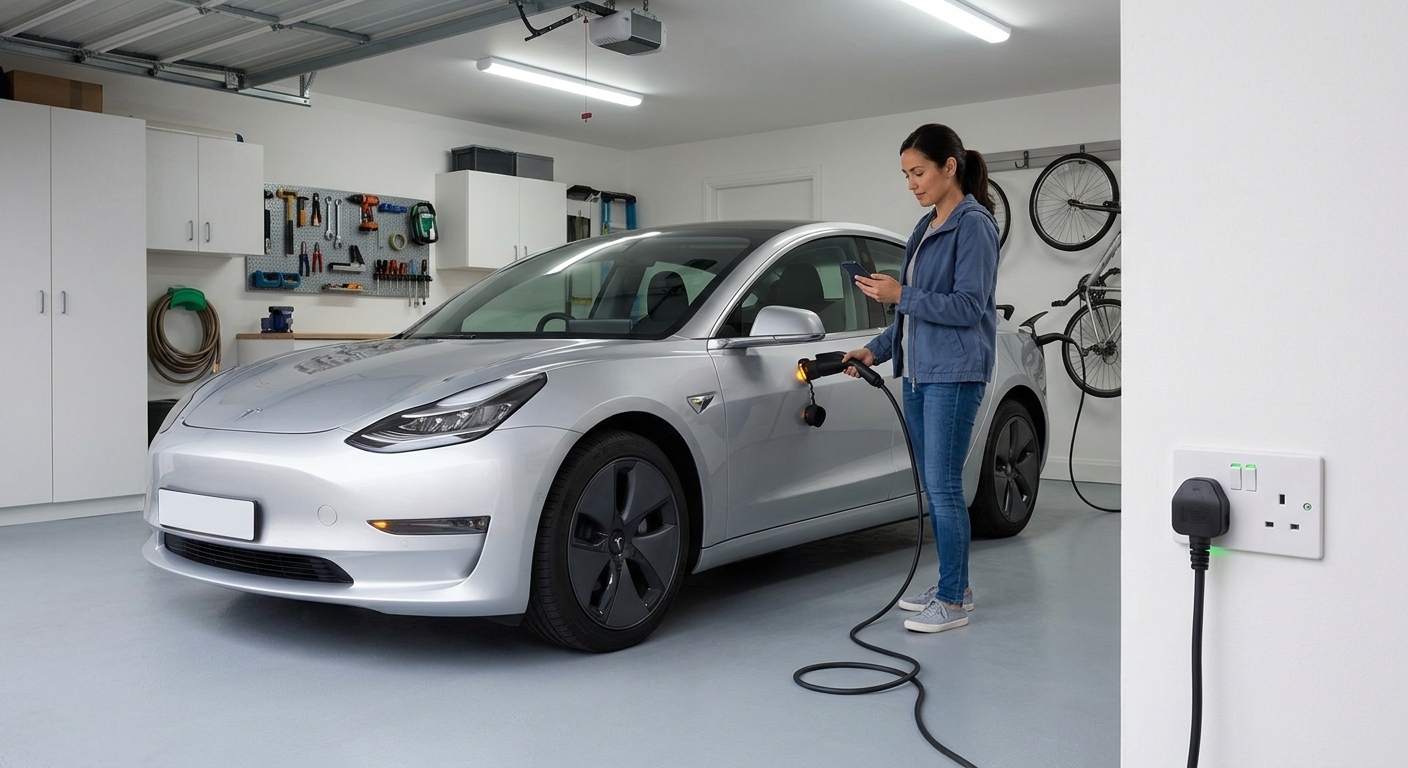
For new electric vehicle (EV) owners, learning how to charge at home without installing expensive electrical infrastructure is often a top priority. A common question among drivers exploring home charging options is: Can you charge an EV from a normal house socket?
The short answer is yes, you can charge an electric vehicle directly from a normal household socket, though it is the slowest and least optimal method available.
Plugging into a standard household wall outlet relies on Level 1 charging equipment (commonly referred to as a “trickle charger” or portable charging cable). While it requires zero upfront electrical upgrades or installation expenses, understanding its performance limits and safety requirements is essential before relying on it for daily driving.
For comprehensive hardware reviews, charging speed comparisons, and home wallbox installation guides, visit EV Charger Advisor.
How Normal House Socket Charging (Level 1) Works
In North America, a “normal house socket” refers to a standard 120-volt 3-prong wall outlet (NEMA 5-15), while in Pakistan and international markets, it refers to a standard 220V/230V 3-prong single-phase household socket.
1. North American Standard (120V Outlet)
-
Power Draw: $12 \text{ Amps continuous}$ at $120 \text{ Volts}$.
-
Power Output: $1.4 \text{ kW}$.
-
Charging Speed: Adds roughly 3 to 5 miles of range per hour.
2. International / Pakistani Standard (220V–230V Outlet)
-
Power Draw: $10 \text{ to } 13 \text{ Amps continuous}$ at $220 \text{ Volts}$.
-
Power Output: $2.2 \text{ kW to } 2.8 \text{ kW}$.
-
Charging Speed: Adds roughly 7 to 10 miles of range per hour.
While a 220V household socket delivers twice the speed of a 120V socket, both remain significantly slower than a dedicated Level 2 wallbox charger ($7.2\text{ kW} – 11.5\text{ kW}$) operating on a dedicated 240V circuit.
To learn more about how charger power levels compare, check out our guide on EV charging types.
Step-by-Step Mathematical Example: Level 1 Full Recharge Time
To demonstrate why charging from a normal house socket is considered a slow “trickle” charge, let us calculate the time required to recharge a 60 kWh EV battery pack from $10\%$ to $90\%$ state of charge ($48\text{ kWh}$ needed) using a standard 120V outlet versus a 220V household socket.
Given Parameters:
-
Energy Required: $48 \text{ kWh}$
-
120V Socket Output (12A): $1.44 \text{ kW}$ gross
-
220V Socket Output (10A): $2.20 \text{ kW}$ gross
-
Onboard AC-to-DC Charging Efficiency: $85\%$ ($0.85$)
Calculation 1: Usable Power Delivered
Calculation 2: Total Charging Duration (120V Standard Socket)
Calculation 3: Total Charging Duration (220V Standard Socket)
Result Breakdown: Restoring $48\text{ kWh}$ of energy into a medium-sized battery pack takes over 39 hours on a 120V socket and over 25 hours on a 220V household socket.
Safety Rules When Charging From a Normal House Socket
Because electric vehicle charging draws continuous, unyielding current for hours at a time, plugging into a normal household socket carries specific safety precautions:
1. Never Use Standard Lightweight Extension Cords
Plugging a portable EV charger into a thin domestic extension cord creates massive electrical resistance. Under continuous high-amperage draw, lightweight wire insulation can heat up, melt, and ignite surrounding materials. If an extension lead is strictly required, use a heavy-duty 10-gauge (10 AWG) outdoor-rated cord.
2. Inspect Outlet Wires & Contacts
Older or worn wall outlets with loose metal contacts create thermal hot spots under long charging sessions. Ensure the outlet faceplate shows no signs of discoloration, cracks, or loose fitting plugs.
3. Avoid Shared Branch Circuits
Plugging an EV into a household outlet that shares a circuit breaker with refrigerators, air conditioners, or power tools will lead to nuisance breaker trips.
To explore Wi-Fi-enabled smart wallboxes that offer dynamic power adjustments, read our guide on smart chargers.
Comparison Table: Normal House Socket vs. Level 2 Home Wallbox
| Feature | Normal House Socket (Level 1) | Dedicated Level 2 Wallbox |
| Supply Voltage | $120\text{V} – 220\text{V}$ Single-Phase | $240\text{V}$ Single / $400\text{V}$ 3-Phase |
| Power Output | $1.4\text{ kW} – 2.8\text{ kW}$ | $7.2\text{ kW} – 22.0\text{ kW}$ |
| Added Range per Hour | $3 – 8\text{ miles/hr}$ | $25 – 45\text{ miles/hr}$ |
| Full Charge Time ($60\text{kWh}$) | $25 – 40+\text{ Hours}$ | $5 – 8\text{ Hours}$ |
| Upfront Installation Cost | $0 | $500 – $1,500 |
Summary & Key Takeaways
-
Fully Functional: You can charge an EV from a normal household socket using the portable Level 1 cable provided with your vehicle.
-
Slowest Method: Normal wall sockets add only 3 to 8 miles of range per hour, making them best suited for plug-in hybrids (PHEVs) or short daily commutes under 30 miles.
-
Upgrade to Level 2 for Efficiency: Installing a dedicated 240V Level 2 charger reduces charging duration down to 5 to 8 hours while offering better AC-to-DC conversion efficiency.
-
Prioritize Electrical Safety: Avoid thin household extension cords and ensure your wall outlet is grounded and in good physical condition before plugging in.













Leave a Reply