
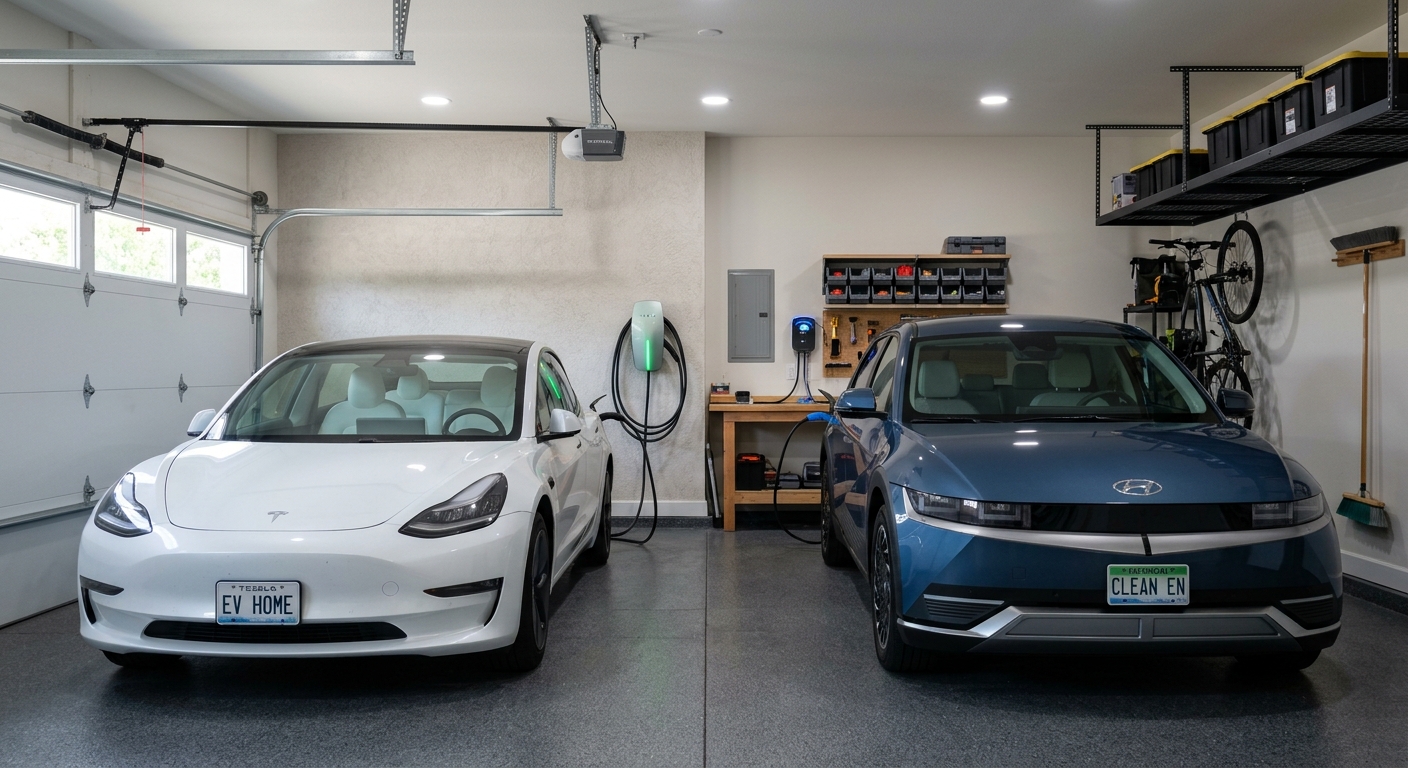
As multi-electric vehicle (EV) households become increasingly common, property owners face the practical challenge of managing daily charging for two vehicles simultaneously. Installing two Level 2 residential wallboxes ensures both vehicles recover 20 to 44 miles of driving range per hour overnight over dedicated 240-volt single-phase or three-phase branch circuits. However, connecting two high-amperage continuous loads to a single distribution board introduces critical capacity considerations. A primary question among multi-EV owners is: Can I run two EV chargers at home?
Yes, you can run two EV chargers at home, provided your home’s electrical panel and power supply can handle the load. Operating two charging stations can be achieved either by installing two dedicated high-amperage circuits on an upgraded panel or by deploying smart load management to share existing capacity dynamically without overloading your main service.
Under National Electrical Code (NEC Article 625) standards, applying continuous load safety rules, independent circuit requirements, and automated energy management ensures a safe, fully code-compliant dual installation.
For complete hardware reviews, installer guides, and panel load calculators, visit EV Charger Advisor.
1. Technical Approaches for Running Two EV Chargers
Accommodating two chargers at a single residence relies on three primary structural strategies:
DUAL CHARGER CONFIGURATION PATHWAYS:
[Main Distribution Panel] ──► [Perform NEC Article 220 Load Calculation]
                                           │
      ┌────────────────────────────────────┼────────────────────────────────────┐
      ▼                                    ▼                                    ▼
[Dual Dedicated Circuits]       [Smart EVSE Load Sharing]             [Single Dual-Socket Unit]
 • 2 × 60A Breakers              • 1 × 60A Shared Circuit              • 1 Shared Circuit
 • 96A Total Draw (11.5 kW × 2)  • Automatically splits current        • Divides power 50/50
 • Requires 200A+ Panel          • Bypasses panel upgrade              • Clean single-wall footprint
A. Dual Independent Dedicated Circuits (Full Speed)
-
National Electrical Code Standard (NEC 625.40): The NEC requires each Level 2 charger to have its own dedicated branch circuit. Two independent chargers cannot share a single standard circuit breaker.
-
Electrical Math (2 × 48A Chargers): Running two 48-amp chargers simultaneously draws 96 Amps of continuous current. Under the NEC 125% continuous duty rule, this setup requires two separate 60-Amp double-pole circuit breakers and #6 AWG copper conductors for each run.
-
Panel Capacity: Requires a robust 200A or 400A main service panel with sufficient headroom.
B. Smart EVSE Power Sharing / Load Management
-
Single Shared Circuit Operation: Smart wallboxes supporting inter-charger communication (such as dual Tesla Wall Connectors, Wallbox Pulsar Plus, or myenergi Zappi) connect to a single 50A or 60A branch circuit.
-
Dynamic Amperage Allocation: When one car is plugged in, it receives the full 48A output. When both vehicles are plugged in, the chargers automatically split the available current (24A to each vehicle). Once the first car finishes charging, full power instantly reverts to the second vehicle.
C. Dual-Output Level 2 Chargers
-
Integrated Hardware: A single wallbox housing two charging cables connected to one branch circuit. Internal power electronics distribute current between both connectors safely, providing a clean installation footprint.
To learn more about how charger power levels and wire sizes compare, check out our guide on EV charging types.
2. Panel Load Calculations & EVEMS Integration
Connecting two high-amperage continuous loads requires evaluating total electrical supply constraints:
-
Service Panel Load Assessment (NEC Article 220): A licensed electrician calculates existing household loads (HVAC, electric ranges, water heaters) before adding dual EV circuits.
-
Older 100A or 150A Service Panels: Standard 100A main panels rarely have spare capacity to operate two unmanaged 40A or 50A EV circuits simultaneously alongside household appliances.
-
EVEMS Load-Shedding (NEC 625.42): Installing an Electric Vehicle Energy Management System (EVEMS) monitors main panel demand in real time. If house loads spike (e.g., air conditioning and oven running together), the EVEMS automatically reduces EV charging current, preventing main breaker trips and saving $2,500 to $5,000 in main service panel upgrades.
To explore Wi-Fi-enabled smart wallboxes engineered with integrated load management features, read our guide on smart chargers.
3. Operational Best Practices for Multi-EV Households
Optimizing energy usage across two electric vehicles involves straightforward planning:
-
Staggered Time-of-Use (TOU) Scheduling: Program each vehicle’s smart charging software to run in alternating time slots (e.g., Vehicle A charges from 10:00 PM to 2:00 AM; Vehicle B charges from 2:00 AM to 6:00 AM). This maximizes cheap off-peak utility tariffs while avoiding simultaneous peak demand draw.
-
Install Both Chargers Simultaneously: Front-loading labor, permitting, and wiring runs for two wallboxes in a single site visit reduces overall electrician installation fees by 30% to 40% compared to scheduling separate installations.
Comparison Table: Dual EV Charger Setup Strategies
| Parameter / Feature | Unmanaged Dual Circuits | Smart Power Sharing (Load Management) | Dual-Output Single Wallbox |
| Dedicated Breakers | Two Double-Pole Breakers | One Double-Pole Breaker | One Double-Pole Breaker |
| Max Combined Power | Up to 23.0 kW (2 × 11.52 kW) | Max 11.52 kW (Shared) | Max 11.52 kW (Shared) |
| Required Circuit Sizing | Two 50A or 60A Circuits | One 50A or 60A Circuit | One 50A or 60A Circuit |
| Main Panel Demand | High (Requires 200A+ Panel) | Low / Moderate (Works on 100A/150A) | Low / Moderate (Works on 100A/150A) |
| Wiring Material Costs | Higher (Two Cable Runs) | Lower (Single Cable Run) | Lower (Single Cable Run) |
| Simultaneous Full Speed | YES (Both cars get max power) | NO (Splits power when both charge) | NO (Splits power when both charge) |
Summary & Key Takeaways
-
Dual Installations Are Fully Achievable: Multi-EV households can run two chargers through separate dedicated circuits or smart load-sharing setups.
-
NEC Continuous Duty Sizing: Independent circuits require circuit breakers and wiring conductors sized to 125% of each charger’s output under NEC continuous load rules.
-
Load Sharing Eliminates Panel Upgrades: Smart chargers configured to share a single 50A or 60A circuit allow two vehicles to charge overnight without needing a main electrical panel replacement.
-
Professional Assessment Is Mandatory: Always have a licensed electrician perform an NEC Article 220 load calculation to determine your panel’s exact available capacity.













Leave a Reply