
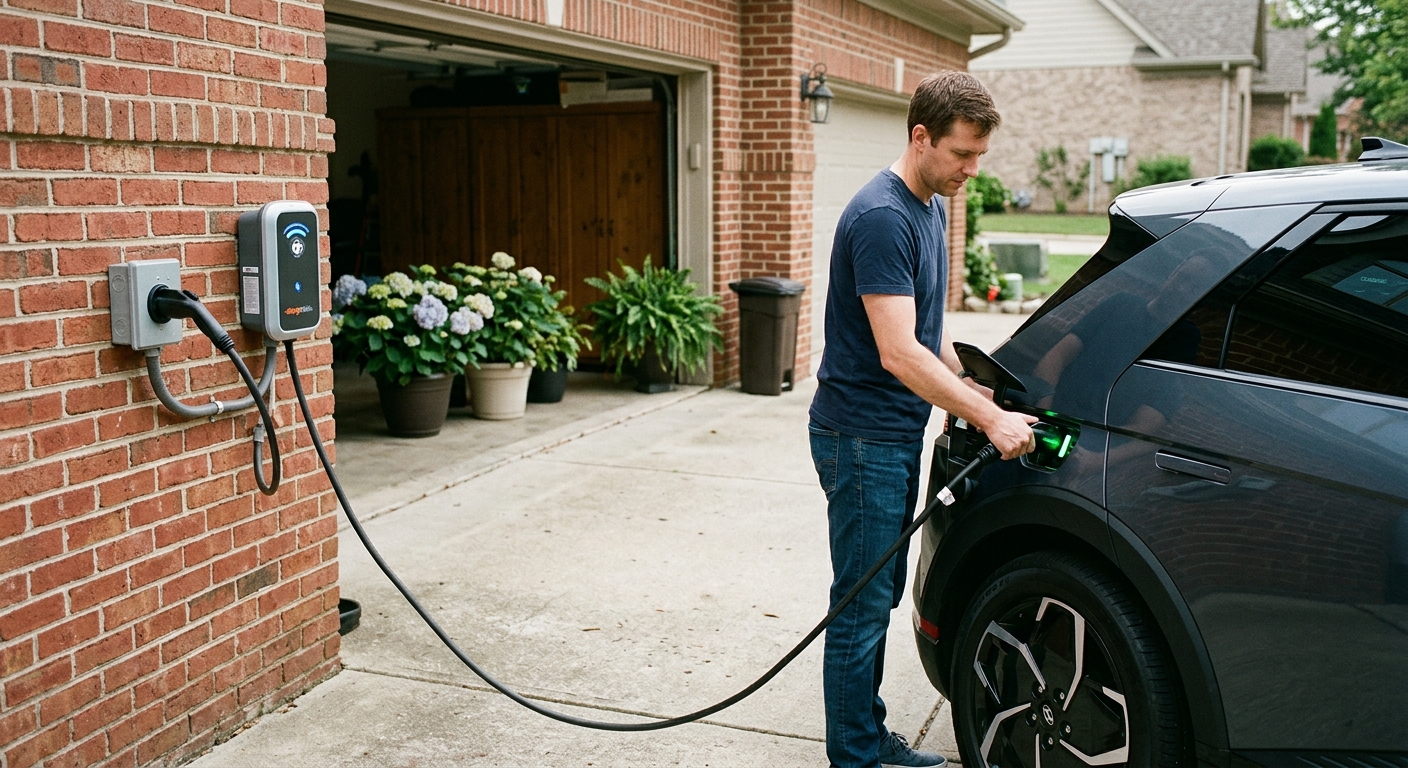
or electric vehicle (EV) drivers seeking significantly faster charging speeds than a standard 120-volt household wall outlet (Level 1) can provide, utilizing a 240-volt electrical outlet is the most practical home charging solution.
The short answer is yes, you can plug your electric vehicle directly into a 240V outlet, provided you use proper Level 2 charging equipment (such as a portable or wall-mounted dual-voltage charging cable) and a compatible, heavy-duty industrial receptacle.
Plugging an EV into a 240V socket upgrades your home charging capacity from 3 to 5 miles of range per hour up to 25 to 30+ miles of range per hour, allowing almost any electric vehicle to achieve a full battery recharge overnight.
For comprehensive hardware reviews, plug adapter guides, and home setup resources, visit EV Charger Advisor.
Common Types of 240V Outlets Used for EV Charging
In residential properties, 240V outlets differ by prong configuration, amperage rating, and historical household application. The three most common 240V receptacles used for EV charging include:
1. NEMA 14-50 (50-Amp Circuit – Most Common)
-
Configuration: 4-prong receptacle (Two hot wires, one neutral, one ground).
-
Application: Commonly found in modern garages, RV parks, and electric oven installations.
-
Charging Capacity: Supports continuous charging at 40 Amps ($9.6\text{ kW}$ output) under National Electrical Code (NEC) continuous load safety rules.
2. NEMA 14-30 / NEMA 10-30 (30-Amp Circuit – Electric Clothes Dryer Outlets)
-
Configuration: 4-prong (14-30) or older 3-prong (10-30) receptacle.
-
Application: Standard residential electric clothes dryer sockets.
-
Charging Capacity: Supports continuous charging at 24 Amps ($5.7\text{ kW}$ output).
3. NEMA 6-20 (20-Amp Circuit – Low-Power 240V)
-
Configuration: 3-prong horizontal blade receptacle.
-
Application: Commercial power tools and room air conditioners.
-
Charging Capacity: Supports continuous charging at 16 Amps ($3.8\text{ kW}$ output).
To learn more about connector standards and plug variations, explore our detailed guide on EV charging types.
Step-by-Step Mathematical Example: Charging Time on a 240V Outlet
To see how plugging into a 240V socket dramatically accelerates charging performance compared to a 120V wall outlet, let us calculate the charge time for a vehicle requiring 60 kWh of energy (e.g., charging a 75 kWh battery pack from $10\%$ to $90\%$).
Given Parameters:
-
Energy Needed: $60 \text{ kWh}$
-
Level 1 Wall Outlet (120V @ 12A): $1.44 \text{ kW}$ gross power
-
Level 2 NEMA 14-50 Outlet (240V @ 40A continuous): $9.60 \text{ kW}$ gross power
-
Charging System Efficiency: $90\%$ ($0.90$)
Calculation 1: Charging Duration on Standard 120V Household Outlet
Calculation 2: Charging Duration on 240V NEMA 14-50 Outlet
Result Breakdown: Upgrading from a standard 120V plug to a 240V NEMA 14-50 outlet slashes total charge time from over 46 hours down to under 7 hours, easily fitting into a standard overnight park.
Critical Safety Rules When Plugging an EV into a 240V Outlet
Because electric vehicle charging draws steady maximum amperage for hours at a time, plugging directly into a 240V socket requires strict adherence to electrical safety guidelines:
1. Use an Industrial-Grade Receptacle (Not Cheap Builder Grade)
Standard cheap residential 240V outlets ($10 – $15 hardware store sockets) are designed for plug-in appliances like dryers that are rarely unplugged and draw intermittent loads. EV charging causes thermal expansion and contraction that can melt cheap outlets. Always install an industrial-grade NEMA 14-50 outlet (such as Bryant or Hubbell) designed for heavy continuous thermal cycles.
2. Obey the NEC 80% Continuous Load Rule
Never draw 100% of a circuit breaker’s rated capacity continuous load. A 50-Amp circuit breaker supports a maximum continuous EV draw of 40 Amps, while a 30-Amp dryer circuit supports a maximum continuous EV draw of 24 Amps.
3. GFCI Breaker Requirements
Under modern National Electrical Code (NEC Article 625) standards, 240V receptacles installed in garages or outdoor locations for EV charging must be protected by a dedicated GFCI (Ground Fault Circuit Interrupter) circuit breaker.
To explore Wi-Fi-enabled smart chargers that support continuous power adjustments, read our guide on smart chargers.
Comparison Table: 240V Outlet Charging Performance
| Outlet Type | Circuit Breaker Size | Continuous Amps | Output Power @ 240V | Added Miles per Hour |
| NEMA 6-20 | $20 \text{ Amps}$ | $16 \text{ Amps}$ | $3.8 \text{ kW}$ | $12 – 15 \text{ Miles/hr}$ |
| NEMA 14-30 / 10-30 | $30 \text{ Amps}$ | $24 \text{ Amps}$ | $5.7 \text{ kW}$ | $18 – 22 \text{ Miles/hr}$ |
| NEMA 14-50 | $50 \text{ Amps}$ | $40 \text{ Amps}$ | $9.6 \text{ kW}$ | $28 – 35 \text{ Miles/hr}$ |
| Hardwired Unit | $60 \text{ Amps}$ | $48 \text{ Amps}$ | $11.5 \text{ kW}$ | $37 – 45 \text{ Miles/hr}$ |
Summary & Key Takeaways
-
Massive Speed Upgrade: Plugging into a 240V outlet provides 15 to 35+ miles of range per hour, compared to just 3 to 5 miles on a 120V outlet.
-
NEMA 14-50 Is Standard: The NEMA 14-50 4-prong receptacle on a 50A breaker is the most versatile 240V outlet for portable and plug-in EV wallboxes.
-
Industrial Hardware Required: Always use high-grade industrial receptacles to prevent plug melting and electrical fire risks.
-
Hardwiring Is Still Superior: If you are installing a new circuit from scratch, direct hardwiring eliminates plug receptacle heating risks and supports faster $48\text{A}$ ($11.5\text{ kW}$) charging speeds on a 60A breaker.













Leave a Reply