
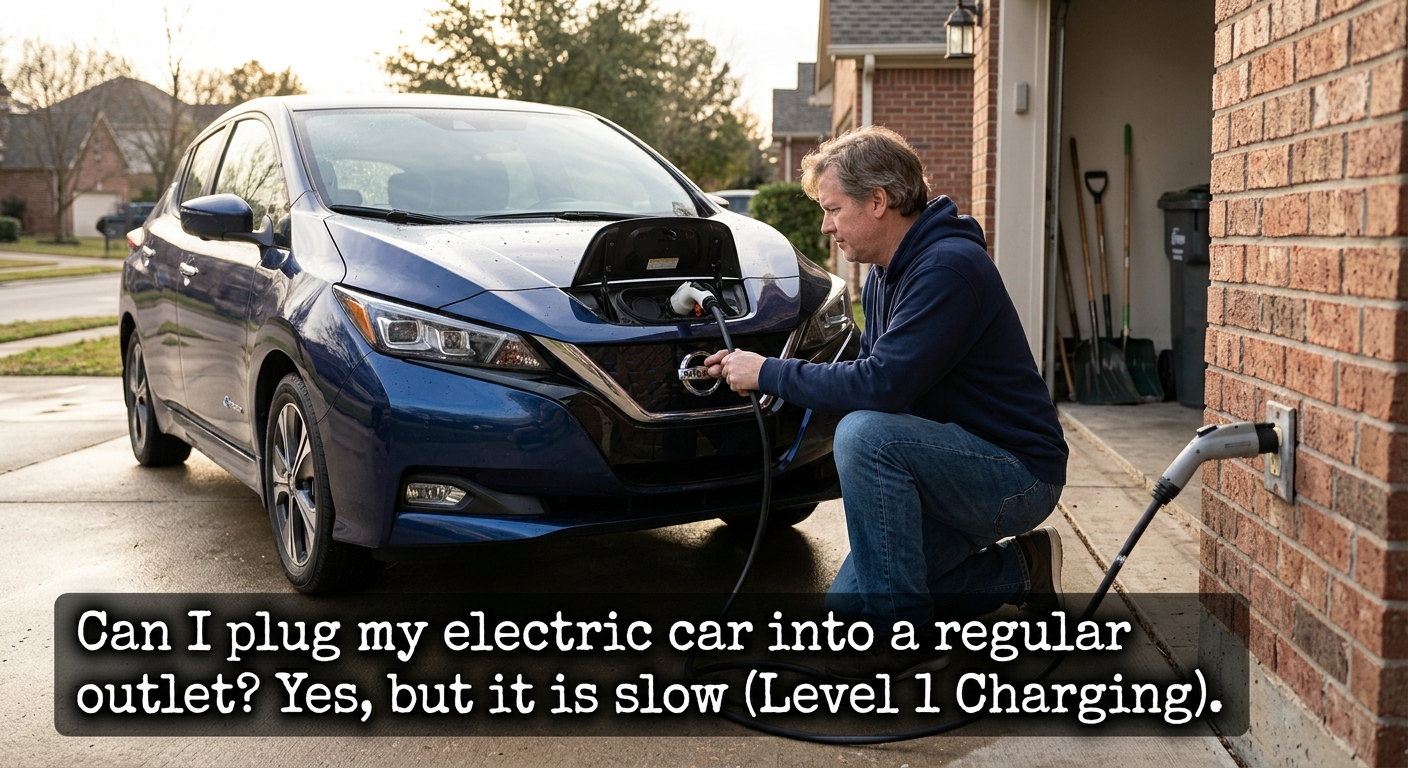
When bringing home a new electric vehicle (EV), understanding your daily charging options is a top priority for smooth ownership. While public charging plazas and Level 2 wallboxes offer rapid speeds, new EV owners frequently ask: Can I plug my electric car into a regular outlet?
The short answer is: yes, you can plug an electric car into a regular household outlet using a Level 1 (or Mode 2) portable charging cable, which is often included with the vehicle.
Known as Level 1 charging, connecting your car to a standard $120\text{-volt}$ three-prong wall socket is the simplest way to power an EV without making immediate electrical modifications. However, operating on a low $120\text{V}$ power envelope comes with specific speed limitations, safety precautions, and continuous electrical load considerations.
For comprehensive hardware reviews, load calculators, and installer guides, visit EV Charger Advisor.
1. How Level 1 Charging Works
When you plug your vehicle into a standard $120\text{V}$ NEMA 5-15 wall socket, you are using the portable dual-voltage cordset (or mobile connector) supplied by the vehicle manufacturer.
The Role of the Mobile Connector
The portable charging cord acts as a safety unit between your home’s $120\text{V}$ outlet and the vehicle. It communicates with the car’s internal onboard AC-to-DC converter to verify ground connection and limit power draw before energizing the cable.
Standard Electrical Metrics for Level 1 Outlets:
-
Line Supply Voltage: $120 \text{ Volts AC Single-Phase}$
-
Circuit Breaker Sizing: $15 \text{ Amps}$ or $20 \text{ Amps}$ Standard Branch Circuit
-
Continuous Amperage Draw (80% Rule): 12 Amps ($1.44\text{ kW}$ output) or 16 Amps ($1.92\text{ kW}$ output)
-
Range Recovery Rate: 3 to 5 miles of range per hour.
To learn more about how charger power levels and wire sizes compare, check out our guide on EV charging types.
Step-by-Step Mathematical Example: Level 1 Power Delivery & Charge Time
Let us perform a continuous load calculation to measure the exact power output, daily energy replenishment, and full battery recharge duration when plugging an EV into a 120V / 15A regular outlet drawing 12 Amps continuously.
Given Parameters:
-
Line Voltage: $120 \text{ Volts}$
-
Continuous Current Draw (NEC 80% Rule on 15A Circuit): $12 \text{ Amps}$
-
Battery Pack Capacity: $60 \text{ kWh}$
-
Onboard AC-to-DC Conversion Efficiency: $88\%$ ($0.88$)
Calculation 1: Continuous Power Delivery Output
Calculation 2: Overnight Energy Replenishment (12-Hour Charge)
Calculation 3: Added Driving Range (12-Hour Charge)
Assuming an average electric efficiency rating of 3.3 miles per kWh:
Calculation 4: Total Charge Time from 0% to 100% (60 kWh Battery)
Result Breakdown: Plugging into a regular outlet restores approximately 50 miles of range during a 12-hour overnight plug-in session. However, fully recharging an empty $60\text{ kWh}$ battery pack requires over 47 hours.
To explore Wi-Fi-enabled smart wallboxes that speed up charging times, read our guide on smart chargers.
2. Key Safety Precautions for 120V Home Charging
While plugging into a regular socket requires no initial setup cost, you should observe three crucial electrical safety rules:
A. Dedicated Branch Circuit Required
Because an EV draws 12 Amps continuously for hours, the wall socket should be on a dedicated circuit. Operating appliances like space heaters, vacuums, or power tools on the same circuit will trip the breaker.
B. Avoid Thin Household Extension Cords
Never use standard 16-gauge or 14-gauge household extension cords with an EV charger. Thin extension cords cause heavy voltage drops, severe $I^2R$ resistance heating, and fire hazards. If an extension cord is unavoidable, use a heavy-duty 10-gauge (10 AWG) outdoor-rated cord rated for 15+ Amps continuous.
C. Inspect Socket Condition
Older, loose $120\text{V}$ wall sockets with worn internal spring contacts can create high terminal resistance, leading to melted plugs. Ensure your wall receptacle is firm and in good condition.
Comparison Table: Regular 120V Outlet (Level 1) vs. Dedicated 240V Setup (Level 2)
| Feature | Regular 120V Outlet (Level 1) | Dedicated 240V Circuit (Level 2) |
| Voltage / Amperage | $120\text{V}$ / $12\text{A}$ Continuous | 240V / 32A – 48A Continuous |
| Power Output (kW) | $1.44 \text{ kW}$ | $7.68 \text{ kW} – 11.52 \text{ kW}$ |
| Added Range per Hour | $3 – 5 \text{ miles/hr}$ | $20 – 44 \text{ miles/hr}$ |
| Overnight Charge (12 hrs) | ~$40 – 50 Miles | Full Battery ($200 – 300+\text{ Miles}$) |
| Installation Cost | $0 (Uses existing outlet) | $800 – $2,500 Total |
Summary & Key Takeaways
-
Fully Capable: You can plug your electric car into a standard $120\text{V}$ household outlet using the included portable mobile connector.
-
Ideal for Low Daily Mileage: A regular outlet adds 3 to 5 miles of range per hour ($40 – 50\text{ miles overnight}$), making it ideal for drivers with short daily commutes.
-
Slow for Full Recharges: Fully recharging an empty long-range battery pack takes 40 to 48+ hours on a regular outlet.
-
Upgrade to Level 2 for Faster Speeds: Installing a dedicated $240\text{V}$ Level 2 circuit fully recharges any EV battery overnight in 6 to 8 hours.













Leave a Reply