
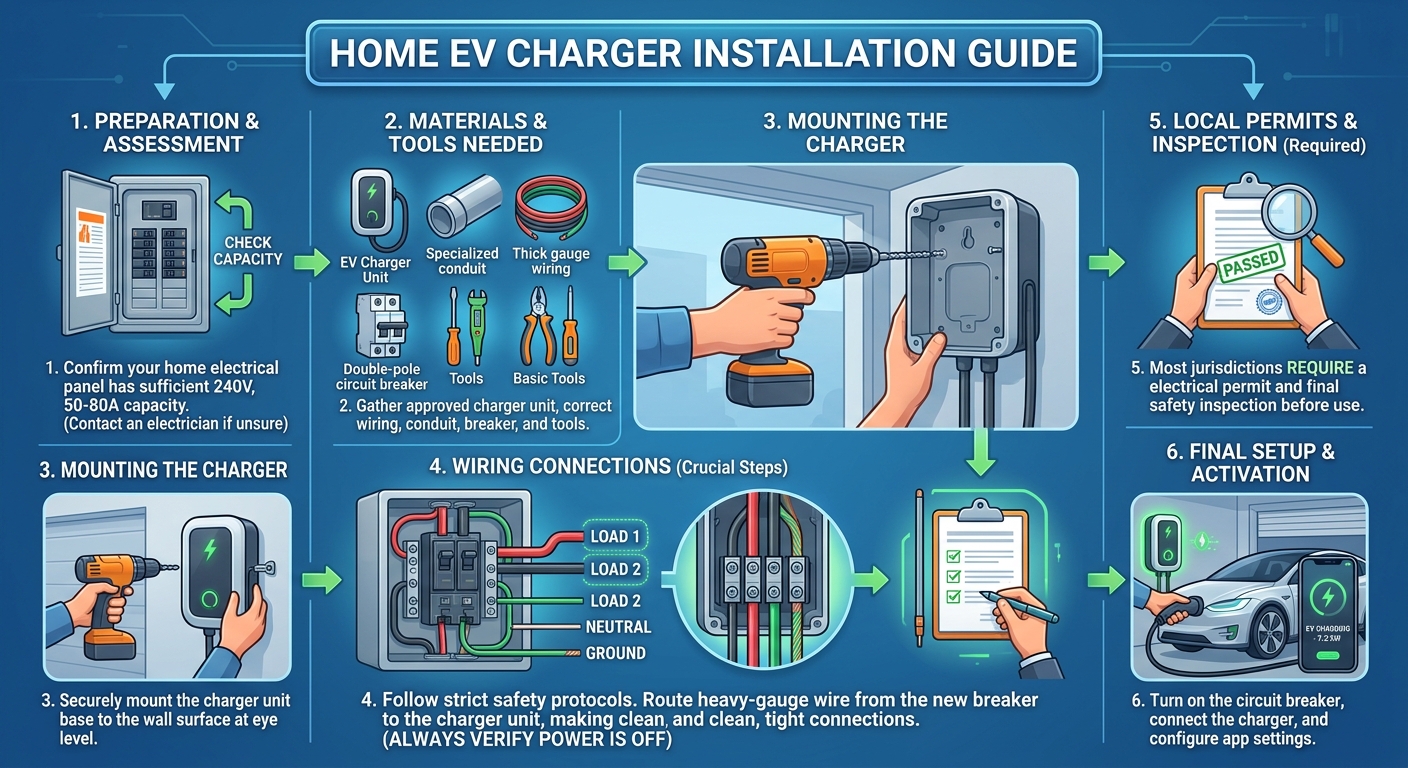
Setting up a Level 2 home EV charger is the most convenient way to keep your electric vehicle charged and ready for daily driving. Delivering 25 to 37 miles of range per hour, a 240-volt charging station replenishes your battery overnight. However, to save on electrician labor fees, many DIY-inclined homeowners wonder: Can I install my EV charger myself?
The short answer is: yes, you can physically mount a plug-in Level 1 or Level 2 EV charger yourself if it uses a standard, pre-existing 240-volt outlet. However, hardwiring a charger or installing a new high-voltage circuit yourself is strongly discouraged and often illegal without a master electrical license and municipal permit.
Understanding the line between simple DIY plug-and-play mounting and complex high-voltage electrical work protects your safety, property insurance coverage, and vehicle warranty.
For complete hardware guides, installer resources, and safety breakdowns, visit EV Charger Advisor.
What You Can DIY vs. What Requires a Licensed Electrician
To ensure safety and code compliance, EV home charger setup is divided into basic mounting tasks and licensed electrical work:
1. What You CAN Do Yourself (Safe DIY Tasks)
-
Unboxing & Wall Mounting: Drilling pilot holes, inserting wall anchors, and mounting the bracket for a plug-in Level 2 wallbox or cable holster on your garage wall.
-
Plugging into an Existing Outlets: Plugging a NEMA 14-50 plug-in Level 2 charger into a pre-existing, properly wired 240V industrial receptacle.
-
Smart App Configuration: Connecting the charger to your home Wi-Fi network, pairing it with your smartphone, setting up off-peak charging schedules, and managing charging access.
2. What Requires a Licensed Electrician (Do NOT DIY)
-
Installing a New 240V Circuit Breaker: Adding a dedicated 40-Amp to 60-Amp double-pole circuit breaker into a live, high-voltage main breaker panel.
-
Running Heavy Conductor Wiring: Pulling thick copper wire (#6 AWG or #4 AWG) through walls, attics, or conduit to supply power to the charger location.
-
Direct Hardwiring: Connecting live 240V line wires directly into the internal terminal blocks of a hardwired EV wallbox.
-
Service Panel Load Calculations & Upgrades: Calculating home ampacity under National Electrical Code (NEC Article 220) rules or upgrading a 100A panel to 200A.
To learn more about how charger power ratings and plug styles compare, check out our guide on EV charging types.
Step-by-Step Mathematical Example: Circuit Sizing & Thermal Risks
Why is high-voltage DIY electrical work so risky? Because electric vehicle charging is legally classified under NEC Article 625 as a continuous load (drawing full power for hours at a time).
Let us calculate the required breaker size and continuous thermal load for a 48-Amp hardwired Level 2 wallbox.
Given Parameters:
-
Charger Continuous Output: $48 \text{ Amps}$
-
Operating Line Voltage: $240 \text{ Volts}$
Calculation 1: Applying the NEC 125% Continuous Load Rule
Breakers and wire sizes must be oversized by 25% to prevent thermal degradation and nuisance tripping:
Calculation 2: Continuous Thermal Power Output
Calculation 3: Added Range Delivery
Assuming an average electric crossover efficiency of 3.3 miles per kWh:
Result Breakdown: Supplying 11,520 Watts continuously generates significant thermal heat inside electrical connections. Loose terminal screws or improper wire gauge choices during a DIY installation can easily lead to thermal melting or electrical fires.
4 Major Risks of DIY High-Voltage Installation
Attempting to perform electrical wiring or hardwiring without proper licensure carries severe real-world consequences:
1. Fire & Electrical Shock Hazards
A loose electrical connection on a 50A or 60A circuit under continuous load acts as an extreme resistance point, creating high temperatures that melt junction boxes and ignite insulation.
2. Voided Homeowner Insurance Coverage
If an unpermitted DIY electrical installation causes a structural fire, home insurance providers frequently reject total loss property claims after investigating building permit records.
3. Municipal Fines & Code Violations
Most local municipalities require building permits and official inspections for installing new 240V circuits. Unpermitted work can prevent home sales or result in city compliance fines.
4. Equipment & Vehicle Warranty Issues
Voltage spikes or improper grounding resulting from amateur wiring can damage your charger’s circuit boards or your electric vehicle’s onboard AC-to-DC converter charger, voiding manufacturer warranties.
To explore Wi-Fi-enabled smart chargers that support automated power adjustment, read our guide on smart chargers.
Comparison Table: DIY Setup vs. Licensed Professional Installation
| Scope of Work | DIY Execution | Professional Installation |
| Mounting Hardware on Wall | Allowed (Safe) | Included in Scope |
| Plugging into Existing NEMA 14-50 | Allowed (Safe) | Included in Scope |
| Installing New 240V Circuit & Breaker | Not Recommended / Illegal | Required & Certified |
| Hardwiring Terminal Connections | Not Recommended / Illegal | Required & Certified |
| City Permit & Pass Inspection | Rare for DIYers | Guaranteed & Handled |
| Safety & Insurance Risk | High Risk | Zero Risk (Insured Work) |
Summary & Key Takeaways
-
Plug-and-Play DIY Is Safe: You can safely mount a bracket and plug into a pre-existing 240V industrial outlet yourself.
-
Never DIY High-Voltage Wiring: Installing new breakers, running heavy copper wire, or hardwiring requires a licensed master electrician.
-
Respect the Continuous Load Rule: EV charging draws full power for hours, generating intense continuous thermal load that demands expert torque specs and wire gauge selection.
-
Protect Your Home Insurance: Always hire a professional who pulls city building permits to ensure full safety compliance and protect property insurance coverage.













Leave a Reply