
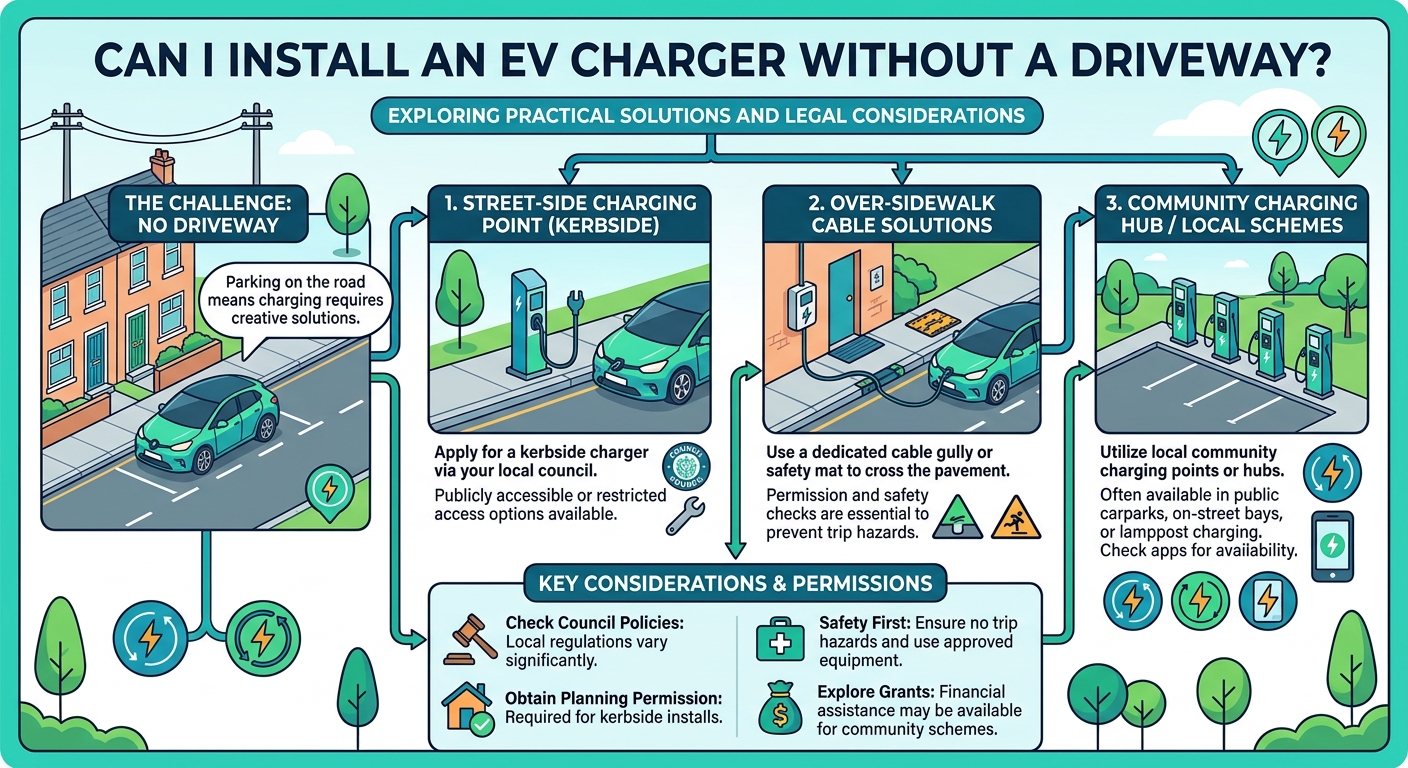
Switching to an electric vehicle (EV) is a fantastic way to cut fuel costs and reduce tailpipe emissions. Delivering 20 to 44 miles of driving range per hour over a high-voltage 240-volt circuit, setting up a home Level 2 wallbox transforms daily charging into an effortless overnight routine. However, for homeowners living in terraced housing, urban townhomes, or flats without off-street parking, a major hurdle emerges: Can I install an EV charger without a driveway?
The short answer is: yes, you can install an EV charger without a driveway, though it requires specific municipal permits, specialized cross-pavement cable hardware, or alternative community charging setups.
While trailing loose cables across public footpaths is illegal and presents serious trip liabilities under highways acts, emerging regulatory frameworks and cross-pavement gully technologies allow non-driveway households to access low-cost home electricity rates safely.
For complete hardware reviews, installer guides, and panel load calculators, visit EV Charger Advisor.
1. Four Practical Ways to Charge an EV Without a Private Driveway
If you do not own a private driveway, garage, or dedicated parking space, you can pursue four practical charging infrastructure pathways:
A. Cross-Pavement Cable Channels / Gullies (The Home Charger Solution)
Instead of running a hazardous loose wire across the sidewalk, installers cut a shallow, flush channel into the pavement. A heavy-duty, impact-resistant rubber or metal gully (such as Kerbo Charge or Gul-e) is set flush with the concrete. When charging, you place your cable securely inside the locking channel.
-
Permit Requirement: Requires approval and a street works license from your local council/highways authority.
B. Front Garden to Driveway Conversion (Dropped Kerbs)
If you have a front lawn or patio with enough depth, you can apply to pave it over using permeable materials and request a dropped kerb from your local highway authority. Converting front space into a legal off-street parking bay guarantees dedicated access to a wallbox.
C. Overhead Cable Arms & Retractors
Overhead charging arms attach to an exterior wall or front garden post. When in use, the arm extends high above the sidewalk (providing ample clearance for pedestrians and cyclists) and drops the connector down directly next to the curb, folding away flush against your house wall when finished.
D. Lamp Post & On-Street Community Chargers
Many municipal councils are actively retrofitting existing street lamp columns with 5.5 kW–7 kW chargers. While these are public units shared by neighbors, they offer convenient overnight street charging right outside your door without requiring private hardware.
To learn more about how charger power levels compare, check out our guide on EV charging types.
2. Regulatory Rules & Legal Liabilities
Charging an EV without a driveway involves public land, which introduces key legal constraints:
-
Strict Prohibition of Loose Cables: Trailing a cable across a public sidewalk—even with a rubber mat cover—violates Section 162 of the Highways Act and local bylaws. Homeowners face substantial legal liability if a pedestrian trips over a loose wire.
-
No Designated Parking Space Guarantees: Installing a wallbox on your exterior house wall or fitting a pavement gully does not reserve or guarantee the street parking space in front of your home. If a neighbor or gas car parks at your curb, you cannot pull your cable to reach it.
-
Permitted Development Reforms: Many jurisdictions are removing full planning permission burdens for cross-pavement gullies, streamlining council approvals into simple highway utility licenses.
To explore smart wallboxes engineered with app-locking features for outdoor street use, read our guide on smart chargers.
Step-by-Step Mathematical Example: Home Gullies vs. Public Fast Charging Economics
Let us perform a formal financial comparison calculating the annual savings and payback time of installing a $1,400 (£1,100) cross-pavement gully system versus relying exclusively on public DC fast chargers for 12,000 miles of annual driving.
Given Parameters:
-
Annual Commute: $12,000 \text{ Miles}$
-
EV Driving Efficiency: $3.3 \text{ Miles per kWh}$ ($0.303 \text{ kWh/mile}$)
-
Public Rapid Fast Charging Cost: $\$0.75 \text{ per kWh}$
-
Off-Peak Overnight Home Tariff: $\$0.12 \text{ per kWh}$
-
Turnkey Gully & Wallbox Installation Cost: $\$1,400$
Calculation 1: Total Annual kWh Required
Calculation 2: Annual Fueling Costs
Calculation 3: Equipment Payback Period
Result Breakdown: Even with the extra permit and gully installation costs, taking advantage of home off-peak electricity tariffs yields $2,290 in annual fuel savings, fully recovering installation expenses in under 8 months.
Comparison Table: Charging Options for Non-Driveway EV Owners
| Charging Strategy | Typical Setup Cost | Permit / Council Approval Required? | Charging Speed |
| Pavement Gully / Channel | $1,200 – $2,000 | Yes (Highways License Required) | $7.4 \text{ kW}$ (Overnight) |
| Front Garden Conversion | $3,500 – $8,000+ | Yes (Dropped Kerb Application) | $7.4 \text{ kW} – 11 \text{ kW}$ |
| Lamp Post Charging | $0 (Publicly owned) | No (Uses municipal infrastructure) | $3.5 \text{ kW} – 7 \text{ kW}$ |
| Overhead Charging Arm | $1,500 – $2,500 | Yes (Airspace / Sidewalk Approval) | $7.4 \text{ kW}$ (Overnight) |
Summary & Key Takeaways
-
Yes, It Is Possible: You can charge an EV at home without a driveway by installing approved cross-pavement gullies, overhead arms, or converting front garden space.
-
Never Trail Loose Wires: Running loose extension cords over public sidewalks creates dangerous trip hazards and violates highways legislation.
-
Check Council Permits: Always obtain local council approval or highway authority permits before modifying pavements or installing street-facing hardware.
-
Massive Cost Savings: Taking advantage of home electricity rates via a pavement gully pays back installation expenses within 8 months compared to public fast charging.













Leave a Reply