
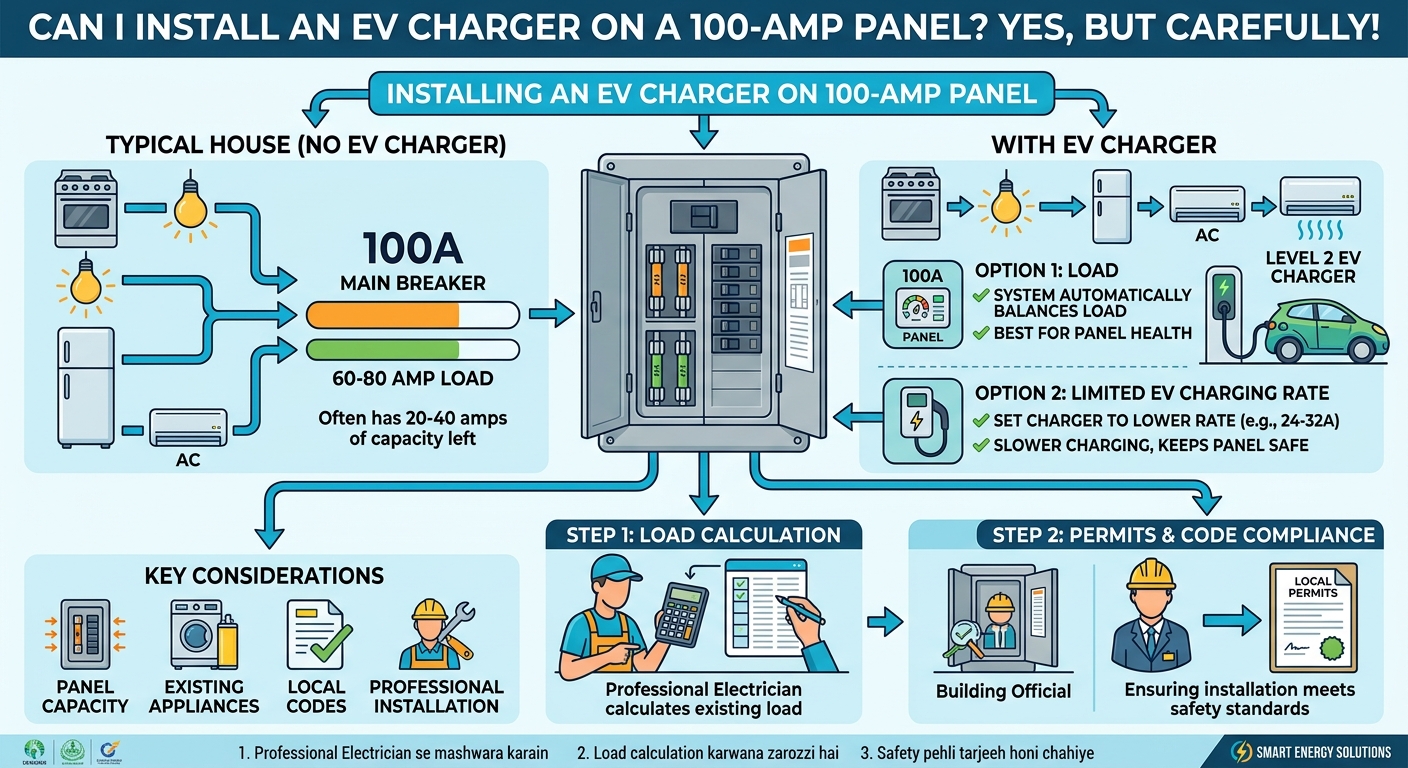
Upgrading your home charging infrastructure for an electric vehicle is one of the best ways to ensure convenient, rapid battery replenishment every morning. Operating on a 240-volt single-phase branch circuit, a Level 2 wallbox adds 20 to 44 miles of range per hour compared to standard 120V trickle charging. However, millions of homeowners reside in properties supplied by a 100-amp main electrical panel.
If you are evaluating your electrical system, you might ask: Can I install an EV charger on a 100-amp panel?
The short answer is: yes, you can install an EV charger on a 100-amp panel, but it depends on your home’s total electrical load.
Under National Electrical Code (NEC) rules, adding a heavy continuous load to a 100-amp service requires performing a formal load calculation to ensure existing household appliances do not overload the main service feeders or trip the primary disconnect breaker.
For complete panel load calculators, wiring charts, and hardware reviews, visit EV Charger Advisor.
1. Evaluating Your Home’s Total Electrical Load (NEC Article 220)
Before mounting a Level 2 wallbox or running copper conductors to a 100-amp panel, a licensed electrician must perform an electrical load calculation under NEC Article 220.
A standard 100-amp panel provides a total maximum capacity of 24,000 Watts ($24\text{ kW}$) at 240 Volts ($100\text{A} \times 240\text{V} = 24,000\text{W}$). Under standard electrical codes, continuous operating loads must not exceed 80% of total panel capacity, leaving a continuous limit of 19,200 Watts ($80\text{ Amps}$).
Appliance Fuel Profile: Gas vs. All-Electric Homes
-
Gas-Appliance Homes: Properties that use natural gas for central space heating, water heating, and cooking typically draw a baseline demand of only 5,000W to 8,000W ($21\text{A} – 33\text{A}$). These panels easily accommodate a 30A or 40A circuit breaker ($24\text{A} – 32\text{A}$ continuous charging) without hardware modifications.
-
All-Electric Homes: Properties relying on electric heat pumps, central AC, electric clothes dryers, ranges, and water heaters often have a baseline load exceeding 15,000W ($62.5\text{A}$). Adding an unmanaged Level 2 charger can breach the $80\text{A}$ continuous safety limit, causing main breaker trips during peak usage.
To learn more about how charger power levels and wire sizes compare, check out our guide on EV charging types.
Step-by-Step Mathematical Example: Load Calculation & Margin Analysis
Let us calculate the available continuous capacity, safe charger amperage output, and driving range recovery for a 100A panel on a home with a $10,800\text{-Watt}$ ($45\text{-Amp}$) baseline electrical load.
Given Parameters:
-
Main Panel Service Rating: $100 \text{ Amps @ 240V} = 24,000 \text{ Watts}$
-
Max Continuous Safety Capacity (80% Rule): $80 \text{ Amps} = 19,200 \text{ Watts}$
-
Baseline Household Demand: $10,800 \text{ Watts} = 45 \text{ Amps}$
Calculation 1: Calculating Remaining Continuous Panel Margin
Calculation 2: Calculating Maximum Safe Continuous Charger Amperage
Calculation 3: Selecting Breaker Sizing & Continuous Output (NEC 125% Rule)
Under NEC Article 625, EV charging continuous load requires sizing the breaker for 125% of the charger’s draw. Standard breaker steps dictate choosing a 32-Amp continuous charger on a 40-Amp double-pole breaker:
Result Breakdown: Operating a 32A continuous charger ($7.68\text{ kW}$) on a 40A breaker keeps total panel demand at $77\text{ Amps}$, safely under the 100A panel’s $80\text{A}$ continuous limit while restoring 22 to 28 miles of driving range per hour.
To explore Wi-Fi-enabled smart wallboxes that support adjustable output settings, read our guide on smart chargers.
3 Ways to Install an EV Charger on a Load-Constrained 100A Panel
If your panel load calculation shows limited electrical headroom, you can implement three code-compliant solutions to avoid spending $3,000 to $6,000 on a service upgrade:
1. Wallbox Amperage De-Rating (DIP Switches / Software)
Most modern Level 2 chargers allow installers to adjust maximum output current via internal DIP switches or commissioning software. Setting your wallbox to 16 Amps ($3.84\text{ kW}$ on a 20A breaker) or 24 Amps ($5.76\text{ kW}$ on a 30A breaker) provides reliable overnight charging while protecting your 100A main service.
2. Smart EVEMS Load Management (Load Shedding)
An Electric Vehicle Energy Management System (EVEMS) uses current transformer (CT) sensors on your main service lines to track live household power draw. If central AC, cooking, or laundry causes total panel usage to approach capacity, the EVEMS dynamically throttles or pauses EV charging until household demand drops.
3. Automatic Circuit Sharing (Smart Splitters)
Smart splitter switches let your EV charger share an existing 240V circuit (such as a NEMA 14-30 or 10-30 electric dryer socket). The switch automatically cuts power to the EV charger whenever the dryer operates, resuming charging once the laundry cycle finishes.
Comparison Table: Level 2 Charging Configurations for 100A Panels
| Charger Setting | Circuit Breaker | Continuous Load (80%) | Power Output @ 240V | Added Range per Hour | Panel Upgrade Required? |
| Low Amperage (16A) | 20-Amp Breaker | $16 \text{ Amps}$ | $3.84 \text{ kW}$ | $12 – 15 \text{ miles/hr}$ | No |
| Medium Amperage (24A) | 30-Amp Breaker | $24 \text{ Amps}$ | $5.76 \text{ kW}$ | $18 – 22 \text{ miles/hr}$ | No |
| Standard Amperage (32A) | 40-Amp Breaker | 32 Amps | 7.68 kW | 22 – 28 miles/hr | No (If Gas Home) |
| Dynamic EVEMS Load Management | 50-Amp Breaker | Dynamic ($0\text{A} – 40\text{A}$) | Up to $9.60 \text{ kW}$ | Up to $34 \text{ miles/hr}$ | No |
| Full Speed Hardwired (48A) | 60-Amp Breaker | $48 \text{ Amps}$ | $11.52 \text{ kW}$ | $36 – 44 \text{ miles/hr}$ | Yes (Upgrade to 200A) |
Summary & Key Takeaways
-
Depends on Total Load: You can install an EV charger on a 100-amp panel, but existing household appliance demand determines available continuous capacity.
-
Perform an NEC Article 220 Load Calculation: Always evaluate total panel demand before choosing breaker and charger sizes.
-
De-Rating Avoids Panel Upgrades: Setting your Level 2 wallbox to 16A or 24A continuous output fits within tight 100A panel limits while fully recharging your vehicle overnight.
-
EVEMS Unlocks Higher Speeds: Installing a smart energy management system dynamically balances charging output with home power draw, eliminating the need for costly 200A service upgrades.













Leave a Reply