
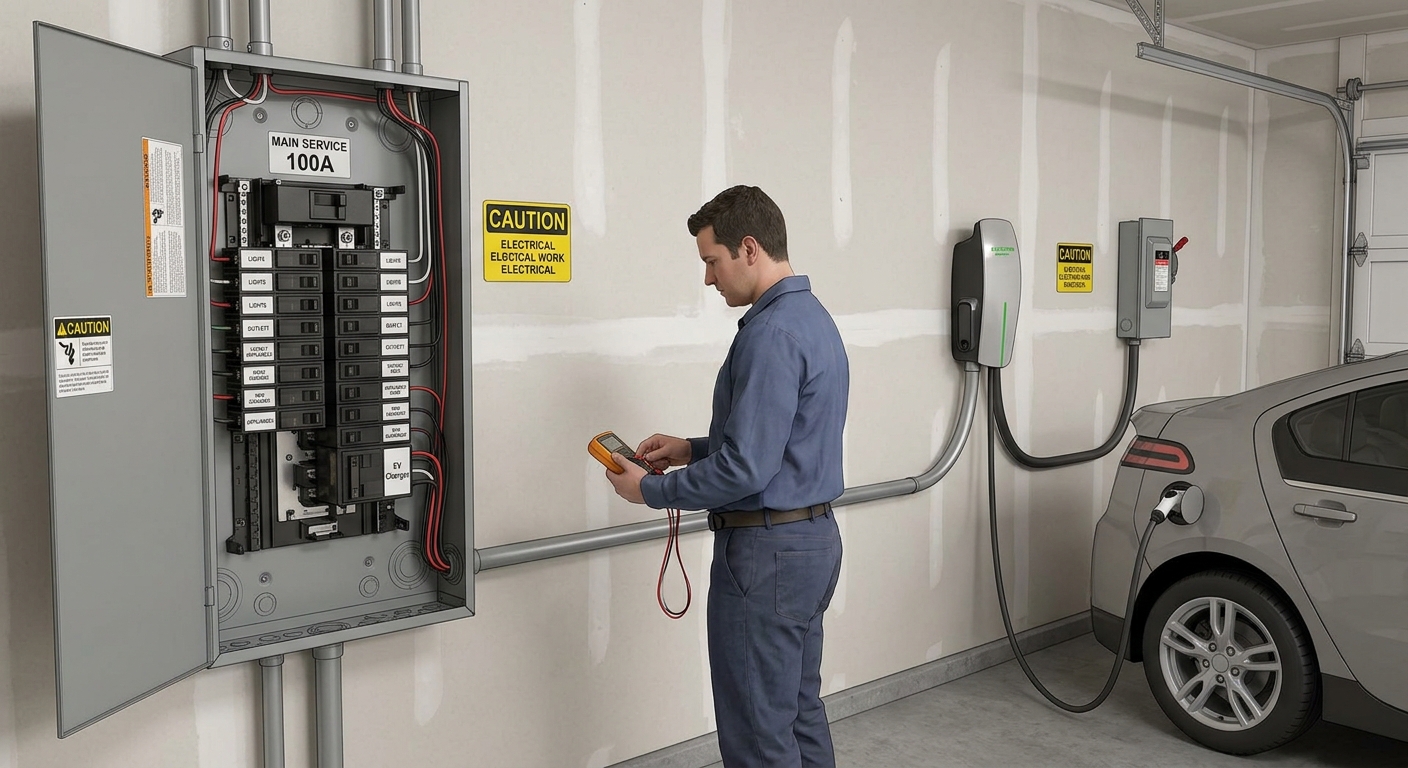
Upgrading your home to support a Level 2 electric vehicle (EV) charger is the best way to ensure rapid, full-overnight battery replenishment. Operating on a 240-volt dedicated circuit, a Level 2 wallbox adds 25 to 37 miles of range per hour compared to standard trickle chargers. However, many established residential homes and urban townhouses operate on a 100-amp electrical panel.
Because adding a high-amperage continuous load introduces significant electrical demand, homeowners frequently ask: Can I install an EV charger on a 100-amp electrical panel?
The short answer is yes, you can install a Level 2 EV charger on a 100-amp electrical panel, provided a licensed electrician performs a proper load calculation to verify that your home’s total electrical demand does not exceed safety limits.
If your home relies heavily on gas appliances, a standard Level 2 charger can often be added directly. If your home is fully electric, modern smart load-management devices and adjustable wallbox amperage settings allow you to charge safely without spending thousands of dollars on an immediate panel upgrade.
For complete load calculators, hardware reviews, and installation breakdowns, visit EV Charger Advisor.
How Electrical Load Calculations Work (NEC Article 220)
Before adding a dedicated 20-Amp to 60-Amp circuit breaker for an EV charger, a licensed electrician must conduct a formal load calculation under National Electrical Code (NEC Article 220) rules.
A 100-amp main panel supplies a total maximum capacity of 24,000 Watts ($24\text{ kW}$) at 240 Volts ($100\text{A} \times 240\text{V} = 24,000\text{W}$). Under standard electrical safety codes, continuous loads must not exceed 80% of total panel capacity, leaving a maximum continuous operating limit of 19,200 Watts ($80\text{ Amps}$).
Comparing Household Fuel Profiles on a 100A Panel:
-
Gas-Heated Homes: Properties utilizing natural gas for space heating, water heating, and cooking typically have baseline electrical demands between 5,000W and 8,000W ($21\text{A} – 33\text{A}$). These panels easily support a 40A breaker ($32\text{A} / 7.68\text{ kW}$ continuous charging).
-
All-Electric Homes: Properties relying on electric heat pumps, electric water heaters, electric clothes dryers, and electric ranges often have baseline demand exceeding 16,000W ($66\text{A}$). Adding an unmanaged high-amperage EV circuit will exceed the 80A limit, leading to main breaker trips.
To learn more about how charger power levels compare, check out our guide on EV charging types.
Step-by-Step Mathematical Example: Sizing an EV Charger for a 100A Panel
Let us calculate the available continuous charger capacity for a 100A panel operating with an existing baseline household load of 12,000 Watts ($50\text{ Amps}$).
Given Parameters:
-
Main Panel Rating: $100 \text{ Amps @ 240V} = 24,000 \text{ Watts}$
-
Max Continuous Safety Limit (80% Rule): $80 \text{ Amps} = 19,200 \text{ Watts}$
-
Baseline House Demand: $12,000 \text{ Watts} = 50 \text{ Amps}$
Calculation 1: Calculating Available Continuous Margin
Calculation 2: Calculating Maximum Safe Continuous Amperage
Calculation 3: Determining Required Circuit Breaker Size (125% Continuous Rule)
Under NEC Article 625, EV charging branch circuits must be sized to 125% of the continuous draw:
Result Breakdown: Configured to a 24-Amp continuous draw on a 30-Amp double-pole breaker, the charger safely delivers $5.76\text{ kW}$ of power—adding 18 to 22 miles of range per hour without overloading the 100A main panel.
3 Solutions for Installing an EV Charger on a 100A Panel
If your panel load calculation reveals tight capacity margins, you can choose from three proven installation pathways:
1. Software De-Rating / Adjustable Amperage Settings
Most modern smart Level 2 wallboxes allow installers to adjust internal DIP switches or software parameters during commissioning. Setting your wallbox to 16 Amps ($3.84\text{ kW}$ on a 20A breaker) or 24 Amps ($5.76\text{ kW}$ on a 30A breaker) fits comfortably into tight panels while delivering full overnight range recovery.
2. Install an EV Energy Management System (EVEMS)
An EVEMS or smart load balancer uses current transformer (CT) clamps to monitor total panel current in real time. If household power draw surges when major appliances turn on, the EVEMS automatically throttles or pauses EV charging, resuming full-speed charging late at night when household demand drops.
3. Complete Service Upgrade to 200 Amps
If you plan to add additional high-draw appliances (such as a heat pump or a second EV), upgrading your main panel to 200 Amps provides complete headroom for an uninhibited 48-Amp ($11.5\text{ kW}$) Level 2 charger.
To explore Wi-Fi-enabled smart chargers that support dynamic load management, read our guide on smart chargers.
Comparison Table: Level 2 Charging Options on a 100A Main Panel
| Option | Circuit Breaker | Max Continuous Draw | Added Range per Hour | Panel Upgrade Required? |
| Low-Amperage Set | 20-Amp Breaker | $16 \text{ Amps} / 3.8 \text{ kW}$ | $12 – 15 \text{ miles/hr}$ | No |
| Standard Set | 30-Amp Breaker | $24 \text{ Amps} / 5.8 \text{ kW}$ | $18 – 22 \text{ miles/hr}$ | No |
| Smart EVEMS Load Shedder | 40A / 50A Breaker | Dynamic ($0\text{A} – 40\text{A}$) | Up to $34 \text{ miles/hr}$ | No |
| Service Upgrade to 200A | 60-Amp Breaker | 48 Amps / 11.5 kW | 36 – 44 miles/hr | Yes ($3,000 – $6,000) |
Summary & Key Takeaways
-
Permissible by Code: A 100-amp electrical panel can handle a Level 2 EV charger if an NEC Article 220 load calculation shows sufficient margin.
-
24A Output Is Ideal: Setting a wallbox to 24 Amps continuous on a 30A breaker provides excellent overnight range ($18 – 22\text{ miles/hr}$) while protecting panel capacity.
-
Smart Load Management Saves Money: EVEMS devices dynamically adjust charging speeds, eliminating the need for expensive utility panel upgrades.
-
Gas vs. Electric Matters: Homes with gas heating and water heaters have significantly more panel space for EV charging than fully electric homes.













Leave a Reply