
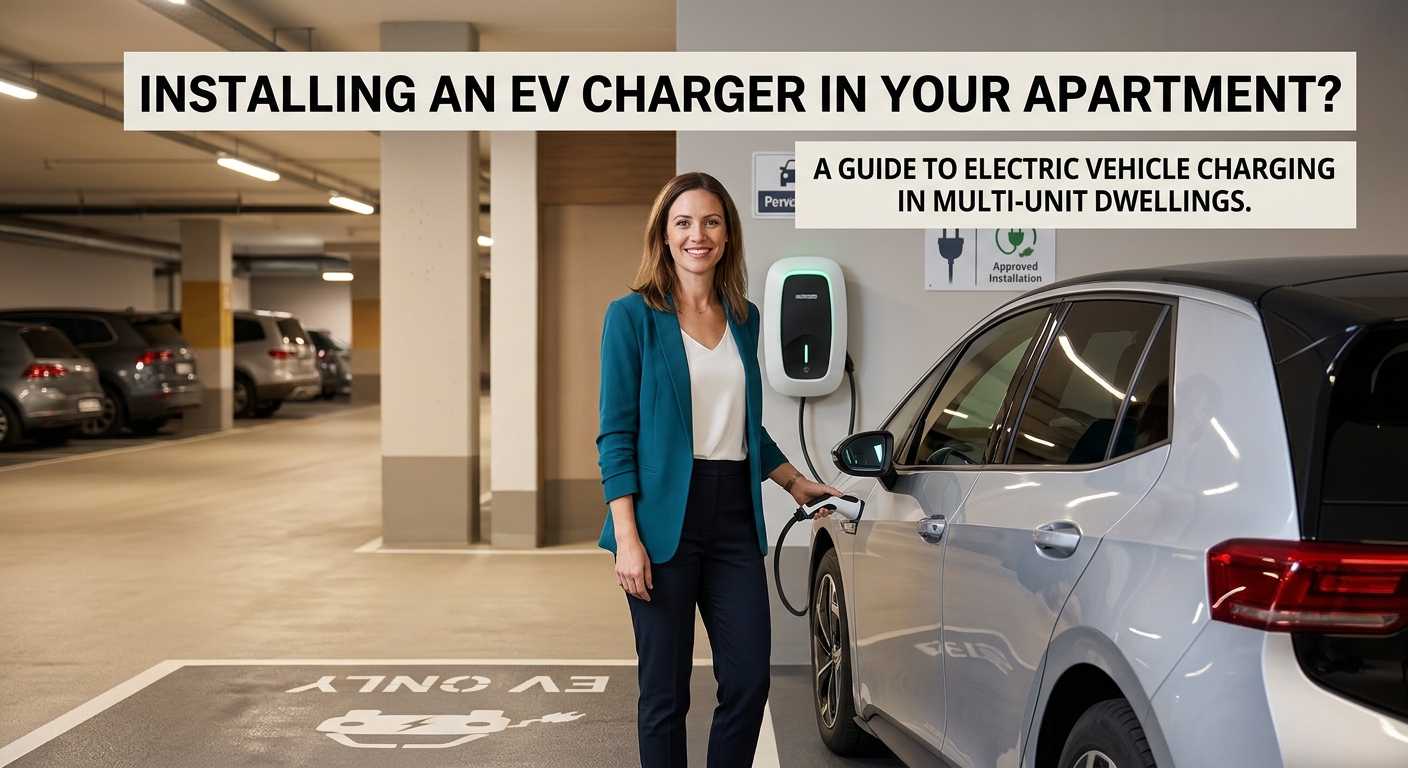
Switching to an electric vehicle (EV) is one of the most effective ways to reduce daily commute costs and eliminate tailpipe emissions. Delivering 20 to 44 miles of driving range per hour over a high-voltage 240-volt branch circuit, setting up a home Level 2 wallbox transforms daily battery replenishment into an effortless overnight routine. However, for millions of residents living in multi-family residential complexes, apartment blocks, or condominiums with shared garage facilities, a critical question arises: Can I install an EV charger in an apartment?
The short answer is: yes, you can install an EV charger in an apartment, but it requires written permission from your building management or owners’ association (HOA/RWA), a certified electrical load assessment, and a dedicated or sub-metered power connection.
Navigating shared electrical infrastructure, multi-family building codes, and metering allocation requires a structured approach to ensure compliance with the National Electrical Code (NEC Article 625) or local distribution utility standards.
For complete hardware reviews, installer guides, and panel load calculators, visit EV Charger Advisor.
1. The Step-by-Step Approval & Installation Roadmap
Installing charging infrastructure in a multi-family building involves navigating shared property boundaries and community utility boards. Follow these five key steps:
A. Submit a Formal Written Request to Building Management / HOA
Before buying hardware or hiring an electrician, submit a formal proposal to your building management or homeowners’ association. Include charger technical datasheets, safety certifications (e.g., UL, IEC 61851), your assigned parking spot details, and the licensed contractor’s credentials.
B. Perform an Electrical Panel Load Assessment
A licensed electrician must conduct a building load assessment to determine if the central service panel or floor distribution sub-panel has sufficient spare thermal margin to support an additional 32A to 48A continuous draw.
C. Select the Metering & Billing Architecture
Building management must verify how electricity consumption will be measured and billed:
-
Direct Connection to Resident’s Meter: Cable is routed directly from your apartment’s primary utility meter down to your dedicated parking bay.
-
Dedicated Sub-Metering / Smart Billing: The charger connects to the building’s common area panel but utilizes a built-in smart meter or RFID access card to bill energy directly to your account.
D. Utilize Dynamic Load Management (DLM)
If building electrical capacity is constrained, installing smart wallboxes equipped with Dynamic Load Management (DLM) allows multiple chargers to share available power dynamically without overloading the central building transformer.
To learn more about how charger power levels and wire sizes compare, check out our guide on EV charging types.
2. Legal Rights & “Right to Charge” Frameworks
Depending on your geographic location, statutory frameworks simplify apartment installations:
-
Right-to-Charge Laws (North America / Europe): Numerous US states (e.g., California, Colorado, Florida, New York) and international jurisdictions have enacted “Right-to-Charge” legislation. These laws prohibit HOAs or landlords from unreasonably denying a tenant or condo owner permission to install an EV charger in their assigned parking space, provided the resident covers installation and electricity costs.
-
Building Code Standards (ECBC / International): Modern energy conservation building codes increasingly mandate “EV-Ready” infrastructure in new residential developments, requiring pre-installed conduit paths and panel capacity for future charging expansions.
To explore smart wallboxes engineered with app-based access control and energy metering, read our guide on smart chargers.
Step-by-Step Mathematical Example: Voltage Drop on Long Apartment Cable Runs
In multi-family garage structures, the main meter room is frequently located at a significant distance from an assigned parking space. Under NEC guidelines, branch circuit voltage drop ($\Delta V$) should stay below 3% to prevent efficiency losses and wire overheating.
Let us evaluate the voltage drop for a 32-Amp continuous Level 2 charger ($240\text{V}$ single-phase supply) running 120 feet ($36.58\text{ m}$) from a central meter room to a basement parking stall using #8 AWG Copper Wire ($R = 0.000778 \Omega/\text{ft}$).
Given Parameters:
-
Continuous Current Draw ($I$): $32 \text{ Amps}$
-
Line Voltage ($V$): $240 \text{ Volts}$
-
One-Way Cable Run ($L$): $120 \text{ feet}$
-
Conductor Resistance ($R_{\text{wire}}$): $0.000778 \Omega \text{ per foot}$
Calculation 1: Voltage Drop ($\Delta V$) Math
For a single-phase $240\text{V}$ circuit ($2 \times L = 240\text{ ft}$ total conductor path):
Calculation 2: Percentage Voltage Drop (%)
Result Breakdown: A 2.49% voltage drop stays safely under the 3% maximum NEC threshold limit, confirming that a 120-foot cable run using #8 AWG copper conductors operates efficiently without excessive line losses.
Comparison Table: Apartment EV Charging Options
| Installation Approach | Metering Connection | Approval Difficulty | Installation Cost |
| Direct Meter Feed | Wired to personal unit meter | Low to Moderate | Moderate (Longer cable run) |
| Common Panel + Sub-Meter | Dedicated smart sub-meter | Moderate (Requires HOA agreement) | Low to Moderate |
| Shared Networked Charger | Building app / RFID billing | High (Requires building-wide plan) | High (Shared property cost) |
| Level 1 (10A Trickle) | Standard common outlet | Varies (Requires meter tracking) | Very Low (Not recommended long-term) |
Summary & Key Takeaways
-
Permission Is Required: Always obtain written authorization from building management or your HOA/RWA prior to starting installation work.
-
Perform a Load Calculation: A certified electrician must verify that the building panel or floor sub-panel can handle the continuous load safely.
-
Establish Clear Metering: Ensure electricity consumption is tied directly to your individual meter or tracked via an approved smart sub-metering system.
-
Mind Voltage Drop on Long Cable Paths: Size conductors appropriately for long basement garage runs to maintain high charging efficiency and code compliance.













Leave a Reply