
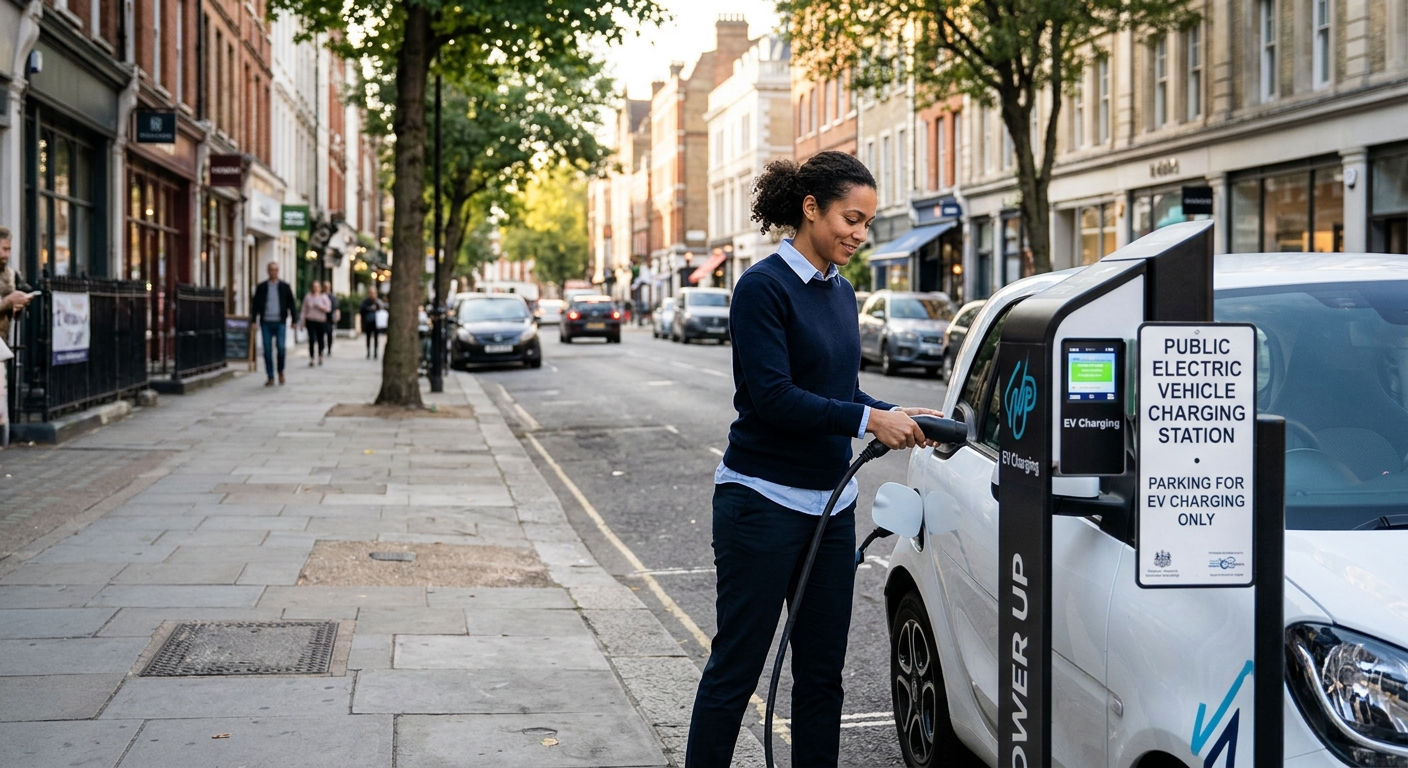
Switching to an electric vehicle (EV) is an excellent way to eliminate gasoline expenses, cut tailpipe emissions, and enjoy quiet, responsive vehicle performance. Delivering 20 to 44 miles of driving range per hour on a high-voltage 240-volt single-phase branch circuit, installing a dedicated home wallbox in a private garage or driveway is the traditional charging approach. However, for urban drivers living in terraced housing, row homes, or city apartments, a fundamental question arises: Can I charge my EV without a driveway?
The short answer is: yes, you can easily charge an EV without a driveway, using a combination of public DC fast chargers, workplace charging, municipal street-lamp chargers, and approved pavement cable gullies or overhead charging arms.
Not having a private off-street parking space is no longer an obstacle to EV ownership. Modern charging infrastructure and local authority accessibility solutions allow urban drivers to keep their batteries topped up conveniently and safely.
For complete hardware reviews, installer guides, and panel load calculators, visit EV Charger Advisor.
1. Four Practical Charging Options Without a Driveway
Drivers who park on public streets or shared urban spaces rely on four primary charging methods:
A. Council-Approved Flush Pavement Cable Gullies
If you park directly outside your front door on a public street, you can install a flush cable gully recessed into the sidewalk. The charging cable sits securely inside a narrow channel, allowing pedestrians and wheelchairs to cross safely while your EV charges from your home’s main panel at cheap residential overnight rates.
B. Municipal Streetlight & Lamp Post Chargers
Many municipal councils and urban transportation authorities retrofit existing streetlights with Level 2 AC outlets (3.7 kW to 7.4 kW). Drivers simply plug in using a standard Mode 3 cable and manage billing through a smartphone app or RFID card.
C. Workplace Charging Infrastructure
Plugging into a Level 2 charging post at your office or workplace parking garage for an 8-hour workday restores 160 to 220 miles of driving range, completely eliminating the need to charge at home during the workweek.
D. Public DC Fast Charging Hubs (Rapid Top-Ups)
Utilizing commercial fast-charging networks (50 kW to 350 kW DC output) allows you to recharge from 20% to 80% battery capacity in 20 to 30 minutes while doing weekly grocery shopping or taking a coffee break.
To learn more about how charger power levels and wire sizes compare, check out our guide on EV charging types.
2. Important Sidewalk Safety & Legal Considerations
When charging an EV parked on a public street, obeying local municipal highway regulations is essential:
-
Avoid Loose Trailing Cables: Running a loose cable across a public sidewalk without an approved recessed channel creates severe trip hazards and public personal injury liability.
-
Overhead Cable Gantries: Retractable overhead arms mounted to property walls suspend cables 8 to 10 feet ($2.4\text{ m} – 3.0\text{ m}$) above the footpath, keeping the sidewalk clear.
-
No Reserved Parking Space Guarantee: Installing a pavement cable channel does not legally reserve the public street space outside your home exclusively for your car unless local bylaws specifically designate it as an EV charging bay.
To explore Wi-Fi-enabled smart wallboxes engineered with remote schedule timers, read our guide on smart chargers.
Step-by-Step Mathematical Example: Pavement Channel Cable Voltage Drop Math
Let us calculate the percentage voltage drop ($\Delta V$) for a 32-Amp Level 2 charger ($240\text{V}$ single-phase supply) running 80 feet ($24.38\text{ m}$) from a home main panel through a front wall and across a sidewalk gully to the curb using #8 AWG Copper Wire ($R = 0.000778 \Omega/\text{ft}$).
Given Parameters:
-
Continuous Current Draw ($I$): $32 \text{ Amps}$
-
Nominal Line Voltage ($V$): $240 \text{ Volts}$
-
One-Way Cable Distance ($L$): $80 \text{ feet}$
-
Conductor Resistance ($R_{\text{wire}}$): $0.000778 \Omega \text{ per foot}$
Calculation 1: Voltage Drop ($\Delta V$) Math
For a single-phase $240\text{V}$ circuit ($2 \times L = 160\text{ ft}$ total conductor path):
Calculation 2: Percentage Voltage Drop (%)
Result Breakdown: A 1.66% voltage drop stays well below the 3% maximum NEC threshold limit, proving that an 80-foot cable run to an on-street parking spot operates safely and efficiently.
Comparison Table: Driveway vs. No-Driveway Charging
| Charging Setup | Location | Typical Speed | Primary Benefit |
| Flush Pavement Channel | On-street curb | 7.4 kW (25–30 mi/hr) | Uses cheap residential overnight rates |
| Lamp Post Charger | On-street curb | 3.7 kW – 7.4 kW | No hardware setup costs for the owner |
| Workplace Charger | Office garage | 7.4 kW – 11 kW | Charges while you work |
| Public DC Fast Charger | Retail hub / Highway | 50 kW – 350 kW | Full recharge in 20–30 minutes |
Summary & Key Takeaways
-
A Driveway Is Not Required: You can successfully own and operate an EV without a private driveway using urban curbside solutions and public networks.
-
Pavement Gullies Save Money: Recessed pavement cable channels connect directly to your home panel, allowing you to charge at low off-peak electricity tariffs.
-
Never Trail Loose Cables: Loose cables across footpaths create public liability risks; always use approved channels or overhead arms.
-
Leverage Workplace & DC Fast Chargers: Charging at work or taking advantage of a quick 30-minute rapid top-up session easily satisfies weekly driving needs.













Leave a Reply