
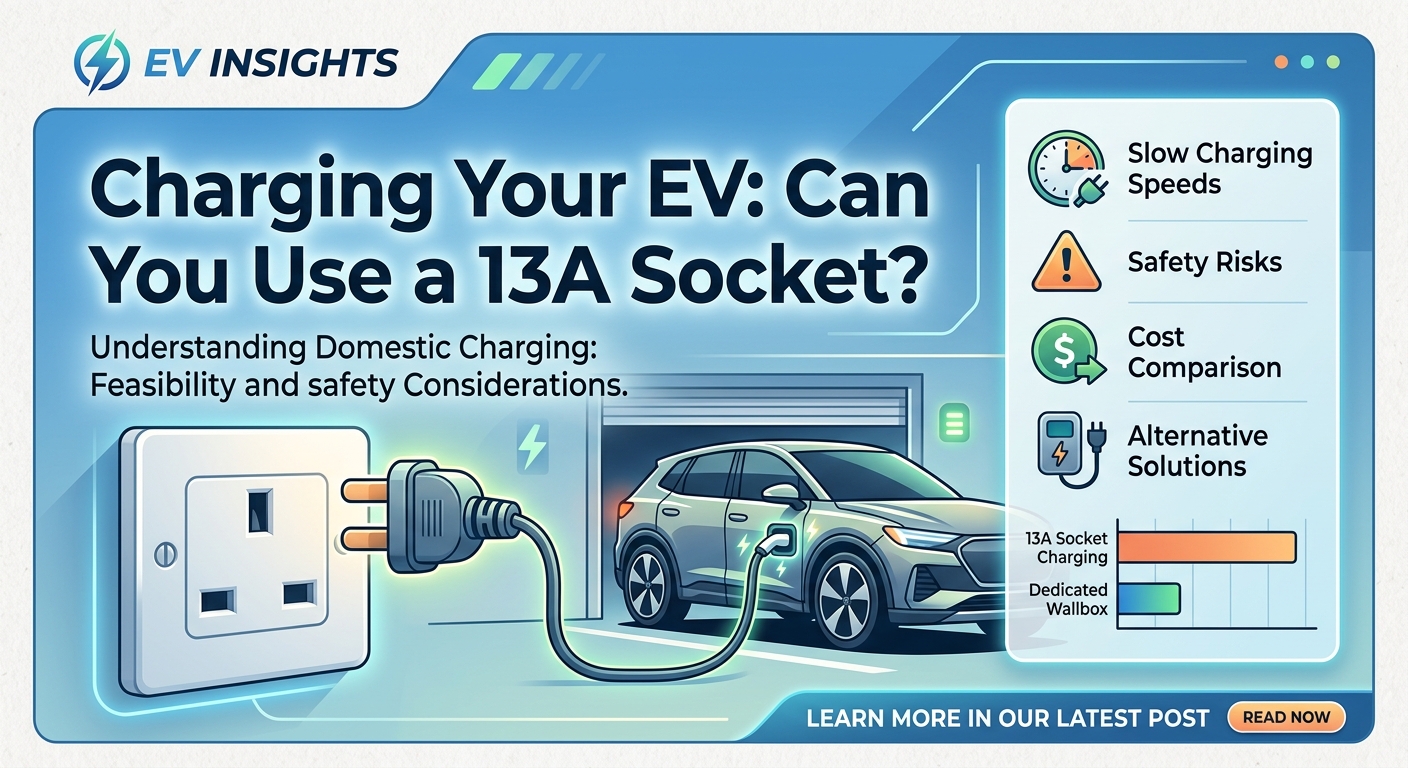
When taking delivery of a new electric vehicle (EV) or plug-in hybrid (PHEV), establishing a reliable daily charging routine is essential. While dedicated Level 2 wallboxes ($7.4\text{ kW} – 22\text{ kW}$) provide rapid overnight replenishment, new owners frequently ask: Can I charge my EV from a 13A socket?
The short answer is: yes, you can charge an electric vehicle (EV) from a standard 13-amp domestic socket using a portable charger—commonly called a “granny charger” or Mode 2 cable—though it is generally recommended only as a temporary or emergency solution.
Operating on a standard $230\text{-volt}$ single-phase household supply, a 13A socket delivers basic trickle power. However, because standard domestic sockets were designed for intermittent loads (like kettles, microwaves, or vacuum cleaners) rather than continuous high-amperage draws lasting 10 to 20+ hours, understanding continuous power derating, thermal heat buildup ($I^2R$), and realistic charging speeds is crucial for safe operation.
For complete hardware reviews, wiring guides, and panel load calculators, visit EV Charger Advisor.
1. How 13A Socket Charging Works (The 10A Continuous Rule)
Although standard household wall sockets carry a nominal peak rating of 13 Amps, official electrical safety regulations and EV portable cable manufacturers deliberately restrict continuous draw to 10 Amps ($2.3\text{ kW}$ output).
Why 13A Sockets Are Restricted to 10A Continuous Draw:
-
Continuous Load Safety Derating: Domestic wall outlets built to BS 1363 standards are designed for short, intermittent 13A peak spikes. Drawing 13 Amps continuously for 12+ hours causes thermal degradation of internal spring terminals, risking melted plastic faceplates or electrical fire hazards.
-
Integrated Plug Thermistors: Quality 10A portable “granny cables” feature built-in temperature sensors inside the 3-pin plug head. If loose socket contacts cause local heating, the unit automatically throttles charging speeds or cuts power completely.
Core Operational Metrics for 13A Sockets:
-
Supply Voltage: $230 \text{ Volts AC Single-Phase}$
-
Max Continuous Amperage Limit: 10 Amps ($2.3 \text{ kW}$ usable power)
-
Range Recovery Speed: 6 to 10 miles (10 to 16 km) of range per hour
-
Primary Use Case: Emergency backup, visiting relatives, or low-commute overnight top-ups
To learn more about how charger power levels and wire sizes compare, check out our guide on EV charging types.
Step-by-Step Mathematical Example: 13A Socket Power & Charge Duration
Let us calculate the exact power delivery, overnight energy replenishment, and full battery charge time when plugging a $60\text{ kWh}$ electric vehicle into a 230V / 13A socket running at a continuous 10-Amp current.
Given Parameters:
-
Supply Voltage ($V$): $230 \text{ Volts}$
-
Continuous Current Limit ($I$): $10 \text{ Amps}$
-
Battery Pack Capacity: $60 \text{ kWh}$
-
AC-to-DC Onboard Inverter Efficiency: $88\%$ ($0.88$)
Calculation 1: Usable Continuous Power Output
Calculation 2: Usable Energy Replenished Overnight (12-Hour Plug-In)
Calculation 3: Added Driving Range (12-Hour Session)
Assuming a vehicle efficiency rating of 3.3 miles per kWh ($5.3 \text{ km/kWh}$):
Calculation 4: Total Charge Time from 0% to 100% (60 kWh Battery)
Result Breakdown: A 13A socket running a 10A granny charger restores ~80 miles of driving range during a 12-hour overnight session, making it adequate for short daily commutes. However, fully recharging a depleted $60\text{ kWh}$ battery pack requires nearly 30 hours.
To explore Wi-Fi-enabled dedicated wallboxes that charge 3x faster, read our guide on smart chargers.
2. Critical Safety Precautions for 13A Socket Charging
If you rely on a standard socket for temporary charging, follow these four electrical safety rules:
-
Never Use Lightweight Extension Cords: Coiled or thin domestic extension leads create significant internal resistance ($I^2R$), leading to rapid heat buildup and fire hazards. If an extension lead is unavoidable, use an uncoiled, heavy-duty 1.5mm² or 2.5mm² outdoor-rated cable.
-
Inspect Physical Socket Quality: Worn or old wall outlets with loose spring tension generate high contact resistance. Ensure the 3-pin plug fits snugly, and feel the plug faceplate for excessive warmth after 1 hour of continuous charging.
-
Avoid Shared Ring Main Circuits: EV charging draws 10 Amps continuously for hours. Avoid operating other high-draw power appliances (such as space heaters or kettles) on the same circuit to prevent tripping the circuit breaker.
-
Verify RCD Ground-Fault Protection: Ensure the wall outlet or portable charger line includes 30mA Residual Current Device (RCD) protection to prevent electric shock in damp environments.
Comparison Table: Standard 13A Household Socket vs. Dedicated Level 2 Wallbox
| Feature / Metric | Standard 13A Household Socket | Dedicated Level 2 Wallbox |
| Continuous Power Draw | 10 Amps ($2.3 \text{ kW}$ usable) | 32 Amps ($7.4 \text{ kW} – 11 \text{ kW}$) |
| Range Added per Hour | $6 – 10 \text{ miles/hr}$ ($10 – 16 \text{ km/hr}$) | $25 – 44 \text{ miles/hr}$ ($40 – 70 \text{ km/hr}$) |
| Full Charge Duration ($60\text{ kWh}$) | ~29.5 Hours | ~6 to 8 Hours |
| Primary Safety Level | Temporary / Emergency backup | Permanent / Dedicated safety features |
| Upfront Installation Cost | $0 (Uses existing plug) | $500 – $1,500 Turnkey |
Summary & Key Takeaways
-
Fully Practical for Emergencies: You can charge an electric vehicle from a standard 13A domestic socket using a portable 10A granny cable.
-
Restricted to 10A Continuous Output: To protect socket wiring from thermal overload, portable cables restrict power to 10 Amps ($2.3\text{ kW}$ usable power).
-
Adds 80 Miles Overnight: A 12-hour overnight charge restores approximately 80 miles (128 km) of range, making it workable for short daily driving needs.
-
Upgrade to a Wallbox for Daily Convenience: Installing a dedicated $7.4\text{ kW}$ Level 2 wallbox reduces charge times from 30 hours down to 6 to 8 hours while eliminating socket wear.













Leave a Reply