
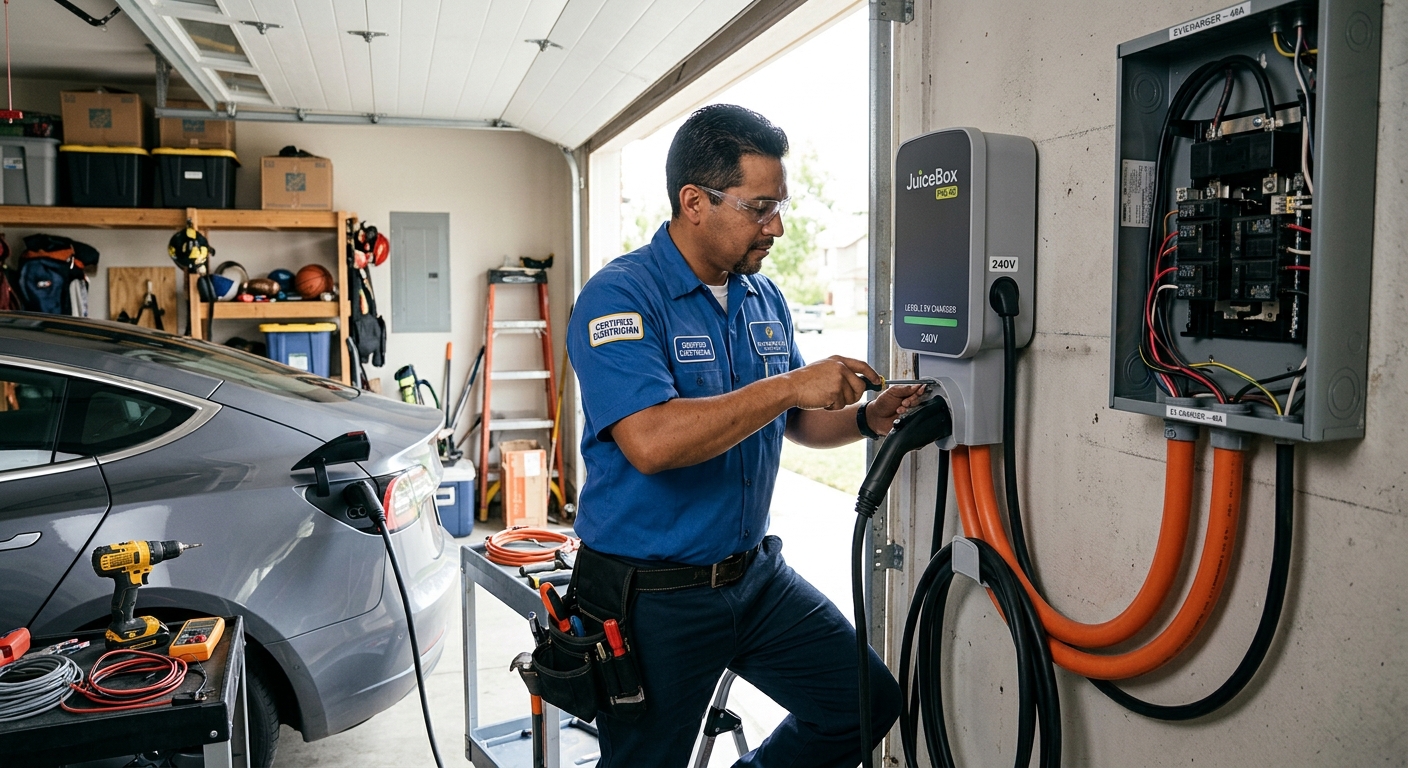
Installing a dedicated Level 2 home EV charger is the best way to ensure rapid, reliable overnight charging for your electric vehicle. Delivering anywhere from 20 to 44 miles of driving range per hour over a high-voltage 240-volt circuit, Level 2 wallboxes represent a significant continuous load on your home’s electrical system. As homeowners prepare to upgrade their garage or driveway setup, a common question arises: Can any electrician install a Level 2 EV charger?
no, not every general electrician is automatically the right choice to install a Level 2 EV charger, even though technically any licensed electrician can run a 240-volt circuit.
While any licensed electrician possesses the basic legal authority to pull electrical wires and wire a breaker, specialized EV charger installation requires expertise in NEC Article 625 continuous load rules, panel load management (NEC Article 220), thermal torque calibration, EVSE smart feature commissioning, and EV-specific safety protocols.
For complete hardware reviews, installer guides, and panel load calculators, visit EV Charger Advisor.
1. Licensed vs. Experienced EV Specialists: What’s the Difference?
A general residential electrician frequently works on standard branch circuits, lighting fixtures, and 120V receptacles—loads that operate intermittently. In contrast, electric vehicle charging demands continuous high-amperage power flow for 4 to 10 hours uninterrupted every single night.
Where General Electricians May Lack Specific Expertise:
-
Misunderstanding Continuous Load Derating: Sizing circuit breakers or wire gauges without applying the NEC 125% continuous load rule (e.g., placing a 40A continuous charger on a 40A breaker instead of a 50A breaker), leading to nuisance tripping.
-
Underestimating Thermal Degradation ($I^2R$ Heat): Failing to use industrial-grade receptacles or calibrated torque screwdrivers, which can cause loose connections to melt under continuous high-amperage heat.
-
Overlooking Smart EVEMS Alternatives: Recommending an expensive $3,000 to $6,000 service panel upgrade on a 100-amp panel instead of configuring software de-rating or installing dynamic load management (EVEMS).
-
Dual-GFCI Nuisance Trips: Installing an expensive GFCI circuit breaker for a hardwired station that already includes internal GFCI protection, causing cross-tripping conflicts.
To learn more about how charger power levels and wire sizes compare, check out our guide on EV charging types.
Step-by-Step Mathematical Example: Thermal Torque Safety Calibration
To illustrate why specialized EV installation expertise matters, let us look at the physics of terminal connection tightness and thermal heat dissipation ($I^2R$ power loss) under continuous 48-Amp charging.
Given Parameters:
-
Continuous Charging Current ($I$): $48 \text{ Amps}$
-
Baseline Terminal Contact Resistance (Properly Torqued): $R_1 = 0.001 \text{ Ohms } (1 \text{ m}\Omega)$
-
Degraded Terminal Resistance (Loose Connection / Improper Torque): $R_2 = 0.050 \text{ Ohms } (50 \text{ m}\Omega)$
Calculation 1: Thermal Heat Dissipation on a Properly Torqued Terminal
Calculation 2: Thermal Heat Dissipation on an Under-Torqued / Loose Terminal
Result Breakdown: A slightly loose wire connection on a 48A continuous circuit generates over 115 Watts of continuous localized heat directly inside the breaker enclosure or wallbox terminal block—enough to melt wire insulation, destroy panel busbars, and trigger electrical fires. EV-specialized electricians use calibrated torque screwdrivers to match exact manufacturer inch-pound specs, preventing thermal failure.
To explore Wi-Fi-enabled smart wallboxes that support dynamic app management, read our guide on smart chargers.
Key Questions to Ask Before Hiring an Electrician for EV Charger Installation
To ensure your installer has the specific qualifications required for high-power EV charging infrastructure, ask these five key questions:
-
“Will you perform a formal NEC Article 220 panel load calculation before installing the breaker?”
-
Correct Answer: Yes. They should evaluate your home’s total baseline load to confirm panel capacity headroom.
-
-
“Do you use a calibrated torque tool to tighten terminal connections?”
-
Correct Answer: Yes. Terminal screws on high-draw 240V circuits must be torqued to exact manufacturer specifications.
-
-
“If installing a NEMA 14-50 plug, do you use cheap builder-grade or heavy-duty industrial-grade outlets?”
-
Correct Answer: They should specify heavy-duty industrial-grade receptacles (such as Hubbell or Bryant) to handle multi-hour continuous heating cycles.
-
-
“Are you certified through EVITP (Electric Vehicle Infrastructure Training Program) or manufacturer installer networks?”
-
Correct Answer: EVITP-certified installers undergo specialized training focused strictly on EVSE infrastructure and safety code standards.
-
-
“Will you pull a municipal permit and arrange for official inspection sign-off?”
-
Correct Answer: Yes. Permitted installations ensure code compliance and keep your homeowners insurance and equipment warranties valid.
-
Comparison Table: General Electrician vs. EV Infrastructure Specialist
| Capability / Checklist | General Residential Electrician | Specialized EVITP Certified Electrician |
| Licensed for 240V Wiring | Yes | Yes |
| NEC Article 625 Continuous Load Sizing | General Knowledge | Expert Alignment (125% Rule) |
| Calibrated Torque Tool Usage | Optional / Rare | Mandatory Standard Practice |
| EVEMS Load Management Knowledge | Limited | Expert Configuration |
| Industrial-Grade Receptacle Sourcing | May use builder-grade | Uses Heavy-Duty Industrial Specs |
| Rebate & Utility Incentive Support | Variable | Experienced with Utility Forms |
Summary & Key Takeaways
-
Technical License vs. EV Expertise: While any licensed electrician can legally wire a $240\text{V}$ circuit, choosing an electrician with specialized EV experience ensures safety and reliability.
-
Torque Calibration Is Crucial: EV chargers pull continuous high-amperage current for hours; precise torque settings prevent dangerous $I^2R$ resistance heating and melted connections.
-
Avoid Unnecessary Panel Upgrades: EV specialists understand how to use smart load management (EVEMS) or wallbox de-rating to fit Level 2 charging onto existing 100A panels.
-
Verify Certifications: Look for EVITP (Electric Vehicle Infrastructure Training Program) certification or manufacturer-approved installer credentials to guarantee code-compliant execution.













Leave a Reply