
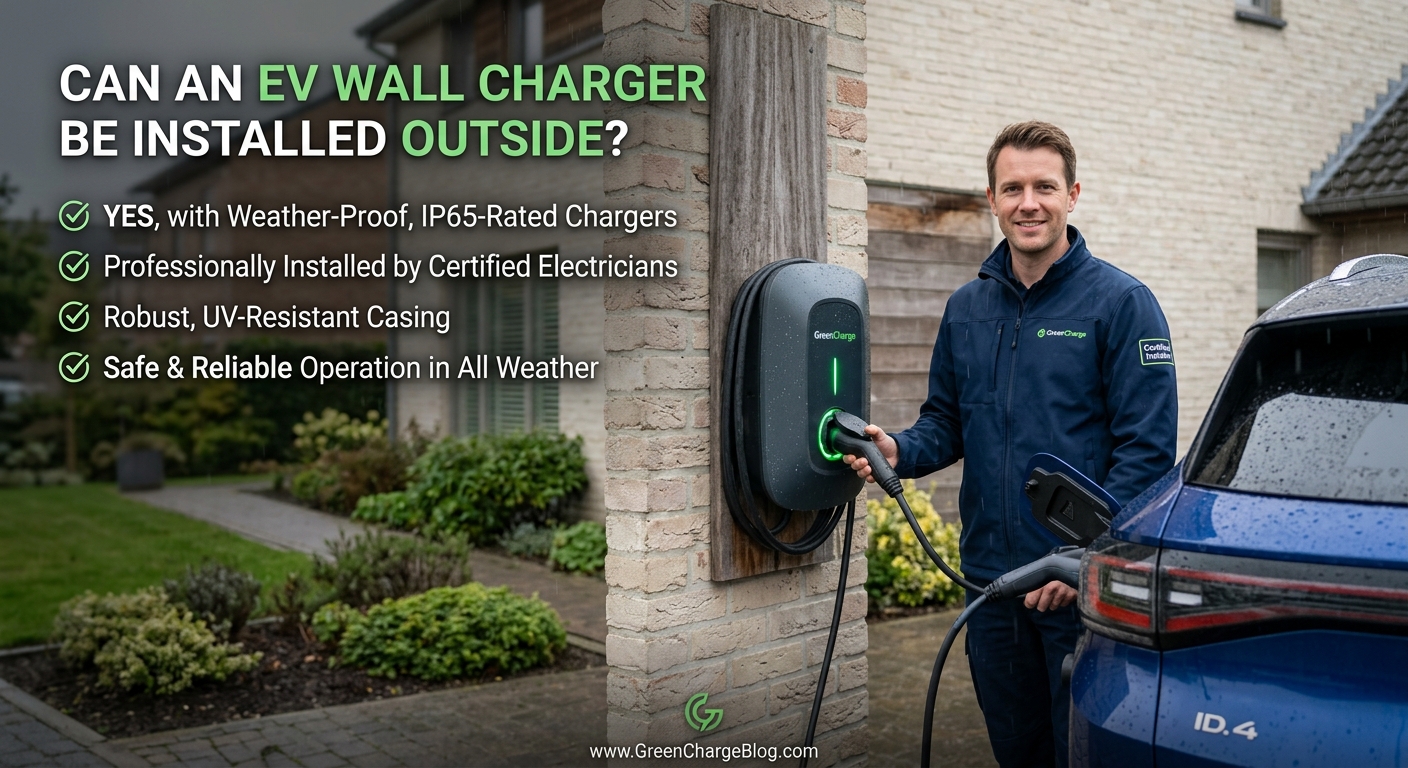
Switching to an electric vehicle (EV) brings substantial long-term fuel savings and the supreme convenience of waking up every morning with a fully charged battery. Delivering anywhere from 20 to 44 miles of driving range per hour over a high-voltage 240-volt branch circuit, a Level 2 wallbox is the industry gold standard for residential charging. However, for homes without an enclosed garage, or for multi-vehicle families who park in the driveway, a fundamental question arises: Can an EV wall charger be installed outside?
The short answer is: yes, an EV wall charger can be installed outside, provided the equipment possesses the proper weatherproof rating (such as NEMA 3R, NEMA 4, or IP65+) and is installed according to National Electrical Code (NEC Article 625) standards.
Modern outdoor-rated wallboxes are specifically engineered to endure extreme environmental conditions—including driving rainstorms, heavy snow accumulation, freezing temperatures, and direct UV sunlight exposure—without compromising electrical safety or performance.
For complete hardware reviews, installer guides, and panel load calculators, visit EV Charger Advisor.
1. Key Engineering Factors for Outdoor EV Charger Installations
Installing an EV charger on an exterior house wall, carport, or standalone pedestal post requires careful consideration of three core factors:
A. Ingress Protection & Weatherproof Ratings
Not all wallboxes are built for outdoor exposure. Equipment installed in exposed outdoor locations must carry official enclosure certifications:
-
NEMA 3R / NEMA 4 (North America): Protects against falling rain, sleet, snow, windblown dust, and ice formation on the exterior enclosure.
-
IP65 / IP66 (International): Guarantees total protection against solid dust ingress and powerful water jets from any direction.
B. Connection Method: Hardwired vs. Plug-In Receptacles
While indoor garage installations often utilize plug-in NEMA 14-50 receptacles, outdoor chargers should preferably be direct-hardwired. Hardwiring seals all high-voltage electrical connections inside the weatherproof wallbox casing, eliminating socket moisture degradation, terminal corrosion, and nuisance tripping on GFCI-protected breakers.
C. Cable Management & Connector Holstering
Exposed charging cables left lying on driveway asphalt face UV degradation, dirt buildup, and damage from vehicle tires. Utilizing a dedicated holster with a downward-facing angle prevents rainwater from collecting inside the charging handle pins when not in use.
To learn more about how charger power levels and wire sizes compare, check out our guide on EV charging types.
2. Mandatory NEC Code Requirements for Outdoor Mounting
Under NEC Article 625, strict safety standards govern outdoor electrical vehicle supply equipment (EVSE) installations:
-
Mandatory Outdoor Mounting Height (NEC 625.102 / 625.30): The coupling/control unit of an outdoor wallbox must be mounted at least 24 inches ($600\text{ mm}$) above finished ground level. This prevents splash-back moisture damage, standing water ingress, and buried snow buildup.
-
Digital Safety Handshake: Power does not flow through the cable while hanging on the wall. High-voltage alternating current is only energized after a dry, low-voltage control pilot signal confirms a sealed, watertight latch inside the vehicle port.
-
Ground Fault Circuit Interruption (GFCI): Integrated CCID sensors continuously monitor current balance between conductors, cutting power in milliseconds if ground leakage is detected.
To explore Wi-Fi-enabled smart wallboxes built with weather-resistant housings, read our guide on smart chargers.
Step-by-Step Mathematical Example: Voltage Drop on Outdoor Conduit Runs
When routing feeder conductors from an indoor main breaker panel to an outdoor driveway charger mounted 80 feet ($24.38\text{ m}$) away, electrical line resistance ($R$) causes a minor voltage drop ($\Delta V$). Under NEC guidelines, total branch circuit voltage drop should stay below 3% to prevent efficiency loss and conductor overheating.
Let us evaluate the voltage drop for a hardwired 48-Amp continuous Level 2 charger ($240\text{V}$ single-phase supply) running 80 feet using #6 AWG Copper Conductors ($R = 0.000491 \Omega/\text{ft}$).
Given Parameters:
-
Continuous Current Draw ($I$): $48 \text{ Amps}$
-
Line Voltage ($V$): $240 \text{ Volts}$
-
One-Way Distance ($L$): $80 \text{ feet}$
-
Conductor Resistance ($R_{\text{wire}}$): $0.000491 \Omega \text{ per foot}$
Calculation 1: Voltage Drop ($\Delta V$) Math
For a single-phase $240\text{V}$ circuit ($2 \times L = 160\text{ ft}$ total conductor path):
Calculation 2: Percentage Voltage Drop (%)
Result Breakdown: A 1.57% voltage drop stays well below the 3% maximum NEC threshold limit, confirming that an 80-foot outdoor conductor run using #6 AWG copper wire operates safely and efficiently during long overnight charging sessions.
Comparison Table: Outdoor Ingress Protection (IP) & NEMA Ratings
| Rating Standard | Protection Capabilities | Outdoor Rain & Snow Safe? |
| Indoor Rated | Basic dust cover / zero water seal | No (Garage Only) |
| NEMA 3R / IP54 | Rain-proof & splash resistant | Yes (Carport / Covered Outdoor) |
| NEMA 4 / IP65 | Heavy driving rain, snow & water jets | Yes (Fully Exposed Exterior Walls) |
| NEMA 4X / IP67 | Corrosion resistant & short immersion | Yes (Extreme Coastal / Industrial) |
Summary & Key Takeaways
-
100% Safe Outdoors: EV wall chargers can be installed outside as long as the equipment is certified with a weatherproof rating (NEMA 3R, NEMA 4, or IP65+).
-
Mount 24 Inches Off Ground: Always comply with NEC 625 rules by mounting outdoor wallboxes at least 24 inches above ground level to protect against water splash and snow.
-
Hardwiring Is Superior: Direct hardwiring into weatherproof conduit eliminates socket corrosion risks and GFCI nuisance tripping outdoors.
-
Dock the Handle Properly: Always seat the charging handle inside its downward-facing holster to prevent water from entering the contact pins.













Leave a Reply