
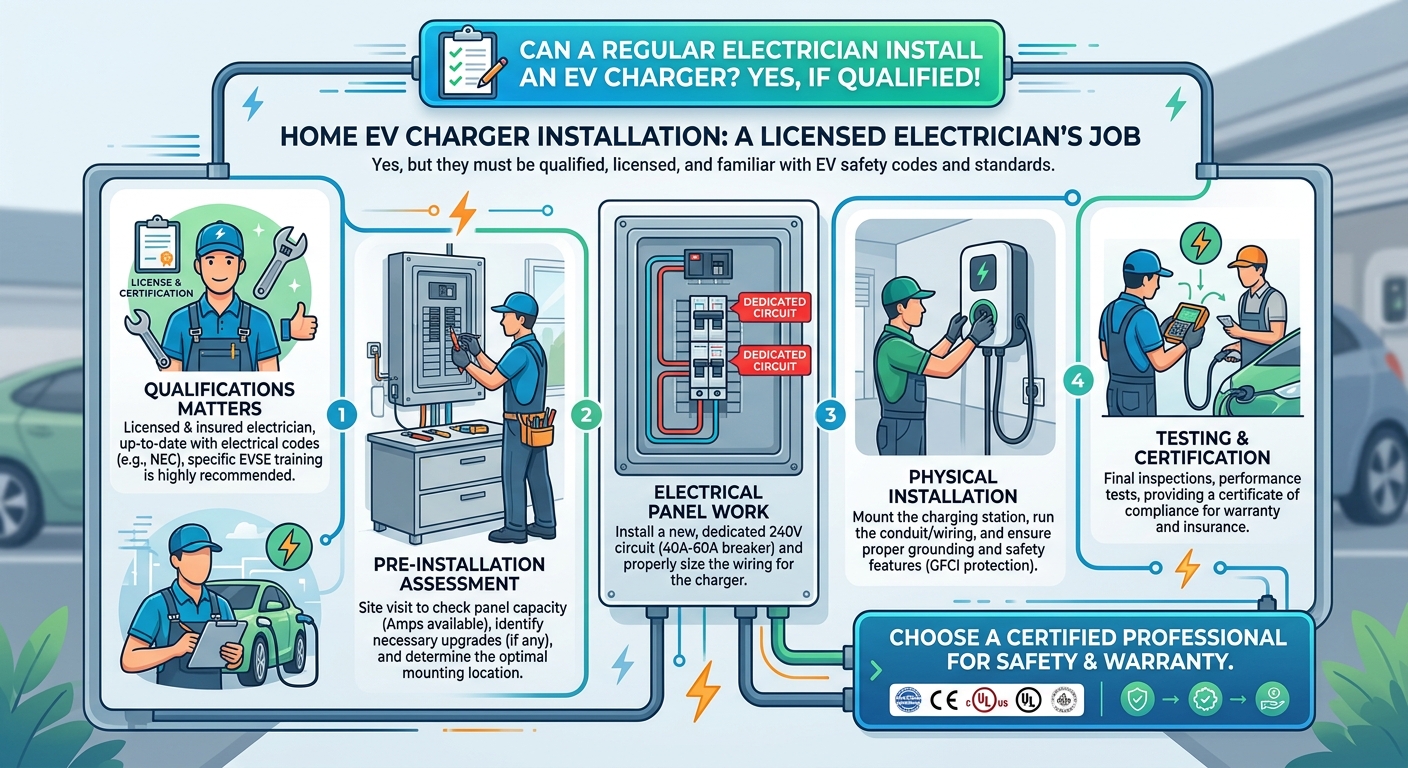
Upgrading your home to support a Level 2 electric vehicle (EV) charger requires adding a dedicated high-voltage (240V) circuit to your residential electrical system. Because setting up charging infrastructure involves working inside your main electrical panel, many homeowners wonder: Can a regular electrician install an EV charger?
The short answer is yes, any licensed and qualified electrician can install an EV charger, provided they understand high-amperage continuous electrical loads, National Electrical Code (NEC) standards, and local permitting requirements.
While you do not strictly need a specialized “EV-only” technician, electric vehicle charging introduces unique electrical demands that differ from traditional home appliances. Working with an experienced professional ensures your home’s wiring remains safe, code-compliant, and reliable.
For comprehensive hardware reviews, panel load calculators, and installer guides, visit EV Charger Advisor.
4 Key Qualifications a Regular Electrician Must Have for EV Charger Installation
When hiring a general licensed electrician, verify that they possess the specific technical knowledge required for heavy continuous load applications:
1. Mastery of the NEC 125% Continuous Load Rule
Unlike appliances like electric clothes dryers or stoves that cycle on and off, electric vehicles draw full rated power continuously for hours. Under NEC Article 625, EV charging is classified as a continuous load, requiring branch circuit conductors and overcurrent protective devices (breakers) to be sized at 125% of the charger’s maximum current rating:
-
A 32-Amp Charger requires a 40-Amp Circuit Breaker ($32\text{A} \times 1.25 = 40\text{A}$).
-
A 40-Amp Charger requires a 50-Amp Circuit Breaker ($40\text{A} \times 1.25 = 50\text{A}$).
-
A 48-Amp Charger requires a 60-Amp Circuit Breaker ($48\text{A} \times 1.25 = 60\text{A}$).
2. Residential Electrical Load Calculations (NEC Article 220)
Before adding a 40A to 60A circuit breaker, a qualified electrician must calculate your home’s total baseline electrical demand. This load calculation verifies whether your main service panel (e.g., 100A vs. 200A main panel) has sufficient spare capacity or if a main service upgrade or energy management device is needed.
3. Proper Copper Wire Gauge & Thermal Rating Selection
An electrician must select heavy-gauge copper wiring (typically #8 AWG, #6 AWG, or #4 AWG) based on the circuit breaker size, continuous ampacity, and temperature ratings (75°C terminal specs) to prevent thermal overload inside walls and panel lugs.
4. Local Municipal Permitting & Inspection Experience
Installing a new 240V dedicated circuit requires obtaining an electrical building permit from your local Authority Having Jurisdiction (AHJ) to ensure the work passes safety inspection and complies with home insurance policies.
To learn more about how charger power levels and wire sizes compare, check out our guide on EV charging types.
Step-by-Step Mathematical Example: Sizing a Circuit for a 40-Amp Charger
To see why understanding continuous load math is critical for any electrician, let us calculate the required breaker size, wire rating, and hourly energy delivery for a 40-Amp Level 2 plug-in wallbox.
Given Parameters:
-
Charger Continuous Draw: $40 \text{ Amps}$
-
Operating Supply Voltage: $240 \text{ Volts}$
Calculation 1: Minimum Circuit Breaker Rating (125% Rule)
Calculation 2: Usable Kilowatt (kW) Charging Power
Calculation 3: Added Range Per Hour
Assuming a standard crossover EV efficiency of 3.3 miles per kWh:
Result Breakdown: A 40A continuous charger requires a 50-Amp double-pole circuit breaker paired with #6 AWG copper wire, delivering 9.6 kW of power to restore roughly 32 miles of range per hour.
Hardwired vs. Plug-In (NEMA 14-50) Installation Considerations
When working with your electrician, discuss whether a hardwired or plug-in connection best fits your home setup:
1. NEMA 14-50 Plug-In Sockets
-
Maximum Output: Capped at 40 Amps continuous output on a 50A breaker.
-
Code Requirements: Under recent NEC safety standards, garage or outdoor receptacles for EV charging require a dedicated GFCI (Ground Fault Circuit Interrupter) circuit breaker. Electricians must install industrial-grade receptacles (such as Hubbell or Bryant) rather than cheap builder-grade outlets to prevent thermal melting.
2. Direct Hardwired Connections
-
Maximum Output: Supports 48 Amps continuous output on a 60A breaker ($11.5\text{ kW}$).
-
Code Advantages: Eliminates the plug outlet entirely, avoiding socket thermal failure risks, skipping expensive GFCI breakers in many jurisdictions, and delivering maximum home charging speeds.
To explore Wi-Fi-enabled smart chargers that support continuous power adjustments, read our guide on smart chargers.
Electrician Selection Checklist
| What to Ask a Regular Electrician | Why It Matters | Correct Standard |
| “Will you perform an NEC Article 220 load calculation?” | Ensures your panel will not trip or overload. | Written calculation provided |
| “What breaker size will you pair with my charger?” | Prevents continuous load breaker tripping. | Breaker rated at $125\%$ of charger amps |
| “Do you install industrial-grade NEMA receptacles?” | Prevents socket melting under long heat cycles. | Heavy-duty industrial outlet used |
| “Will you secure a local building permit?” | Protects home insurance coverage and safety compliance. | City permit and inspection included |
Summary & Key Takeaways
-
Licensed Electricians Are Fully Qualified: Any licensed electrician can safely install an EV charger if they follow NEC guidelines for continuous loads.
-
Apply the 125% Rule: EV chargers draw maximum continuous power for hours; breaker sizes must be rated at 125% of the charger’s output.
-
Verify Panel Load Capacity: Always request a formal electrical panel load calculation before installing 50A or 60A breakers.
-
Prefer Industrial Hardware or Hardwiring: Use heavy-duty industrial NEMA receptacles or choose direct hardwiring for safer thermal performance.













Leave a Reply