
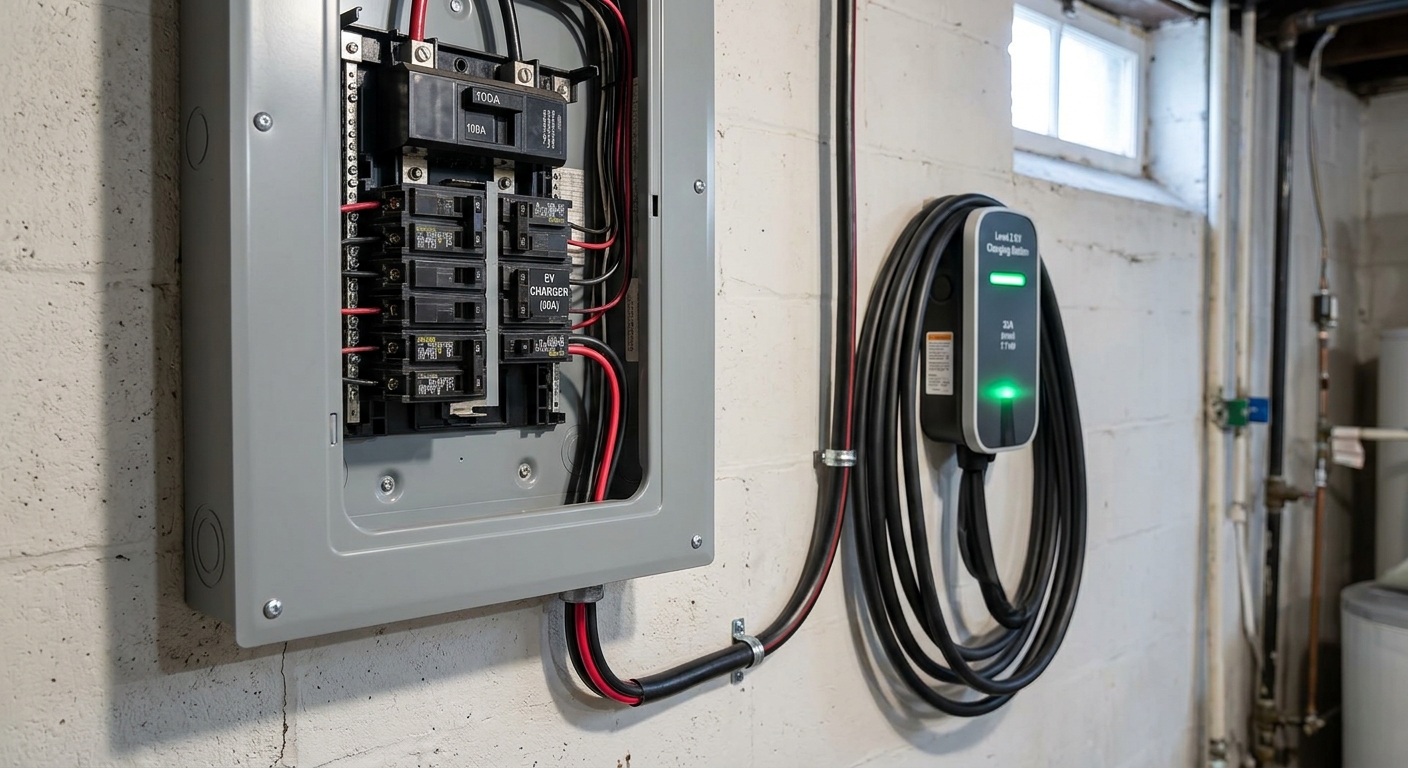
Upgrading your home to support a Level 2 electric vehicle (EV) charger is one of the most effective ways to ensure fast, reliable overnight charging. However, many older homes and urban residences operate on a 100-amp main electrical panel. Because Level 2 chargers require high-amperage dedicated circuits, homeowners frequently ask: Can a 100-amp main panel handle an EV charger?
The short answer is yes, a 100-amp main electrical panel can handle a Level 2 EV charger, though it depends heavily on your home’s total baseline electrical load, appliance usage, and whether you use a smart power-management solution or dynamic load balancing device.
While adding a dedicated 40A or 50A breaker directly to a heavily loaded 100A panel can cause main breaker tripping, modern smart electrical hardware allows homeowners to safely add Level 2 charging without paying thousands of dollars for a complete service upgrade.
For comprehensive load calculators, hardware reviews, and installer guides, visit EV Charger Advisor.
Understanding Residential Panel Load Capacity (NEC Article 220)
Before adding any high-draw appliance to an electrical panel, a licensed electrician must perform an electrical load calculation according to National Electrical Code (NEC Article 220) guidelines.
An electrical panel’s capacity is measured in total amperage, but continuous loads are governed by thermal limits:
1. Baseline Electrical Demand in a 100A Home
A typical 100-amp main panel supplies 24,000 Watts ($24\text{ kW}$) of total power at 240 Volts ($100\text{A} \times 240\text{V} = 24,000\text{W}$). In a standard household, major non-discretionary appliances draw significant baseline power:
-
Central Air Conditioning / Heat Pump: $3,500\text{W} – 5,000\text{W}$ ($15\text{A} – 20\text{A}$)
-
Electric Clothes Dryer: $4,000\text{W} – 5,000\text{W}$ ($18\text{A} – 22\text{A}$)
-
Electric Water Heater: $4,500\text{W}$ ($18.75\text{A}$)
-
Electric Oven / Range: $3,000\text{W} – 8,000\text{W}$ ($12\text{A} – 33\text{A}$)
-
General Lighting & Receptacle Circuits: $1,500\text{W} – 3,000\text{W}$ ($6\text{A} – 12\text{A}$)
If all major household appliances run simultaneously, total demand can reach 18,000W to 22,000W ($75\text{A} – 90\text{A}$), leaving virtually no room to add a standard 40A ($9.6\text{ kW}$) or 50A ($12\text{ kW}$) continuous EV charging circuit without risking a main breaker trip.
To learn more about how charger power ratings compare, check out our guide on EV charging types.
Step-by-Step Mathematical Example: Panel Load Calculation With & Without Load Management
To see how a 100A panel behaves when adding a Level 2 charger, let us calculate total panel load under two scenarios: a Standard Unmanaged Setup versus a Smart Load-Managed Setup.
Given Panel Parameters:
-
Main Panel Capacity: $100 \text{ Amps @ 240V} = 24,000 \text{ Watts}$
-
Safe Maximum Continuous Limit (80% Rule): $80 \text{ Amps} = 19,200 \text{ Watts}$
-
Existing Household Peak Demand: $16,800 \text{ Watts} = 70 \text{ Amps}$
Scenario A: Adding a Standard 32-Amp EV Charger ($40\text{A}$ Breaker / $7,680\text{W}$ Draw)
Result: The total load exceeds the 100A main panel capacity ($24,480\text{W} > 24,000\text{W}$), causing the main 100A breaker to trip during peak usage.
Scenario B: Adding a Smart Load Management Device (EVEMS / Dynamic Balancing)
A smart load management device dynamically pauses or throttles EV charging whenever household demand exceeds a safety threshold (e.g., $80\text{A}$ or $19,200\text{W}$):
-
During peak evening hours (when AC and oven are running), the smart management system automatically throttles the EV charger to 10A to 16A ($2.4\text{ kW} – 3.8\text{ kW}$).
-
Late at night (when household appliances turn off), available capacity increases to 32A ($7.68\text{ kW}$), providing full-speed overnight charging safely within the 100A main limit.
3 Ways to Install an EV Charger on a 100-Amp Main Panel
If you have a 100A panel, you do not necessarily have to spend $2,000 to $4,000 on a full service panel upgrade. Consider these 3 proven installation options:
1. Install an EV Energy Management System (EVEMS) / Smart Load Shedder
An EVEMS device (or smart breaker system) monitors real-time total panel amperage using current transformer (CT) clamps. If total household draw approaches 80% of panel capacity, the device temporarily cuts power to the charger, restoring full charging speed when home energy consumption drops.
2. De-Rate Charger Amperage Settings
Most modern smart Level 2 wallboxes allow electricians to set internal DIP switches or software settings to lower maximum output amperage. Setting a charger to 16 Amps ($3.8\text{ kW}$ on a 20A breaker) or 24 Amps ($5.7\text{ kW}$ on a 30A breaker) fits comfortably into many 100A panels while still providing 12 to 22 miles of range per hour—4 to 5 times faster than a standard wall socket.
3. Perform a Complete Panel Upgrade to 200 Amps
If your home relies entirely on high-draw electric appliances (electric heat, electric dryer, electric range, water heater) and lacks gas alternatives, upgrading your main service panel to 200 Amps provides complete headroom for high-speed 48A ($11.5\text{ kW}$) charging alongside all home loads.
To explore Wi-Fi-enabled smart chargers that support dynamic load management, read our guide on smart chargers.
Comparison Table: 100A Panel EV Charger Installation Options
| Solution | Typical Charger Speed | Panel Upgrade Needed? | Hardware & Installation Cost | Best For |
| Low-Amperage Set (16A / 24A) | $12 – 20 \text{ miles/hr}$ | No | $600 – $1,100 | Homes with moderate electrical loads |
| Smart EVEMS Load Balancer | $25 – 35 \text{ miles/hr}$ (Dynamic) | No | $1,200 – $1,800 | Homes with tight panel capacity |
| Full 200A Panel Service Upgrade | 35 – 45 miles/hr ($48\text{A}$) | Yes | $2,500 – $5,000 | Fully electric homes with heavy total load |
Summary & Key Takeaways
-
Possible Without Upgrade: A 100-amp main panel can support a Level 2 EV charger if total load calculations permit or if smart energy management is used.
-
De-Rating Works Well: Setting a wallbox to 16A or 24A continuous output fits many 100A panels, delivering plenty of range overnight without overloading system capacity.
-
Smart Load Balancers Save Money: Installing an EVEMS smart load shedding device avoids $2,000+ in utility panel upgrade fees while permitting full-speed off-peak charging.
-
Always Get a Load Calculation: Have a licensed electrician perform an NEC Article 220 load calculation before purchasing hardware or installing breakers.













Leave a Reply