
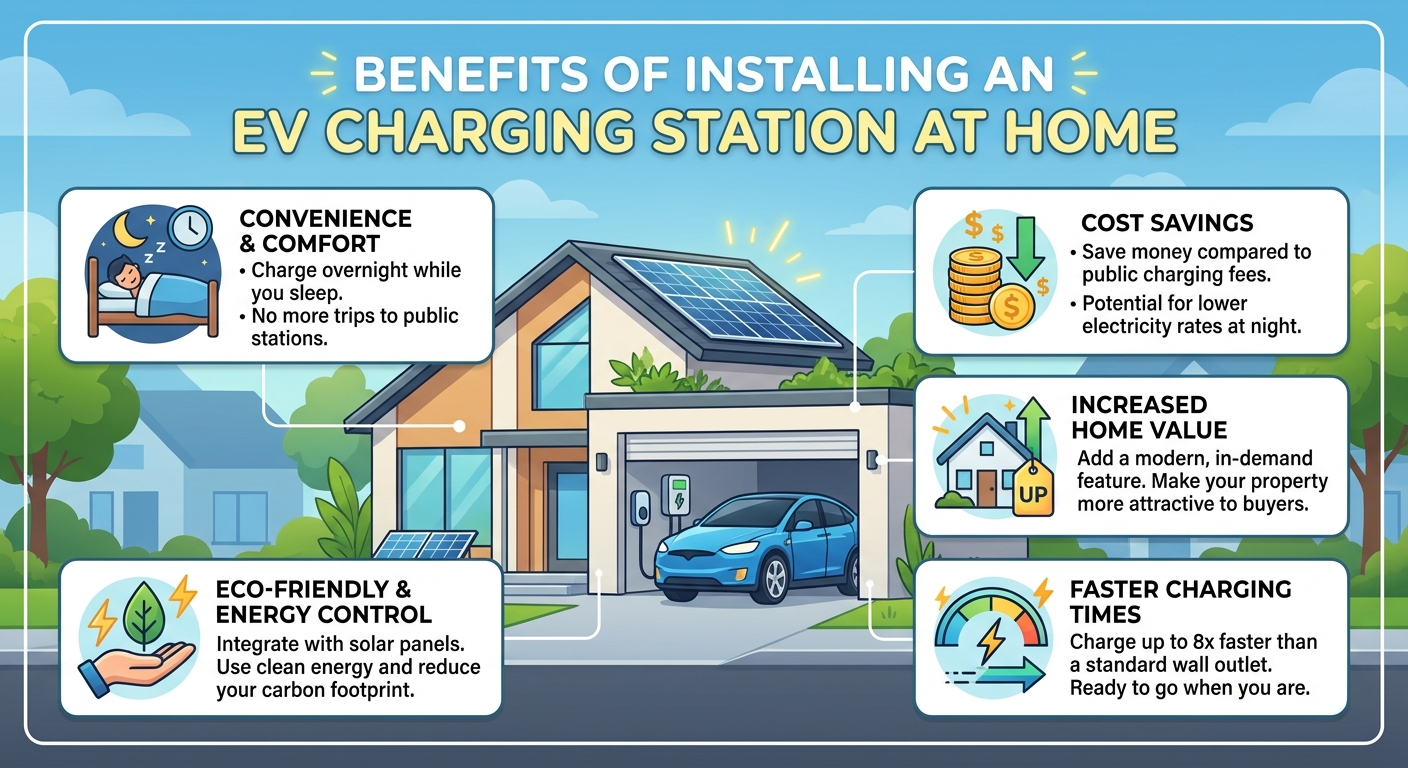
Transitioning to an electric vehicle (EV) is one of the most impactful choices a driver can make to eliminate monthly petrol expenditures, enjoy quiet and responsive acceleration, and reduce daily tailpipe emissions. However, as thousands of new EV owners quickly realize, the true key to unlocking the full potential of electric mobility lies in how and where you refuel. While public charging hubs and DC fast-charging plazas serve a vital role during long-distance highway travel, installing a dedicated home Level 2 wallbox transforms the electric vehicle ownership experience into a seamless, highly economical daily routine.
Operating over a high-voltage 240-volt single-phase branch circuit, a dedicated residential charger delivers 20 to 44 miles of driving range per hour. Beyond sheer charging speed, home charging delivers substantial financial savings, enhances battery longevity, adds property value, and integrates seamlessly with renewable energy systems.
For complete hardware reviews, installer guides, and panel load calculators, visit EV Charger Advisor.
1. Substantial Financial Savings: Home Power vs. Public Tariffs
The single largest economic advantage of a home EV charging station is the vast difference between residential utility rates and commercial charging tariffs:
A. Residential Electricity Tariffs ($0.10 – $0.18 per kWh)
Charging your EV at home overnight allows you to tap into standard or off-peak residential utility rates, which average $0.10 to $0.18 per kWh across most regions. Recharging a typical 60 kWh EV battery pack at home costs roughly $6.00 to $10.80.
B. Commercial Public Fast Charging Markup ($0.35 – $0.55+ per kWh)
Public DC fast chargers (such as Tesla Superchargers or commercial plazas) incur heavy commercial demand charges, hardware maintenance markups, and profit margins, billing between $0.35 and $0.55 per kWh. Recharging that same 60 kWh battery at a public fast charger costs $21.00 to $33.00—nearly three to four times more expensive than home fueling.
C. Off-Peak Time-of-Use (TOU) Rates & Solar PV Pairing
Many electric utilities offer Time-of-Use (TOU) tariffs that discount electricity prices during late-night hours (e.g., 12:00 AM to 6:00 AM). Modern smart wallboxes can be programmed to charge exclusively during these hours, slashing fuel costs by 50% to 80% compared to gasoline. Furthermore, pairing your charger with rooftop solar panels enables driving on 100% clean, self-generated energy.
To learn more about how charger power levels and wire sizes compare, check out our guide on EV charging types.
2. Maximum Convenience & Battery Health Optimization
Home charging eliminates the friction of traditional gas stations and public charging queues:
-
Wake Up to a “Full Tank” Every Day: Plugging in taking under five seconds when you park in your garage or driveway. Overnight Level 2 charging ensures your car is fully replenished every morning without detours or waiting in line.
-
Thermal Management & Extended Battery Life: Frequent reliance on high-power Level 3 DC fast chargers subjects lithium-ion battery cells to extreme thermal stress, accelerating chemical degradation over time. Gentle overnight Level 2 AC charging (7.6 kW to 11.5 kW) operates within optimal thermal bounds, preserving long-term battery health and vehicle resale value.
-
Property Value Enhancement: Homes equipped with dedicated 240V Level 2 EV charging infrastructure are increasingly sought after by homebuyers, providing a measurable boost to residential real estate value and modern electrical appeal.
To explore Wi-Fi-enabled smart wallboxes engineered with integrated load management features, read our guide on smart chargers.
Step-by-Step Mathematical Example: Annual Fuel Savings & Installation Payback Math
Let us perform a technical financial calculation to determine the net annual savings and payback period for a driver commuting 14,000 miles per year in an EV achieving an energy efficiency rating of 3.5 Miles per kWh ($4,000\text{ kWh/year}$ consumed) who installs a $1,400 Level 2 Home Charger Setup ($450 wallbox + $950 installation).
Given Parameters:
-
Annual Driving Distance ($D$): $14,000 \text{ miles / year}$
-
Vehicle Efficiency ($\eta_{\text{veh}}$): $3.5 \text{ Miles per kWh}$
-
Total Annual Energy Consumption ($E$): $14,000 / 3.5 = \mathbf{4,000 \text{ kWh / year}}$
-
Home Overnight Off-Peak Tariff ($R_{\text{home}}$): $\$0.13 \text{ per kWh}$
-
Public Fast Charger Tariff ($R_{\text{public}}$): $\$0.45 \text{ per kWh}$
-
Equivalent Petrol ICE Vehicle (30 MPG at $3.80/gal): $\$0.1267 \text{ per mile}$
-
Total Home Charging Installation Cost: $\$1,400.00$
Calculation 1: Annual Cost of Charging Exclusively at Home ($C_{\text{home}}$)
Calculation 2: Annual Cost of Fueling a Petrol Car ($C_{\text{gas}}$)
Calculation 3: Net Annual Savings vs. Gasoline ($\Delta C$)
Calculation 4: Hardware & Installation Payback Period
Result Breakdown: Charging at home saves $1,253.80 per year compared to a gas-powered vehicle, enabling the full $1,400 installation to pay for itself in just over 13 months.
Comparison Table: Home Charging vs. Public Fast Charging vs. Gasoline
| Feature / Metric | Home Level 2 AC Charging | Public DC Fast Charging | Gasoline Vehicle (ICE) |
| Average Cost per Unit | $0.10 – $0.18 / kWh | $0.35 – $0.55 / kWh | $3.50 – $4.50 / Gallon |
| Annual Fueling Cost (14k mi) | ~$520 | ~$1,800 | ~$1,770 |
| Convenience Factor | Extreme (Refuel while sleeping) | Moderate (20-45 min wait) | High (5-min stop at station) |
| Long-Term Battery Impact | Gentle / Thermal Optimal | Elevated heat degradation risk | N/A |
| Grid / Renewable Potential | High (Solar PV / TOU Matching) | None (Fixed station tariffs) | Zero (Fossil fuel dependent) |
Summary & Key Takeaways
-
Unmatched Convenience: Plugging in overnight transforms your garage into a personal fueling station, ensuring you wake up to maximum range every morning.
-
Massive Annual Savings: Charging at residential utility rates saves over $1,200 annually compared to gasoline or public fast chargers.
-
Preserves Battery Health: Gentle Level 2 AC power keeps thermal stress low, extending your vehicle’s battery lifespan.
-
Fast Financial ROI: Lower home charging costs allow a complete Level 2 wallbox installation setup to achieve full payback in under 14 months.













Leave a Reply