
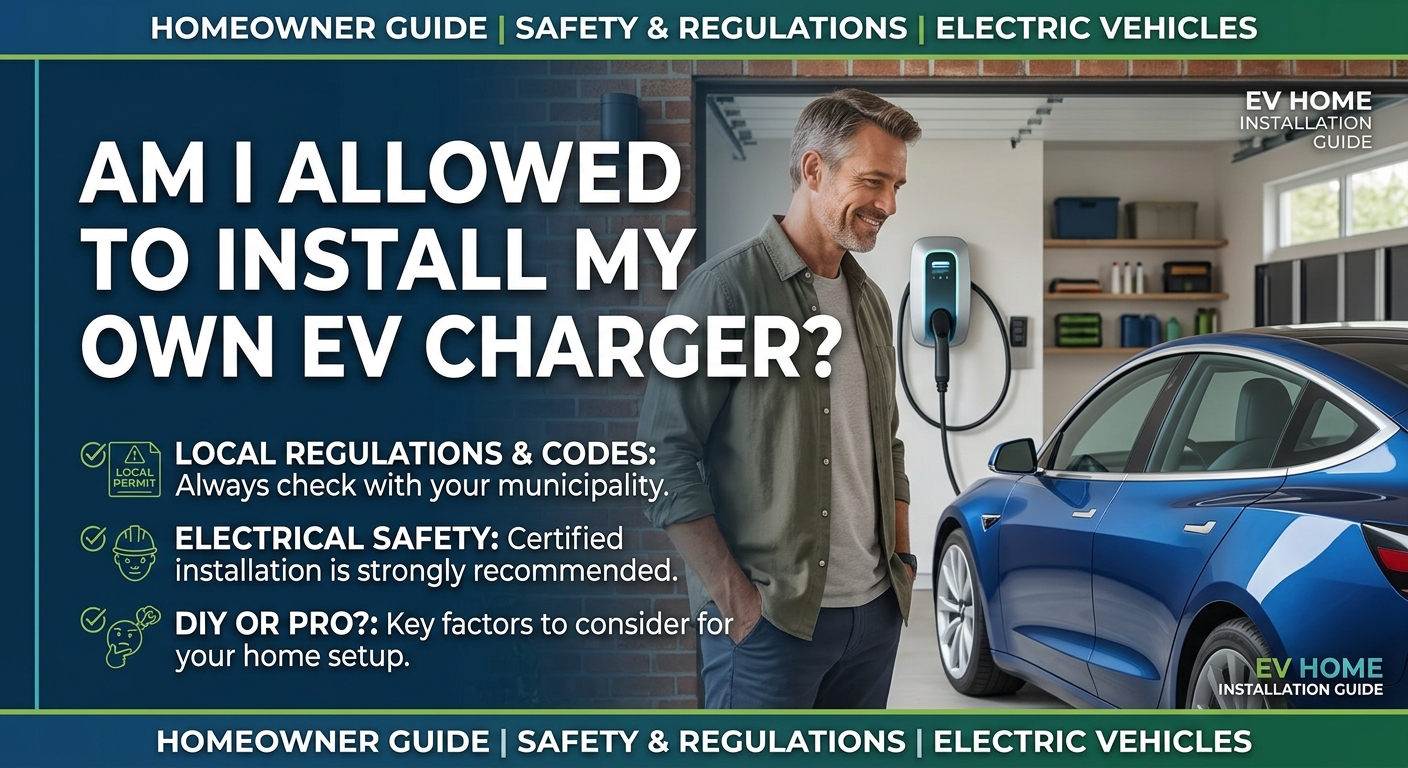
Transitioning to electric mobility offers immediate savings on daily running costs, whisper-quiet performance, and the daily convenience of starting every morning with a fully replenished battery. Delivering 20 to 44 miles of driving range per hour over a high-voltage 240-volt single-phase branch circuit, dedicated Level 2 wallboxes transform vehicle charging into an effortless overnight routine. However, as homeowners evaluate hardware costs and electrician installation quotes, a fundamental practical question arises: Am I allowed to install my own EV charger?
The short answer is: while you are generally allowed to plug in a portable Level 1 or Level 2 mobile EV connector into an existing, pre-installed NEMA 14-50 or heavy-duty wall socket, DIY hardwiring or adding new 240-volt high-amperage circuits yourself is restricted, illegal without a license in many jurisdictions, and strictly regulated under building codes.
Attempting uncertified DIY electrical work on high-draw continuous loads violates National Electrical Code (NEC Article 625) standards, voids property insurance coverage and manufacturer warranties, and introduces severe fire and electrocution risks.
For complete hardware reviews, installer guides, and panel load calculators, visit EV Charger Advisor.
1. The Two DIY Scenarios: Plug-in Connectors vs. Hardwired Installations
Understanding what you can legally and safely do yourself comes down to whether you are plugging into an existing outlet or running new high-voltage wiring:
A. Scenario 1: Plug-in Portable Chargers (100% Legal DIY)
-
How It Works: If your garage or exterior wall already features a code-compliant, electrician-installed 240V NEMA 14-50 receptacle (or standard 120V Level 1 socket) protected by a GFCI circuit breaker, you can physically mount a wall bracket and plug in a mobile charging unit yourself.
-
Permit Required: No. Plugging a safety-tested, UL/CE-listed charger into an existing outlet requires no electrical permits or licensed sign-offs.
B. Scenario 2: Hardwiring or Installing a New 240V Circuit (Licensed Electrician Required)
-
How It Works: Running heavy copper wiring (#8 AWG or #6 AWG) from your main breaker panel, installing a new 40A, 50A, or 60A double-pole breaker, and hardwiring a wallbox directly into a junction box.
-
Permit Required: Yes. In almost all jurisdictions across North America, Europe, and internationally, extending new high-voltage branch circuits legally requires an electrical permit, installation by a licensed electrician, and a sign-off inspection by local building control authorities.
To learn more about how charger power levels and wire sizes compare, check out our guide on EV charging types.
2. Four Major Risks of Uncertified DIY EV Charger Wiring
EV chargers operate as continuous loads, drawing maximum current for hours at a time. Improper DIY installation creates severe consequences:
-
Continuous Thermal Overheating: Under NEC 625.42, chargers draw continuous current. Sizing wire or breakers incorrectly without applying the 125% safety rule causes rapid insulation melting, socket terminal melting, and electrical fires.
-
Voided Property Insurance & Manufacturer Warranties: If an unpermitted DIY installation causes a garage fire or damages your vehicle’s onboard charger, insurance companies routinely deny claims, and wallbox manufacturers void all repair warranties.
-
Loss of Government & Utility Rebates: State, federal, and utility EV charger installation rebates (such as the UK OZEV grant or US utility panel upgrades) strictly require proof of installation receipts from a certified electrical contractor.
-
Missing Open-PEN & Earth Fault Protections: Uncertified installations often fail to incorporate proper Ground Fault Circuit Interrupter (GFCI) or PEN fault protection, exposing users to lethal casing shocks in wet weather.
To explore Wi-Fi-enabled smart wallboxes engineered with built-in GFCI safety mechanisms, read our guide on smarts chargers.
Step-by-Step Mathematical Example: Certified Breaker & Conductor Sizing Math
When a certified electrician installs a 48-Amp Level 2 EV Charger ($240\text{V}$ single-phase supply), they execute continuous load calculations under NEC Article 625 to determine the correct breaker and conductor gauge.
Given Parameters:
-
Continuous Charger Draw ($I_{\text{continuous}}$): $48 \text{ Amps}$
-
NEC Continuous Duty Safety Factor: $125\% \quad (1.25)$
-
Supply Line Voltage ($V$): $240 \text{ Volts}$
Calculation 1: Minimum Circuit Breaker Rating
Calculation 2: Continuous Power Delivery Output ($P$)
Calculation 3: Minimum Copper Conductor Gauge (NEC Table 310.16 at 75°C)
-
#8 AWG Copper Wire = 50A Max $\rightarrow$ INSUFFICIENT (Melting Hazard under 60A breaker)
-
#6 AWG Copper Wire = 65A Ampacity $\rightarrow$ REQUIRED
Result Breakdown: A certified installer correctly selects a 60A double-pole circuit breaker and #6 AWG copper conductors, ensuring safe, code-compliant delivery of 11.52 kW of continuous power without fire hazards.
Comparison Table: Plug-In DIY vs. Licensed Hardwired Installation
| Feature / Criteria | Plug-In Mobile Connector (DIY) | Hardwired Wallbox (Licensed Electrician) |
| Requires Existing 240V Outlet? | Yes (NEMA 14-50 receptacle) | No (Hardwired directly to new circuit) |
| Permit & Inspection Needed? | No (If outlet already exists) | Yes (Mandatory building permit) |
| Maximum Charging Output | 32A – 40A ($7.68\text{ kW} – 9.6\text{ kW}$) | 48A ($11.52\text{ kW}$) |
| Safety & Warranty Standing | Full compliance if outlet is code-valid | Maximum safety & warranty protection |
Summary & Key Takeaways
-
Plug-In Units Are DIY Friendly: You can physically mount and plug in a charger yourself if a certified 240V outlet is already installed.
-
Hardwiring Requires a License: Running new wiring, installing circuit breakers, or hardwiring a wallbox legally requires a licensed electrician and building permits.
-
Protects Property Insurance: Certified installation ensures building code compliance (NEC 625) and prevents voiding property insurance and EV warranties.
-
Enables Rebates: Utility grants and state incentives require certified electrician receipts to qualify for installation cost rebates.













Leave a Reply