
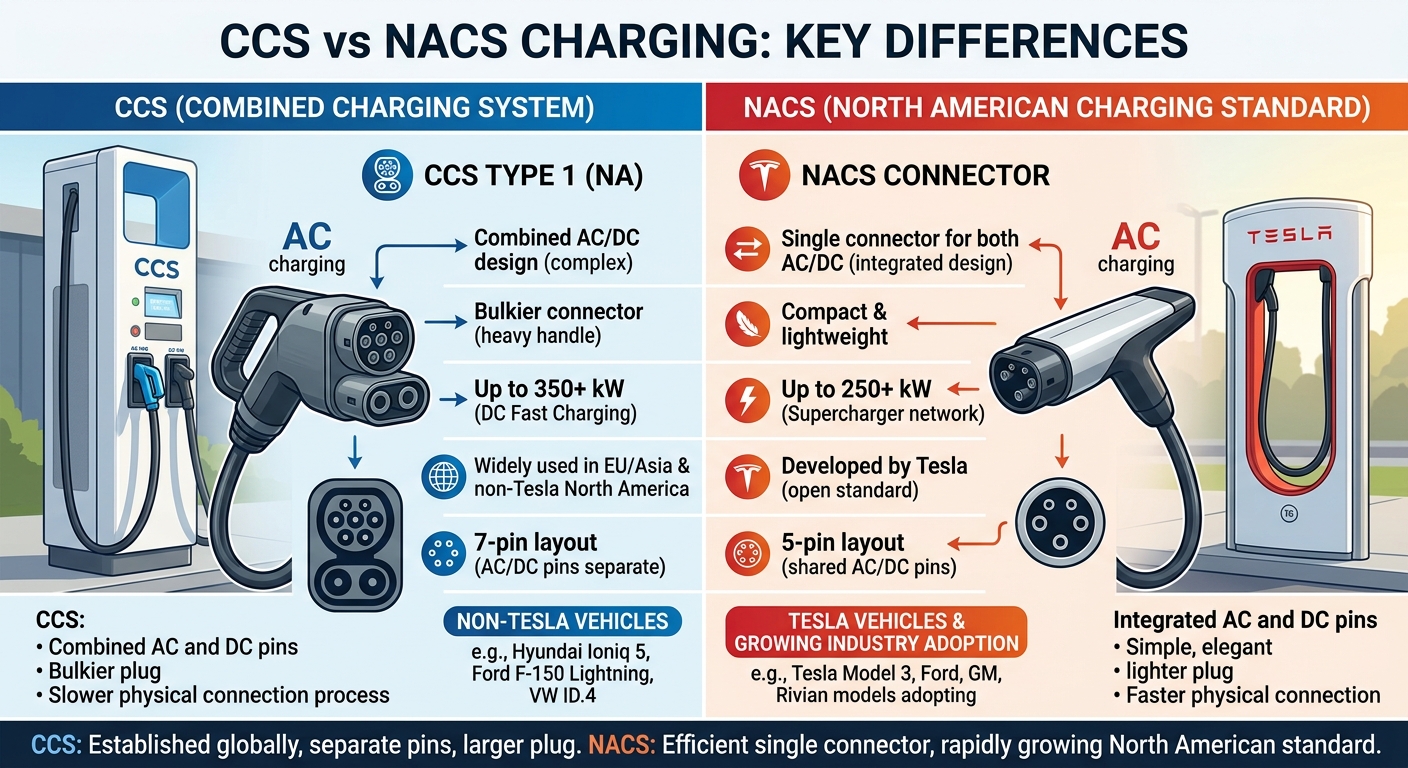
Electric vehicle (EV) charging technology is experiencing an unprecedented convergence. For years, the market in North America was divided between two major direct current (DC) fast-charging interfaces: the Combined Charging System (CCS / CCS Type 1) and Tesla’s proprietary connector, which was rebranded as the North American Charging Standard (NACS) and standardized by SAE International as SAE J3400.
If you are evaluating EV charging hardware, building public charging infrastructure, or buying a new electric car, understanding the technical, physical, and operational differences between CCS and NACS is critical.
While both connectors deliver high-voltage direct current fast-charging capabilities, they differ significantly in pin architecture, handle ergonomics, commercial grid compatibility, and market adoption strategy.
For hardware teardowns, plug comparisons, and home installation resources, visit EV Charger Advisor.
Understanding CCS and NACS: Origins & Background
To understand why two distinct standards exist, it helps to review their individual development paths.
1. The Combined Charging System (CCS / CCS1)
Introduced by a global consortium of automakers (CharIN), CCS Type 1 was created to add DC fast-charging capabilities to existing AC J1772 connectors. It achieved this by placing two large, dedicated direct-current pins beneath the standard AC socket. This “combo” design allowed vehicles to use a single body opening for both slow home charging and rapid public charging.
2. The North American Charging Standard (NACS / SAE J3400)
Originally designed by Tesla in 2012 for the Model S, NACS was engineered from day one to be ultra-compact and multi-functional. Rather than adding extra pins for DC fast charging, NACS uses a shared-pin design where the main power pins automatically switch between AC and DC power depending on the plugged-in station type. In 2023, SAE International standardized this protocol as SAE J3400.
To explore how these connector formats fit into global markets, read our comprehensive guide on EV charging types.
Physical & Mechanical Design Differences
The most noticeable difference between CCS and NACS is physical size, weight, and pin layout.
1. Pin Architecture & Layout
-
CCS Type 1 (7 Pins Total): Contains a top section with 5 AC pins (J1772 layout) for single-phase charging, plus a bottom section with 2 massive high-current DC power pins ($\text{DC+}$ and $\text{DC-}$).
-
NACS / SAE J3400 (5 Pins Total): Features 2 dual-purpose main power contacts ($\text{DC+/L1}$ and $\text{DC-/L2}$), 2 signal pins (Control Pilot and Proximity Pilot), and 1 ground contact.
2. Handle Ergonomics & Usability
-
CCS Handle: Bulky, heavy, and features a mechanical latch on the charger handle that locks into the car. The rigid, thick liquid-cooled cables can be cumbersome to manage in cold weather.
-
NACS Handle: Roughly half the size and weight of a CCS handle. It uses a sleek design with no moving mechanical latches on the plug itself; locking is handled internally by an automated latch inside the vehicle’s charge port.
Electrical Capabilities: Voltage, Amperage, and Grid Integration
Both standards are engineered to support fast charging speeds, but they achieve their performance through different electrical configurations.
1. DC Fast Charging Performance
-
CCS Type 1: Formally rated up to $350 \text{ kW}$ ($500 \text{ Amps}$ at $1,000 \text{ Volts DC}$). Legacy 800V EV architectures (like Porsche and Hyundai) utilized CCS to achieve maximum fast-charging speeds.
-
NACS (SAE J3400): Supports upwards of $350 \text{ kW} \text{ to } 1 \text{ MW}$ in updated specifications. While early Tesla Supercharger stalls operated at 400V, newer generation stations and SAE J3400 infrastructure natively support $800\text{V} – 1,000\text{V}$ high-voltage outputs.
2. Commercial AC Grid Support (277V Advantage)
A key engineering improvement specified in SAE J3400 (NACS) is native support for 277V single-phase AC charging. Commercial buildings in North America run on $480\text{V}/\text{277V}$ three-phase power. CCS1 chargers require step-down transformers to supply 208V/240V power, whereas J3400 chargers can wire directly into 277V commercial utility lines.
Step-by-Step Mathematical Example: Calculating Charging Speeds (CCS vs. NACS)
To show how real-world speeds compare, let us perform a step-by-step mathematical comparison for an electric vehicle equipped with an 80 kWh battery pack (charging from 10% to 80% state of charge).
Given Parameters:
-
Total Energy Required: $80 \text{ kWh} \times (0.80 – 0.10) = 56 \text{ kWh}$
-
CCS1 Station (150 kW Average Effective Rate): $150 \text{ kW}$
-
NACS Supercharger / SAE J3400 Station (250 kW Peak, 175 kW Average Effective Rate): $175 \text{ kW}$
Calculation 1: CCS 150 kW DC Fast Charging
Calculation 2: NACS High-Power DC Fast Charging
Result Breakdown: Both protocols offer fast charging, but high-current NACS stations can reduce road-trip charging stops to under 20 minutes.
Comprehensive Comparison Table: CCS vs. NACS
| Technical Feature | CCS Type 1 (Legacy Standard) | NACS / SAE J3400 (Unified Standard) |
| Primary Region | North America (Legacy) / Europe (CCS2) | North America |
| Physical Design | Bulky, Dual-Port “Sandwich” | Compact, Single Integrated Plug |
| Pin Layout | 7 Pins (Separate AC & DC) | 5 Pins (Shared AC & DC) |
| Mechanical Latch | Exposed Latch on Charger Handle | Electronic Solenoid Lock inside Vehicle Port |
| Supported AC Voltage | $120\text{V} / 240\text{V}$ | $120\text{V} / 240\text{V} / 277\text{V}$ |
| Peak Power Rating | Up to $350 \text{ kW}$ | Up to $350 \text{ kW} – 1 \text{ MW}$ |
| Communication Protocol | ISO 15118 / DIN 70121 (PLC) | ISO 15118 / DIN 70121 (PLC) |
Communication & Interoperability
A major technical milestone in the standardization of NACS as SAE J3400 was adopting the exact same communication language as CCS.
Both modern NACS and CCS use Powerline Communication (PLC) over the Control Pilot line running on ISO 15118 protocols. Because both interfaces speak the same digital language, simple passive adapters allow:
-
CCS-equipped vehicles to charge at NACS stations using a NACS-to-CCS adapter.
-
NACS-equipped vehicles to charge at CCS public stations using a CCS-to-NACS adapter.
-
Automated Plug & Charge billing without needing smartphone apps or RFID credit cards.
To explore smart charging options for residential home setups, read our guide on smart chargers.
Summary & Key Takeaways
-
Physical Ergonomics: NACS features a lightweight, sleek 5-pin handle, whereas CCS uses a heavier 7-pin combo design.
-
Shared vs. Dedicated Pins: NACS uses the same primary power contacts for both AC and DC charging, while CCS uses separate pins for AC and DC.
-
Grid Advantage: SAE J3400 (NACS) offers direct support for 277V commercial grid power, lowering station installation costs.
-
Market Direction: NACS (SAE J3400) is the dominant standard across North America, with automakers integrating native J3400 ports into new EV models.






Leave a Reply