
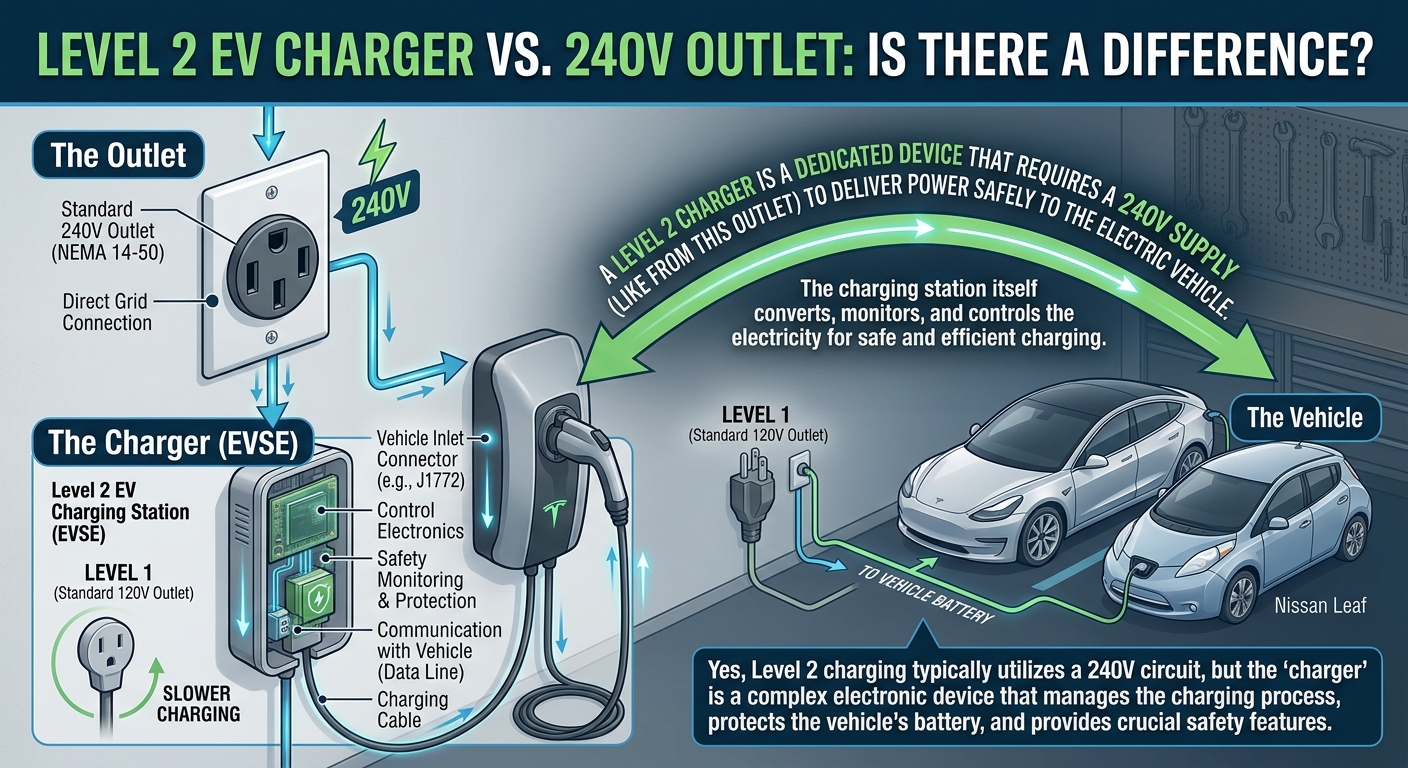
When setting up home charging infrastructure for an electric vehicle, new EV owners often encounter two terms used interchangeably: a 240V heavy-duty electrical outlet (such as a NEMA 14-50 or NEMA 6-50 receptacle) and a Level 2 EV charger (technically called Electric Vehicle Supply Equipment, or EVSE). Because both supply high-voltage 240-volt power to charge an electric car, drivers frequently ask: Is a Level 2 EV charger just a 240V outlet?
The short answer is: no, a Level 2 EV charger is not just a 240V outlet.
While a 240V outlet is simply a passive electrical socket mounted on your wall that supplies high-voltage power, a Level 2 EV charger is an intelligent safety control unit equipped with specialized communication protocols, automated circuit protection, Ground Fault Circuit Interruption (GFCI), smart connectivity, and physical charging cables designed to interface safely with your car’s battery management system.
Understanding the distinction between passive electrical receptacles and active Level 2 EVSE hardware ensures your home charging installation remains safe, compliant, and efficient.
For comprehensive hardware reviews, installer guides, and wiring charts, visit EV Charger Advisor.
1. Passive Outlet vs. Active EVSE: Understanding the Technology
To understand why a Level 2 charger is far more than a simple wall socket, it helps to break down the technical differences between passive outlets and active charging stations:
The 240V Wall Outlet (Passive Electrical Connector)
A standard 240V wall socket (such as a NEMA 14-50 used for electric clothes dryers or RV parks) is completely “dumb.” It maintains live electrical voltage at its contacts at all times. It has no microprocessors, no safety communication relays, no temperature monitoring sensors, and no ability to adjust or cut power flow if a electrical fault occurs downstream.
The Level 2 EV Charger / EVSE (Active Safety Unit)
A Level 2 wallbox acts as an active intermediary control station between your home panel and your vehicle:
-
Control Pilot Protocol (SAE J1772 / NACS): Before delivering any electrical voltage, the wallbox uses low-voltage pilot signal communication to “handshake” with the vehicle’s onboard charger.
-
Dead-Cable Safety: The flexible charging cable plugged into your car remains completely de-energized (0 Volts) until the vehicle and wallbox establish a secure signal connection.
-
Integrated GFCI & Thermal Sensing: Modern Level 2 wallboxes incorporate sensitive internal Ground Fault Circuit Interruption (GFCI) monitoring and continuous plug temperature sensing to prevent arc faults and electrical fires.
To learn more about how charger power levels and plug styles compare, check out our guide on EV charging types.
2. Hardwired Level 2 Chargers vs. Plug-In 240V Outlets
When installing Level 2 home charging, you must choose between plugging a portable/wallbox unit into a 240V receptacle or hardwiring the wallbox directly:
Option A: Plug-In EV Chargers (NEMA 14-50 / 6-50 Outlet)
-
Amperage Cap: Capped at 40 Amps maximum continuous draw ($9.6\text{ kW}$) on a 50-Amp circuit breaker under the National Electrical Code (NEC) 80% continuous load rule.
-
Added Requirements: NEC standards mandate installing expensive industrial-grade GFCI circuit breakers ($100–$150) and commercial-grade outlets to withstand continuous thermal heat cycles without melting standard residential sockets.
Option B: Hardwired Level 2 Wallboxes (Direct Wire Connection)
-
Amperage Speed: Supports up to 48 Amps continuous draw ($11.5\text{ kW}$) on a 60-Amp circuit breaker, delivering up to 44 miles of range per hour.
-
Superior Safety: Completely eliminates plug-and-socket contacts, removing the risk of socket meltdowns or thermal degradation over time.
To explore Wi-Fi-enabled smart chargers that support automated energy scheduling, read our guide on smart chargers.
Step-by-Step Mathematical Example: Power & Efficiency Comparison
Let us compare the electrical performance and charge duration of a Plug-In 240V Outlet setup (40A continuous draw) versus a Hardwired Level 2 Wallbox setup (48A continuous draw) when restoring 60 kWh of energy into an EV battery pack.
Given Parameters:
-
Energy Required: $60 \text{ kWh}$
-
Operating Supply Voltage: $240 \text{ Volts}$
-
Onboard AC-to-DC Charging Efficiency: $90\%$ ($0.90$)
Calculation 1: Power Output & Charge Time on a 240V Plug-In Outlet (40A Draw / 50A Breaker)
Calculation 2: Power Output & Charge Time on a Hardwired Level 2 Charger (48A Draw / 60A Breaker)
Result Breakdown: Hardwiring a dedicated Level 2 wallbox delivers $11.52\text{ kW}$ of power, reducing total charging time by over 1 hour compared to plugging into a standard 240V outlet.
Comparison Table: 240V Wall Outlet vs. Level 2 EV Charger (EVSE)
| Feature | 240V Heavy-Duty Wall Outlet | Dedicated Level 2 EV Charger (EVSE) |
| Function | Passive electrical current pass-through | Active smart controller & safety hub |
| Max Continuous Draw | $40 \text{ Amps } (9.6\text{ kW})$ | 48 Amps ($11.52\text{ kW}$ Hardwired) |
| Safety Handshake | None (Pins remain live) | Active J1772 / NACS signal verification |
| Ground Fault Protection | Requires expensive external GFCI breaker | Built-in internal automatic GFCI |
| Smart Features | None | Wi-Fi control, scheduling, energy tracking |
| Physical Cable | None (User must bring cable) | Integrated heavy-duty $18\text{ft}-25\text{ft}$ cable |
Summary & Key Takeaways
-
Active Controller, Not Just an Outlet: A Level 2 EV charger is an intelligent EVSE safety device that actively controls current flow, communicates with your vehicle, and provides integrated circuit protection.
-
240V Outlets Are Passive Sockets: A 240V wall socket simply supplies raw high-voltage electricity and requires a separate portable charging cable to operate.
-
Hardwiring Unlocks Maximum Speed: Hardwiring a Level 2 charger allows $48\text{A}$ ($11.5\text{ kW}$) output on a 60A breaker, whereas plug-in 240V outlets are capped at $40\text{A}$ ($9.6\text{ kW}$).
-
Hardwiring Improves Thermal Safety: Direct hardwiring eliminates socket contact points, avoiding potential overheating and socket wear associated with heavy continuous charging.













Leave a Reply