
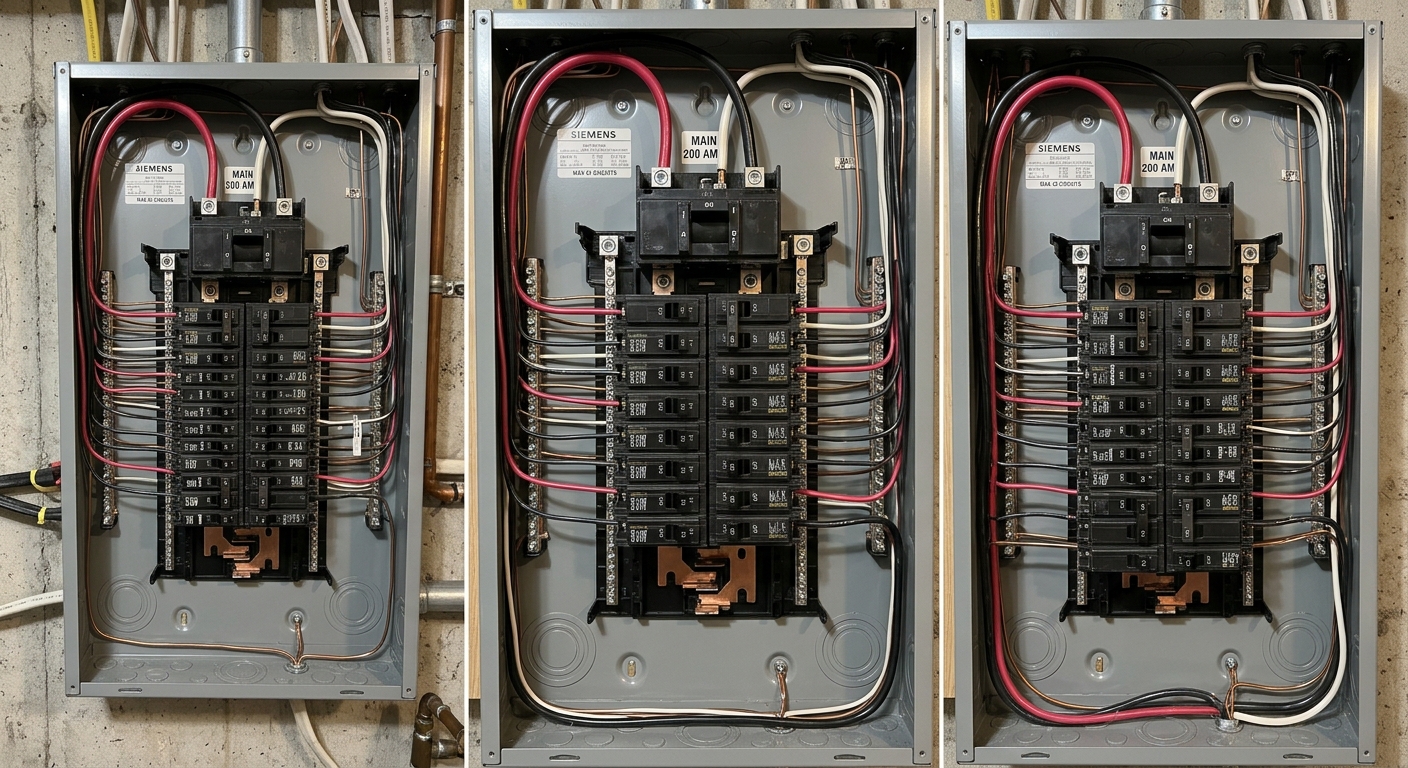
When upgrading your home electrical system or planning the installation of a high-power Level 2 electric vehicle (EV) charger, checking your breaker panel’s physical capacity is just as important as calculating total amperage load. A frequent question homeowners ask electricians when adding a double-pole EV charging circuit is: How many breakers are allowed in a 200-amp electrical panel?
The short answer is: a standard 200-amp electrical panel typically has 40 to 42 physical breaker spaces, though modern panel models support up to 54–60 individual circuits using tandem (twin) breakers.
While physical slot availability dictates whether you can physically snap in a new double-pole breaker for an EV charger, electrical codes and panel busbar ratings dictate total safe electrical load. Understanding how physical spaces, tandem breakers, and circuit limitations interact ensures a code-compliant home charging installation.
For comprehensive load calculators, hardware reviews, and installation guides, visit EV Charger Advisor.
1. Physical Spaces vs. Maximum Circuit Limits
To understand panel capacity, you must distinguish between physical slots and total allowable circuits:
Physical Spaces (Spaces / Stab Positions)
A standard residential 200-amp panel enclosure typically features 20 to 40 physical spaces down the center busbar. Each physical space can accept either a single-pole breaker ($120\text{V}$) or one side of a double-pole breaker ($240\text{V}$).
Designations (e.g., “40/40” or “42/42”)
Older panel labels often show markings like “40/40,” meaning the panel has 40 physical spaces designed to accept a maximum of 40 individual circuits. Modern panels often feature ratings like “42/54” or “30/60,” indicating they are engineered to accept tandem breakers in designated slots to expand total circuit capacity.
To learn more about how charger power ratings and breaker sizes compare, check out our guide on EV charging types.
2. The Evolution of the NEC “42-Circuit Rule”
For decades, the National Electrical Code (NEC) enforced the famous “42-Circuit Rule” (former NEC Section 384-15), which legally capped lighting and appliance branch circuit panels at a maximum of 42 circuits, regardless of physical space availability.
Current NEC Standards (NEC Article 408.54)
The National Electrical Code removed the blanket 42-circuit restriction. Today, modern 200-amp panels are permitted to house as many circuits as their manufacturer’s listing allows, provided:
-
The panel enclosure and busbars are certified and listed for those specific tandem breakers.
-
Total electrical load calculation limits (NEC Article 220) are strictly observed.
3. Step-by-Step Mathematical Example: Calculating Breaker Slots for an EV Charger
Let us calculate physical panel slot availability for a homeowner wanting to install a Level 2 EV charger requiring a double-pole 50-amp breaker in a panel that currently has 38 active single-pole breakers installed across 38 physical slots.
Given Panel Parameters:
-
Total Physical Spaces Available: 40 Spaces
-
Currently Occupied Single-Pole Breakers: 38 Single-Pole Breakers (occupying 38 slots)
-
Required EV Charger Breaker: 1 Double-Pole Breaker (requires 2 adjacent vertical slots)
Calculation 1: Calculating Remaining Unoccupied Physical Spaces
Calculation 2: Verifying Fit for the EV Charger Double-Pole Breaker
Result Breakdown: The 50A double-pole EV breaker fits into the final 2 remaining slots exactly. However, if the panel was completely full (40 out of 40 slots occupied by single-pole breakers), the electrician would need to install tandem breakers to free up 2 adjacent slots without upgrading the entire panel box.
To explore Wi-Fi-enabled smart chargers that support dynamic energy management, read our guide on smart chargers.
4. Managing Panel Slot Shortages: Tandem Breakers & Subpanels
If your 200-amp panel is physically out of slot space but has plenty of electrical amperage capacity left, you have two primary methods to make room for an EV charger:
1. Install Tandem (Twin) Breakers
Tandem breakers combine two independent single-pole switches into a single physical 1-inch breaker space. By replacing two standard single-pole breakers with one twin tandem breaker in a code-approved panel slot, your electrician instantly frees up 1 physical space for your EV double-pole breaker.
2. Install a Dedicated Subpanel
If your main 200A panel is completely packed with tandem and standard breakers, installing a 100A subpanel near your garage or parking area provides dozens of new breaker slots and centralizes your EV charging infrastructure.
Comparison Table: 200A Panel Configurations & Slot Capacities
| Panel Design Type | Physical Spaces | Max Circuits (With Tandems) | Ideal For |
| Standard Main Panel | 30 to 40 Spaces | 30 to 40 Circuits | Homes with minimal branch circuits |
| Modern High-Capacity Panel | 40 to 42 Spaces | 54 to 60 Circuits | Modern homes with EV chargers & solar |
| Main Panel + Subpanel | 40 Spaces + 12 Spaces | 64+ Circuits | Large homes with heavy electrification |
Summary & Key Takeaways
-
Standard Slot Count: A typical 200-amp electrical panel features 40 to 42 physical breaker spaces.
-
Double-Pole Requirement: An EV charger requires a double-pole breaker that occupies 2 adjacent vertical physical slots.
-
Tandem Breakers Free Up Space: If your panel is full, code-approved tandem breakers can consolidate single circuits to create room for your EV charger.
-
Check Amperage Capacity Too: Having physical slot space does not guarantee your panel has remaining electrical amperage headroom—always perform an NEC load calculation.













Leave a Reply