
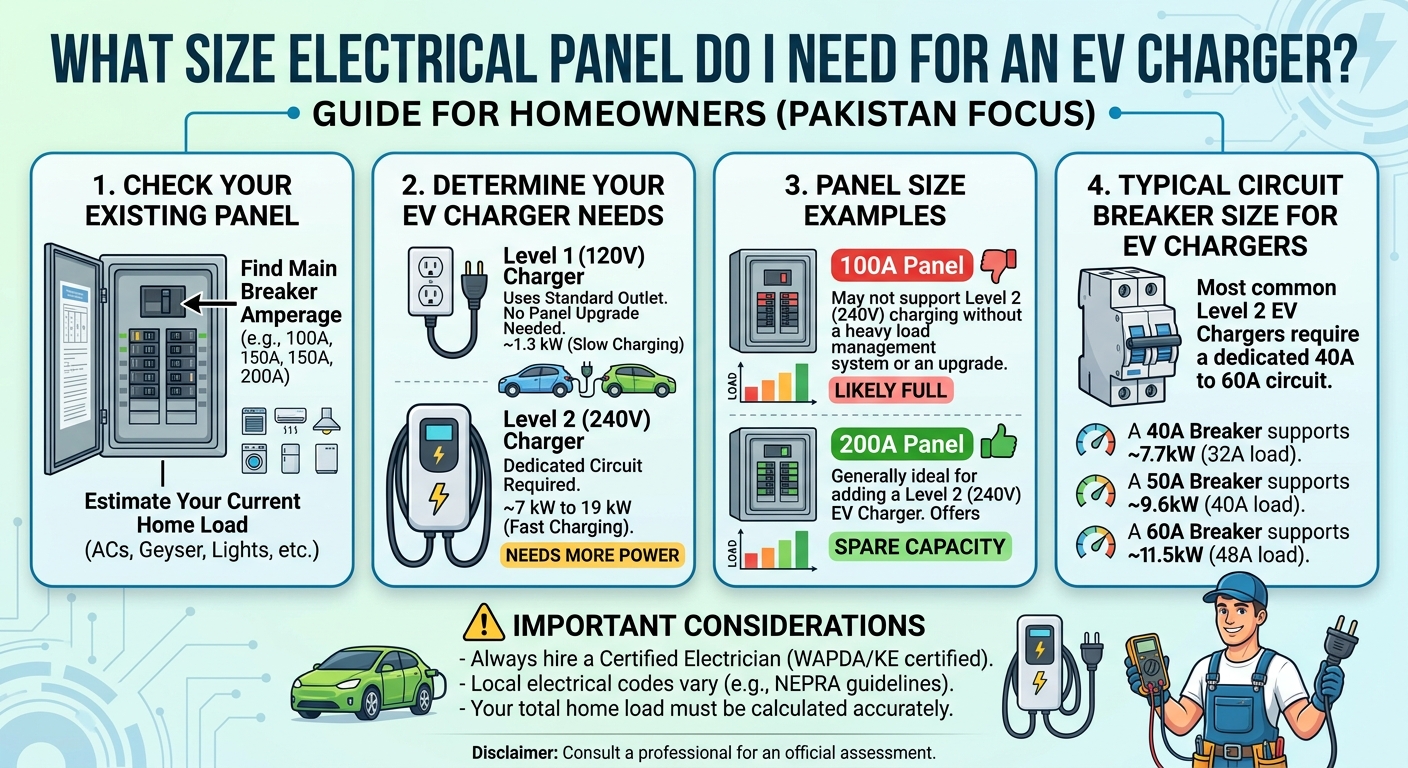
Upgrading your home to support a Level 2 electric vehicle (EV) charger provides maximum daily driving convenience, allowing you to replenish your vehicle’s battery pack fully overnight. Operating on a dedicated $240\text{-volt}$ branch circuit, Level 2 wallboxes deliver 25 to 37 miles of driving range per hour. However, during initial site planning with a licensed electrician, one of the most vital questions you must answer is: What size electrical panel do I need for an EV charger?
The short answer is: a 200-amp electrical panel is the modern standard and the recommended minimum size for a trouble-free Level 2 EV charger installation, though a 100-amp panel can often work if your home’s overall electrical demand is low or if you use smart energy management.
Understanding how your main electrical panel capacity interacts with Level 2 charger amperage requirements, continuous load rules under the National Electrical Code (NEC), and household energy consumption ensures a safe, optimized home charging setup.
For comprehensive load calculators, hardware reviews, and installation guides, visit EV Charger Advisor.
Understanding Main Electrical Panel Sizes & Capacity Limits
Your residential main electrical panel (or breaker box) serves as the central distribution point for all electrical current entering your home. Panels are rated by their total amperage capacity at $240\text{ Volts}$:
-
100-Amp Electrical Panel ($24,000\text{ Watts}$ Total Capacity): Common in older homes built before 1990, townhomes, and smaller urban residences.
-
125-Amp / 150-Amp Panel ($30,000 – 36,000\text{ Watts}$ Total Capacity): Common in mid-sized homes constructed in the 1990s and 2000s.
-
200-Amp Electrical Panel ($48,000\text{ Watts}$ Total Capacity): The modern standard for new residential construction, supporting high-draw home electrification needs.
-
400-Amp Panel ($96,000\text{ Watts}$ Total Capacity): Designed for large luxury estates, multi-family properties, or homes with multiple EV chargers and dual central AC units.
Under NEC Article 625, EV charging is classified as a continuous load (drawing maximum current continuously for 3 hours or longer). Consequently, branch circuit breakers and wires must be sized to 125% of the charger’s continuous draw—meaning a charger drawing $48\text{ Amps}$ requires a dedicated 60-Amp double-pole circuit breaker.
To learn more about how charger power levels and wire sizes compare, check out our guide on EV charging types.
Step-by-Step Mathematical Example: Panel Load Calculation (NEC Article 220)
To determine if your existing panel can support an EV charger without tripping the main breaker, a licensed electrician performs a load calculation under NEC Article 220.
Let us calculate the panel margin for a 100-Amp panel ($24,000\text{W}$ max) versus a 200-Amp panel ($48,000\text{W}$ max) in a home with a $14,400\text{-Watt}$ ($60\text{-Amp}$) baseline household demand.
Given Parameters:
-
Baseline House Demand: $14,400 \text{ Watts} = 60 \text{ Amps @ 240V}$
-
Continuous Safety Limit (80% Rule):
-
100A Panel Limit: $100\text{A} \times 0.80 = \mathbf{80 \text{ Amps (19,200 Watts)}}$
-
200A Panel Limit: $200\text{A} \times 0.80 = \mathbf{160 \text{ Amps (38,400 Watts)}}$
-
-
Target Level 2 Charger Output (48A Continuous / 60A Breaker): $11,520 \text{ Watts}$ ($48\text{A} \times 240\text{V}$)
Calculation 1: Evaluating the 100-Amp Electrical Panel
Result: The total demand ($25,920\text{W}$) exceeds both the safe 80% continuous limit ($19,200\text{W}$) and the absolute panel capacity ($24,000\text{W}$). A full 48A charger cannot be added to this 100A panel without load management or de-rating.
Calculation 2: Evaluating the 200-Amp Electrical Panel
Result: The total load sits far below the 160A continuous limit ($108\text{A} < 160\text{A}$). The 200-amp panel handles the full 48A charging load effortlessly with $52\text{ Amps}$ of spare continuous margin.
3 Ways to Install an EV Charger If You Have a 100A Panel
If your home currently has a 100-amp electrical panel, you do not automatically need to spend $3,000 to $6,000 on a full service upgrade. Consider these 3 strategies:
1. Configure Software Amperage De-Rating
Most modern smart wallboxes allow installers to adjust internal DIP switches or commissioning software. Configuring your charger to draw 24 Amps ($5.76\text{ kW}$ on a 30A breaker) or 16 Amps ($3.84\text{ kW}$ on a 20A breaker) fits safely within tight 100A panel margins while still delivering 12 to 22 miles of range per hour—4 to 5 times faster than a standard wall socket.
2. Install an EV Energy Management System (EVEMS)
An EVEMS or smart load shedding device monitors live panel current using current transformer (CT) clamps. If central air conditioning or electric ovens turn on, the EVEMS automatically pauses or throttles EV charging, resuming maximum speed late at night when home energy consumption drops.
3. Upgrade to a 200-Amp Service Panel
If you plan to fully electrify your home (adding heat pumps, solar, induction ranges, or a second EV), upgrading to a 200-amp main panel provides complete long-term flexibility and supports uninhibited 48A ($11.5\text{ kW}$) Level 2 charging.
To explore Wi-Fi-enabled smart chargers that support dynamic power management, read our guide on smart chargers.
Comparison Table: Panel Sizes vs. Level 2 EV Charger Compatibility
| Main Panel Rating | Max Safe Continuous Power | Max Level 2 Charger Output | Added Range per Hour | Panel Upgrade Recommended? |
| 100 Amps | $19.2 \text{ kW } (80\text{A})$ | 16A – 24A (Or Dynamic EVEMS) | $12 – 22 \text{ miles/hr}$ | No (If de-rated or using EVEMS) |
| 125 / 150 Amps | $24.0 – 28.8 \text{ kW}$ | 32A – 40A | $22 – 34 \text{ miles/hr}$ | Optional |
| 200 Amps | 38.4 kW $(160\text{A})$ | 48A ($11.52\text{ kW}$ on 60A Breaker) | 36 – 44 miles/hr | No (Ideal Modern Standard) |
| 400 Amps | 76.8 kW $(320\text{A})$ | Dual 48A Chargers ($23\text{ kW}$ Total) | $36 – 44 \text{ miles/hr}$ per car | No (Luxury / Multi-EV Setup) |
Summary & Key Takeaways
-
200-Amp Is the Ideal Standard: A 200-amp electrical panel is the recommended minimum size for uninhibited $48\text{A}$ ($11.5\text{ kW}$) Level 2 charging alongside full household electrical loads.
-
100-Amp Panels Can Work: If your baseline household demand is low or you de-rate the charger output to $24\text{A}$ on a 30A breaker, a 100A panel can handle Level 2 charging safely.
-
Smart EVEMS Saves Money: Using a dynamic load management device allows fast off-peak charging on a 100A panel without paying thousands for a service panel upgrade.
-
Perform an NEC Article 220 Load Calculation: Always consult a licensed electrician to evaluate your panel’s continuous capacity before purchasing hardware or installing breakers.













Leave a Reply