
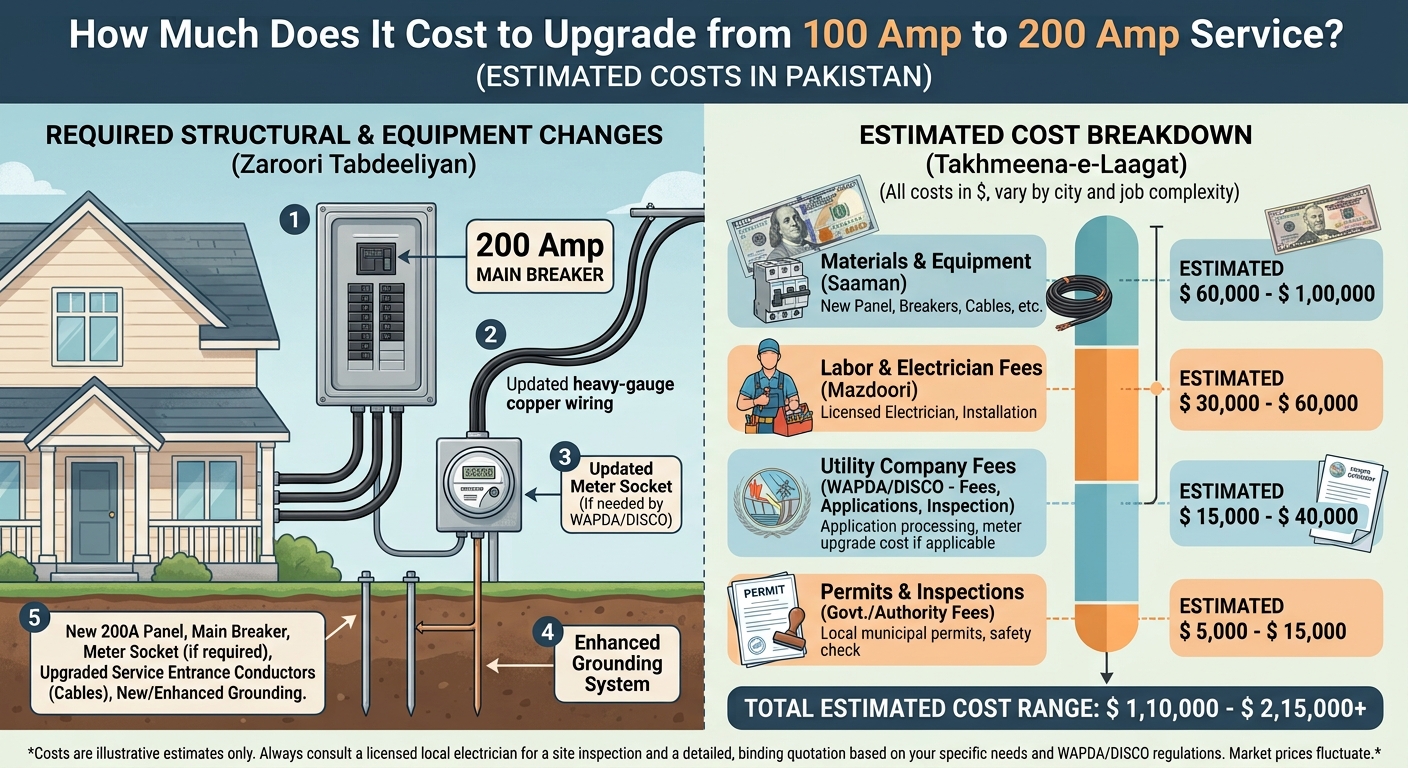
Upgrading your property’s electrical supply from 100-amp to 200-amp service is one of the most effective ways to modernise your home’s infrastructure. As electric vehicle (EV) adoption surges, adding high-power Level 2 charging stations (40A to 60A circuits), heat pumps, or solar PV systems often exhausts the capacity of older 100A panels.
The cost to upgrade from a 100 Amp to a 200 Amp electrical service typically ranges from $3,000 to $6,000 for a full service upgrade.
While a basic “panel-only” replacement with existing service lines might cost between $1,500 and $3,000, a complete utility-level service upgrade—including heavy entrance cables, meter socket replacement, weatherhead modifications, and city permitting—routinely reaches $3,000 to $6,000+.
For comprehensive load calculators, hardware reviews, and home installation guides, visit EV Charger Advisor.
Key Components That Drive Service Upgrade Expenses
Upgrading to 200-amp service is far more involved than simply swapping a breaker box on the garage wall. A complete utility service upgrade encompasses several interconnected components:
1. Utility Service Entrance Cables & Meter Socket ($1,000 – $2,500)
Your local power utility (such as LESCO, K-Electric, or regional providers) feeds electricity from the main transformer to your home. Upgrading to 200A requires replacing thin entrance wires with heavy 2/0 AWG copper or 4/0 AWG aluminum service conductors and installing a certified 200-amp rated outdoor meter socket.
2. Main Breaker Panel & Busbar Hardware ($500 – $1,200)
The interior 200A main panel enclosure houses thick copper or aluminum busbars, a 200-amp main disconnect breaker, and space for 30 to 40 individual branch circuit breakers.
3. Licensed Electrician Labor ($1,200 – $2,500)
A complete service upgrade takes a certified master electrician 8 to 16 hours of labor. This involves coordinating utility power shut-offs, pulling main service cables, grounding connections, and organizing existing household branch circuits.
4. Municipal Permits, Utility Fees & Inspections ($200 – $500)
City building departments mandate electrical building permits and formal inspections before the utility company will reconnect main high-voltage service lines to your weatherhead.
To learn more about how charger power ratings and panel capacities compare, check out our guide on EV charging types.
Step-by-Step Mathematical Example: Project Cost & Tax Credit ROI
To see how a 200A panel upgrade combined with a Level 2 EV charger installation balances out financially, let us calculate the net investment after applying potential energy efficiency tax incentives.
Given Project Expenses:
-
200A Full Utility Service Upgrade: $4,200
-
Level 2 Smart EV Charger Hardware (48A): $600
-
Dedicated 60A Circuit Installation: $700
-
Gross Project Cost: $\$4,200 + \$600 + \$700 = \mathbf{\$5,500}$
Calculation 1: Federal IRS Section 30C Tax Credit (30% Discount on EV Hardware & Circuit)
Under federal tax incentive programs, qualifying EV charging equipment and dedicated electrical circuit installations receive a 30% tax credit:
Calculation 2: Calculating Net Out-of-Pocket Expense
Result Breakdown: While the initial upgrade represents a gross investment of $5,500, tax credits help reduce out-of-pocket costs to $5,110, completely future-proofing your electrical system for high-speed EV charging and modern home electrification.
Underground vs. Overhead Service Lines: Cost Differences
How power enters your property significantly affects labor duration and overall pricing:
1. Overhead Weatherhead Lines (Lower Cost: $3,000 – $4,500)
If electrical utility lines run overhead from a utility pole to a mast on your roof or exterior wall, upgrading the service cable and meter enclosure is accessible and straightforward.
2. Underground Lateral Lines (Higher Cost: $4,500 – $8,000+)
If main service lines run underground, upgrading to heavy 200A wire requires underground trenching across yards or driveways, conduit burial, and coordination with utility excavation teams, pushing total costs significantly higher.
To explore Wi-Fi-enabled wallboxes that support dynamic energy scheduling, read our guide on smart chargers.
Cost Comparison Table: 100A to 200A Service Upgrade Scenarios
| Upgrade Scope | Typical Labor Duration | Component Costs | Average Total Cost |
| Panel Swap Only (Service lines already 200A) | 4 – 6 Hours | 200A Panel & Breakers | $1,500 – $2,800 |
| Standard Overhead Service Upgrade | 8 – 12 Hours | Meter, Mast, Cable & Panel | $3,000 – $5,000 |
| Complex Underground Service Upgrade | 1 – 2 Days | Trenching, Heavy Conduit & Panel | $4,500 – $8,000+ |
| Panel Upgrade + 48A EV Charger | 1 – 2 Days | Service Upgrade + Charger & 60A Circuit | $4,500 – $6,500 |
Summary & Key Takeaways
-
Typical Budget Range: A full 100A to 200A utility service upgrade costs $3,000 to $6,000 on average.
-
Essential for Full Electrification: Upgrading to 200A provides $38.4\text{ kW}$ of total capacity, unlocking uninhibited 48A Level 2 EV charging ($11.5\text{ kW}$) alongside central AC and heat pumps.
-
Underground Costs More: Underground trenching and lateral conduit burial add substantial labor costs compared to overhead line upgrades.
-
Leverage Tax Incentives: Combine your panel upgrade with an EV charger installation to claim tax credit savings on equipment and wiring labor.













Leave a Reply