
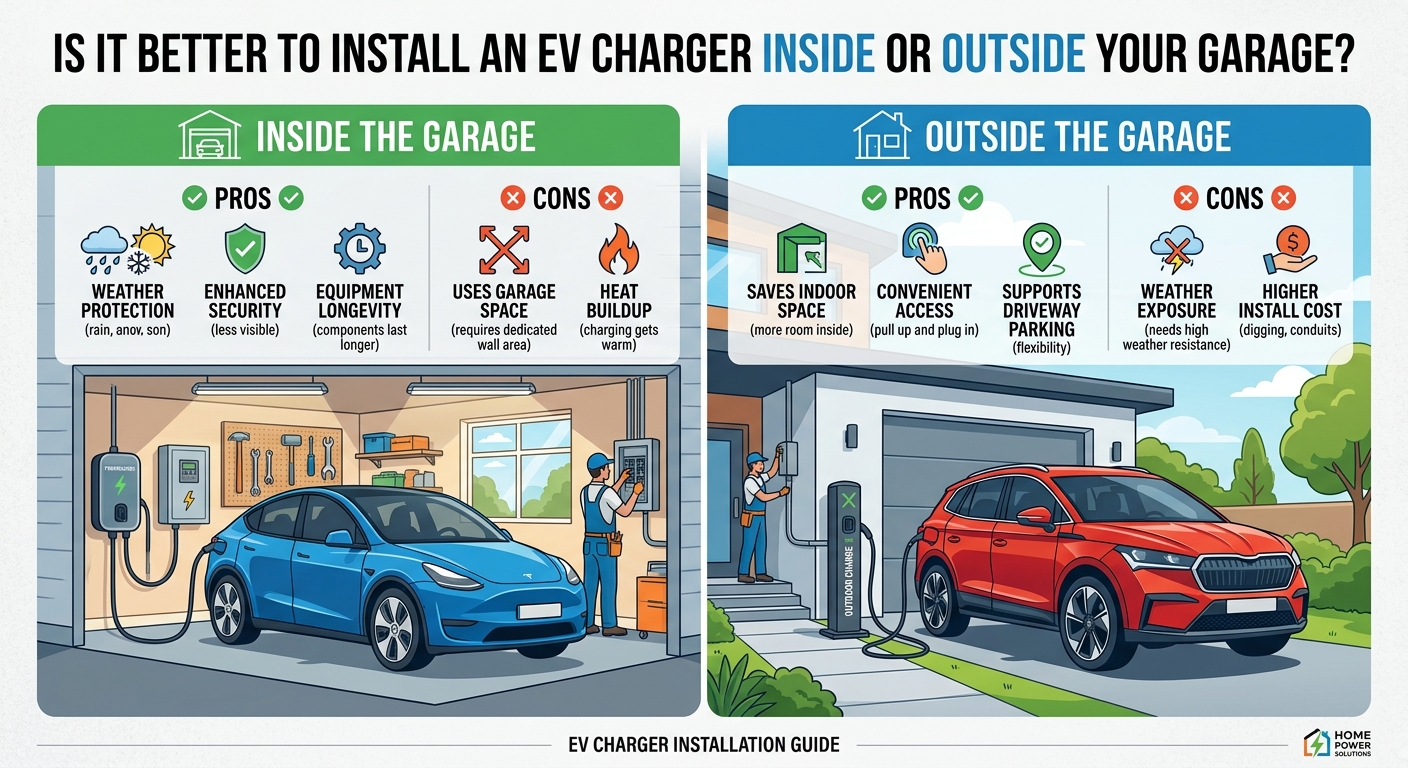
Upgrading your home to support a Level 2 electric vehicle (EV) charger provides maximum daily charging convenience, adding 25 to 37 miles of range per hour overnight. However, during site planning with an electrician, one of the primary decisions you must make is equipment placement: Is it better to install an EV charger inside or outside my garage?
The short answer is: installing an EV charger inside your garage is generally better and more cost-effective if you routinely park your vehicle inside, while an outdoor installation is better if you routinely park in the driveway, carport, or lack interior garage space.
While most modern Level 2 chargers carry weatherproof ratings (such as NEMA 4 / IP65 or higher) for outdoor operation, indoor installations offer superior hardware protection from extreme weather, added physical security, and lower upfront installation material expenses.
For complete hardware guides, weatherproof wallbox reviews, and installation breakdowns, visit EV Charger Advisor.
Pros & Cons of Indoor Garage EV Charger Installation
Installing your Level 2 wallbox inside an attached or detached garage remains the most common residential configuration.
Advantages:
-
Maximum Weather & Hardware Protection: Indoor installation shields the wallbox, charging cable, and vehicle port from direct rain, snow, freezing ice, UV radiation, and severe ambient heat. This reduces thermal degradation and prolongs hardware lifespan.
-
Lower Installation Costs: Indoor electrical setups typically do not require specialized weatherproof conduit, “extra-duty” outdoor junction hoods, or underground trenching.
-
Physical Security & Tampering Protection: Keeping the charger behind a closed garage door protects the unit from vandalism, cable theft, or unauthorized energy access by neighbors.
Disadvantages:
-
Garage Parking Requirement: Requires keeping your garage decluttered enough to comfortably park your vehicle inside every night.
-
Limited Cable Pass-Through: Passing a heavy 240V charging cable under a closed garage door to reach a driveway-parked car can pinch, damage, or fray the thick rubber cable jacket over time, creating safety hazards and violating building codes.
To explore connector standards and plug styles, check out our detailed guide on EV charging types.
Pros & Cons of Outdoor Driveway EV Charger Installation
If you use your garage for workshop space or storage, or regularly park multiple vehicles in the driveway, an exterior wall or pedestal installation is ideal.
Advantages:
-
Convenient Driveway Access: Allows you to plug in directly where you park without navigating tight garage spaces or moving stored household items.
-
Flexible Multi-Vehicle Access: Positioned on an exterior wall or central post between two parking bays, a single charger with an $18\text{-foot}$ to $25\text{-foot}$ cable can easily reach two vehicles parked outside.
Disadvantages:
-
Higher Upfront Installation Costs: Outdoor setups often require NEMA 4 / IP65 weatherproof enclosures, extra-duty weatherproof outlet covers, metallic liquid-tight conduit, and higher mounting clearances off the ground (minimum 24 inches per NEC codes).
-
Exposure to Thermal Extremes: Direct exposure to harsh sunlight or freezing winter temperatures can temporarily reduce charging power or stiffen heavy copper cables, making handling cumbersome.
To learn more about smart home charging management, explore our guide on smart chargers.
Step-by-Step Mathematical Example: Installation Cost Comparison
To see how indoor vs. outdoor placement impacts your budget, let us calculate the total installation cost for an indoor garage setup ($15\text{-foot}$ wire run) versus an outdoor driveway setup ($45\text{-foot}$ run with weatherproof conduit and trenching).
Given Project Costs:
-
Smart Level 2 Wallbox Hardware (NEMA 4 Rated): $600
-
Electrician Labor Rate: $100 \text{ per hour}$
-
Standard Interior Wiring & Breaker: $150
-
Outdoor Weatherproof Conduit, GFCI, & Heavy Wiring: $400
-
Underground Trenching / Exterior Wall Labor: $300
Calculation 1: Indoor Garage Setup Total Cost
Calculation 2: Outdoor Driveway Setup Total Cost
Calculation 3: Federal Tax Credit Discount (30% IRS Section 30C)
Result Breakdown: While an outdoor setup costs roughly $800 more in materials and labor, tax credit incentives help offset the difference, making both options highly accessible depending on your parking habits.
Comparison Table: Indoor vs. Outdoor EV Charger Placement
| Feature | Indoor Garage Installation | Outdoor Driveway Installation |
| Average Installation Labor | 2 – 3 Hours | 4 – 6 Hours |
| Material & Conduit Requirements | Standard Indoor NM-B Wire / Conduit | Weatherproof NEMA 4 Enclosure & Wet-Rated Wire |
| Hardware Longevity | Maximum (Shielded from elements) | Moderate (Exposed to sun, snow, ice) |
| Security & Vandalism Risk | Maximum (Behind closed door) | Moderate (Requires locking features) |
| Parking Convenience | Ideal for interior garage parking | Ideal for driveway & carport parking |
Summary & Key Takeaways
-
Park Where You Charge: Choose indoor installation if you park inside the garage; choose outdoor installation if you regularly park in the driveway.
-
Indoors Costs Less: Indoor installations generally require less complex conduit, weatherproofing hardware, and labor hours.
-
Verify Weather Ratings Outdoors: If installing outside, select a charger with a NEMA 4 / IP65 rating or higher to resist rain, freezing weather, and dust.
-
Never Pinch Cables: Do not run an indoor charger cable under a closed garage door to reach the driveway, as this damages internal wiring and creates severe fire hazards.













Leave a Reply