
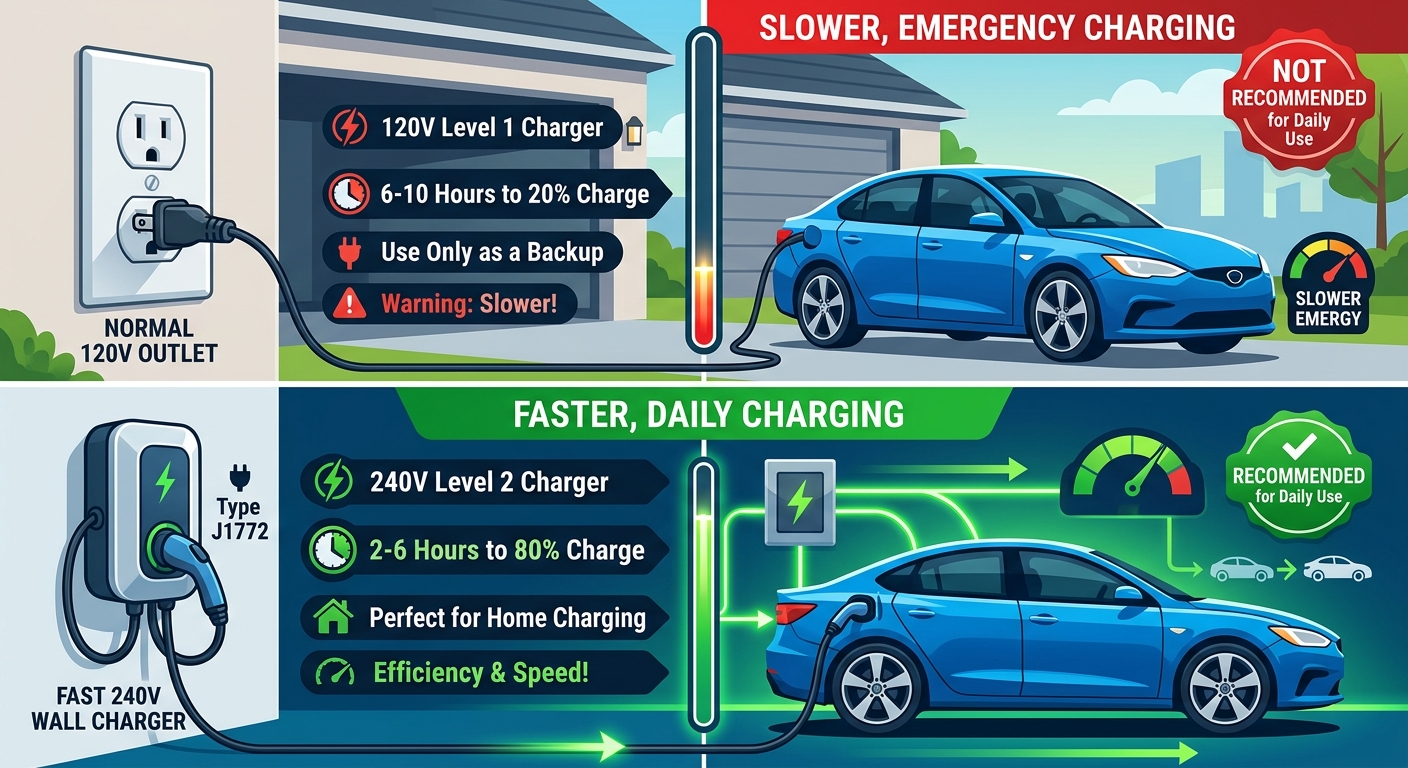
For new and prospective electric vehicle (EV) owners, understanding how to keep a vehicle battery replenished without expensive home upgrades is a top priority. A common question among first-time buyers is: Can I plug my EV into a normal outlet?
The short answer is yes, you can plug an electric vehicle into a standard 120-volt household wall outlet using a Level 1 portable charger. Every new electric vehicle comes equipped with (or offers as an accessory) a Level 1 portable charging cable that plugs directly into a standard 3-prong household socket (NEMA 5-15).
While plugging into a normal wall socket requires zero electrical upgrades, it represents the slowest method of charging. Level 1 trickle charging adds approximately 3 to 5 miles of range per hour, making it ideal for low-mileage daily drivers, plug-in hybrids (PHEVs), or overnight top-ups.
For comprehensive hardware guides, charging speed comparisons, and home setup reviews, visit EV Charger Advisor.
How Level 1 Charging Works on a Standard 120V Outlet
Level 1 charging relies on the existing residential electrical infrastructure already found in your garage, driveway, or carport.
1. Electrical Specifications
-
Supply Voltage: $120 \text{ Volts AC}$ (Standard North American wall socket).
-
Continuous Amperage Draw: $12 \text{ to } 15 \text{ Amps}$.
-
Power Delivery Output: $1.4 \text{ kW} \text{ to } 1.9 \text{ kW}$.
-
Receptacle Required: Standard grounded NEMA 5-15 or NEMA 5-20 3-prong wall outlet.
2. Daily Energy Delivery
Plugging an EV into a standard wall outlet overnight for 12 hours transfers approximately 14 to 18 kWh of usable energy into the battery pack. For an efficient electric car averaging $3.5 \text{ miles per kWh}$, this translates to 40 to 60 miles of replenished driving range—more than enough to cover the average American or urban daily commute.
To learn more about how charger power levels compare, check out our guide on EV charging types.
Step-by-Step Mathematical Example: Calculating Level 1 Charge Time
To see how Level 1 trickle charging performs in real-world conditions, let us calculate the time required to restore 50% charge (37.5 kWh) to an EV equipped with a 75 kWh battery pack.
Given Parameters:
-
Energy Needed: $37.5 \text{ kWh}$
-
Level 1 Charger Power Output (120V @ 12A): $1.44 \text{ kW}$ ($120\text{V} \times 12\text{A} / 1000$)
-
Onboard AC-to-DC Charging Efficiency: $85\%$ ($0.85$)
Calculation 1: Usable Power Delivered to Battery
Calculation 2: Total Charging Duration Required
Calculation 3: Added Miles Per Hour
Assuming a vehicle efficiency of 3.3 miles per kWh:
Result Breakdown: Restoring half a battery pack ($37.5\text{ kWh}$) on a normal 120V outlet takes over 30 hours, adding roughly 4 miles of range per hour.
Critical Safety Guidelines for Plugging an EV Into a Normal Outlet
Because electric vehicle charging draws continuous current for extended periods, plugging into a standard wall outlet requires following strict safety precautions:
1. Avoid Using Lightweight Household Extension Cords
Never connect a Level 1 EV charger to a thin, residential extension cord. High continuous current draw generates intense heat along lightweight wires, causing voltage drops and creating severe fire risks. If an extension cord is strictly necessary, use a heavy-duty 10-gauge (10 AWG) outdoor-rated cord.
2. Ensure a Dedicated Branch Circuit
Plugging an EV into a 120V outlet that shares a circuit with other high-draw appliances (such as refrigerators, space heaters, or power tools) will overload the circuit breaker and cause frequent trips.
3. Check Outlet Condition and Grounding
Ensure the wall outlet is properly grounded, fits the plug tightly, and shows no signs of wear, discoloration, or loose connections. Worn receptacle contacts create thermal resistance points that can melt the outlet faceplate.
To explore Wi-Fi-enabled smart chargers that support dynamic power monitoring, read our guide on smart chargers.
Comparison Table: Normal Outlet (Level 1) vs. Dedicated Wallbox (Level 2)
| Feature | Level 1 Normal Outlet (120V) | Level 2 Dedicated Charger (240V) |
| Power Output | $1.4\text{ kW} – 1.9\text{ kW}$ | $7.2\text{ kW} – 11.5\text{ kW}$ |
| Continuous Amperage | $12\text{A} – 15\text{A}$ | $30\text{A} – 48\text{A}$ |
| Added Range per Hour | $3 – 5\text{ miles/hr}$ | $25 – 37\text{ miles/hr}$ |
| Time for 50% Charge (75kWh) | $\approx 30\text{ Hours}$ | $\approx 4.5\text{ Hours}$ |
| Upfront Equipment Cost | $0 (Included with vehicle) | $300 – $700 (Hardware) |
Summary & Key Takeaways
-
Entirely Possible: You can safely plug an EV into a standard 120V wall outlet using a Level 1 portable charger.
-
Slow Speed: Normal outlets add 3 to 5 miles of range per hour, requiring 24 to 40+ hours for a full charge from empty.
-
Great for Short Commutes: If you drive under 40 miles per day, Level 1 overnight charging can cover your daily transportation needs without electrical installation costs.
-
Safety First: Always use a dedicated, grounded outlet and avoid thin household extension cords to prevent overheating.













Leave a Reply