
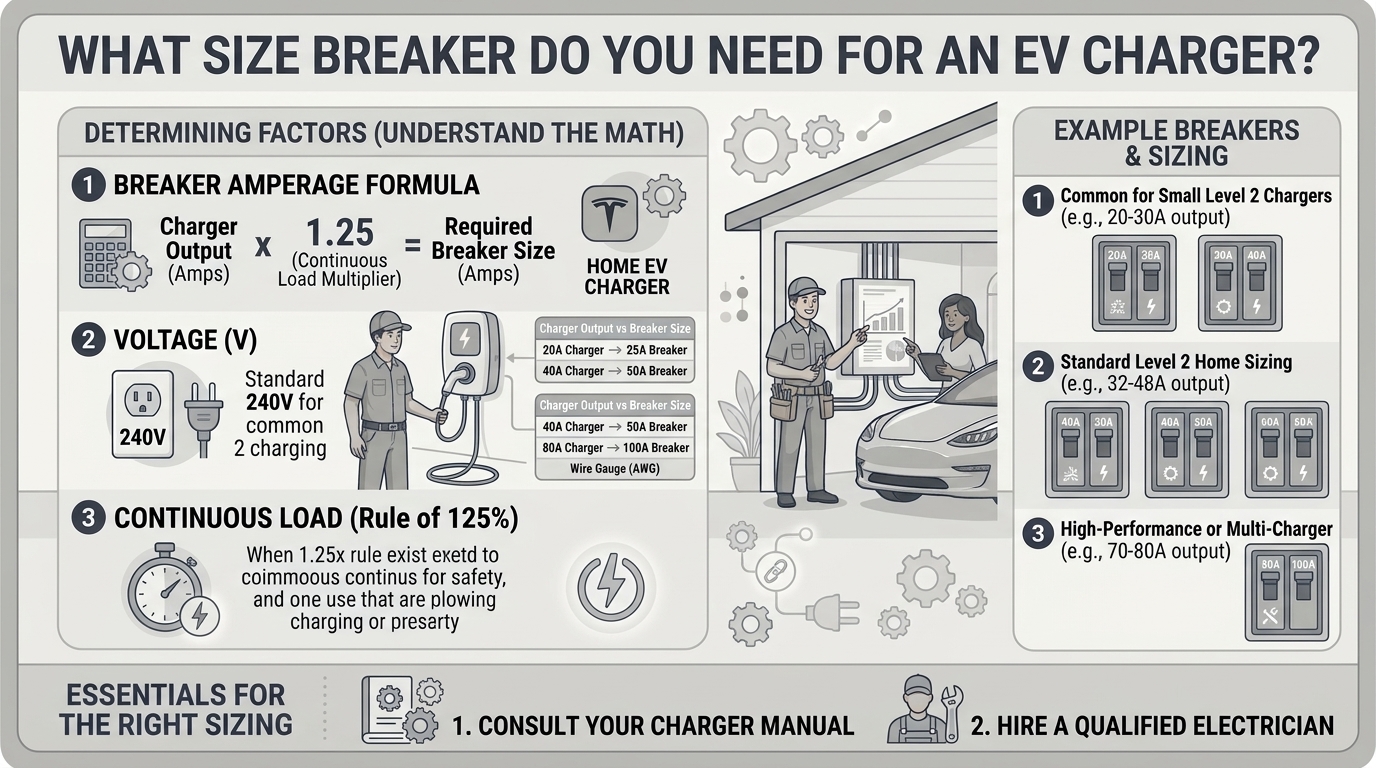
Upgrading your home electrical system to support a Level 2 electric vehicle (EV) charger requires careful component selection, with the circuit breaker serving as the primary protective device. Installing a circuit breaker that is under-sized will lead to nuisance trips, while over-sizing a breaker relative to your conductor wire gauge creates a severe fire hazard.
The most common Level 2 EV chargers require a 40-amp to 60-amp circuit breaker, depending on the maximum amperage output of the charger.
Because EV charging draws steady, uninterrupted current for hours at a time, electrical codes mandate specific sizing rules to prevent thermal overload on home wiring and breaker panels.
For detailed breaker sizing tools, wire gauge charts, and installer recommendations, visit EV Charger Advisor.
The NEC 125% Rule: Why Breaker Size Must Exceed Charger Amperage
The primary standard governing EV charger circuit installation in North America is the National Electrical Code (NEC Article 625). Under the NEC, electric vehicle charging is legally classified as a continuous load—defined as any electrical draw that continues at maximum current for 3 hours or more.
Because circuit breakers and wiring heat up under continuous electrical loads, branch circuits must be sized to 125% of the charger’s continuous output rating (or conversely, a charger must draw no more than 80% of the breaker’s total rated capacity):
Why You Cannot Match Charger Amps Directly to Breaker Amps:
-
A 32-Amp Charger requires a 40-Amp Breaker ($32\text{A} \times 1.25 = 40\text{A}$).
-
A 40-Amp Charger requires a 50-Amp Breaker ($40\text{A} \times 1.25 = 50\text{A}$).
-
A 48-Amp Charger requires a 60-Amp Breaker ($48\text{A} \times 1.25 = 60\text{A}$).
Plugging a 40-Amp charger into a 40-Amp circuit breaker will cause the breaker internal thermal trips to activate after 1 to 2 hours of continuous operation due to cumulative heat accumulation.
To learn more about how charger power levels compare, check out our guide on EV charging types.
Breaker & Wire Gauge Sizing Table for Level 2 EV Chargers
Circuit breakers are designed to protect the copper wire inside your walls. Whenever a breaker size is increased, the thickness (gauge) of the electrical wire must be increased accordingly. Below is the standard NEC branch circuit sizing matrix for common 240V residential Level 2 chargers:
| Charger Max Output (Amps) | Power Output @ 240V | Required Breaker Size | Min Copper Wire Gauge (NM-B Romex / THHN) | Common Receptacle / Connection |
| 16 Amps | $3.8 \text{ kW}$ | 20 Amps | #12 AWG Copper | NEMA 6-20 Plug / Hardwired |
| 24 Amps | $5.7 \text{ kW}$ | 30 Amps | #10 AWG Copper | NEMA 14-30 / 10-30 Plug |
| 32 Amps | $7.7 \text{ kW}$ | 40 Amps | #8 AWG Copper | NEMA 14-50 Plug / Hardwired |
| 40 Amps | $9.6 \text{ kW}$ | 50 Amps | #6 AWG Copper | NEMA 14-50 Plug / Hardwired |
| 48 Amps | $11.5 \text{ kW}$ | 60 Amps | #6 AWG THHN / #4 AWG Romex | Hardwired Only (No 60A Plug) |
| 80 Amps | $19.2 \text{ kW}$ | 100 Amps | #2 AWG Copper | Hardwired Commercial |
Note: Wire gauge requirements may vary based on long conduit runs ($>100\text{ feet}$), conduit fill factors, ambient temperatures, or local code amendments. Always consult a certified electrician.
Step-by-Step Mathematical Example: Sizing a Circuit for a 48A Charger
To see how the 125% NEC continuous load rule applies during a real-world installation, let us calculate the required breaker size and total power delivered for a high-speed 48-Amp hardwired Level 2 wallbox.
Given Parameters:
-
Charger Continuous Draw: $48 \text{ Amps}$
-
Operating Supply Voltage: $240 \text{ Volts}$
Calculation 1: Determining Minimum Circuit Breaker Rating
Calculation 2: Total Kilowatt (kW) Power Delivery
Calculation 3: Added Miles of Range Per Hour
Assuming a standard electric SUV efficiency of 3.3 miles per kWh:
Result Breakdown: A 48A charger requires a 60-Amp double-pole circuit breaker and delivers 11.52 kW of power, adding roughly 38 miles of range per hour of charge time.
Plug-In (NEMA 14-50) vs. Hardwired Breaker Rules
Understanding how your charger connects to your electrical panel dictates the maximum breaker size permitted by building safety codes:
1. Plug-In Receptacles (NEMA 14-50)
-
Maximum Breaker Allowed: 50 Amps.
-
Maximum Charger Output: 40 Amps.
-
Code Requirement: Under recent NEC rules, 240V receptacles installed in garages or outdoor locations for EV charging require a dedicated GFCI (Ground Fault Circuit Interrupter) circuit breaker ($100 – $150+ cost).
2. Hardwired Direct Connections
-
Maximum Breaker Allowed: 60 Amps+ (Supports 48A to 80A charging).
-
Maximum Charger Output: 48 Amps ($11.5\text{ kW}$) on residential panels.
-
Code Advantage: Hardwiring connects directly to the wallbox terminals, skipping the plug socket entirely. This eliminates plug thermal failure risks, saves the cost of a GFCI breaker in many jurisdictions, and allows faster charging speeds.
To explore Wi-Fi-enabled smart chargers with adjustable amperage settings, read our guide on smart chargers.
Summary & Key Takeaways
-
Apply the 125% Rule: Always multiply your charger’s continuous output amperage by 1.25 to find the required breaker size.
-
Match Wire to Breaker: Never install a larger circuit breaker without upgrading the copper wire gauge. For example, a 50A breaker requires heavy #6 AWG copper wire.
-
Hardwire for 60A Circuits: If you want maximum $48\text{A}$ ($11.5\text{ kW}$) home charging speeds, you must hardwire the unit on a 60-Amp breaker.
-
Check Panel Capacity: Ensure your main electrical panel has enough remaining ampacity (e.g., 200A main service) before adding a dedicated 50A or 60A double-pole breaker.













Leave a Reply