
🟢 — START OF BLOG POST — 🟢
Can I Own an EV Without a Home Charger? The Complete Lifestyle & Practical Guide
When drivers consider switching to an electric vehicle (EV), the ability to install a dedicated Level 2 home charging station inside a garage or driveway is often seen as a strict prerequisite. For renters, apartment dwellers, condo owners, and street-parking residents, this creates a major question: Can I own an EV without a home charger?
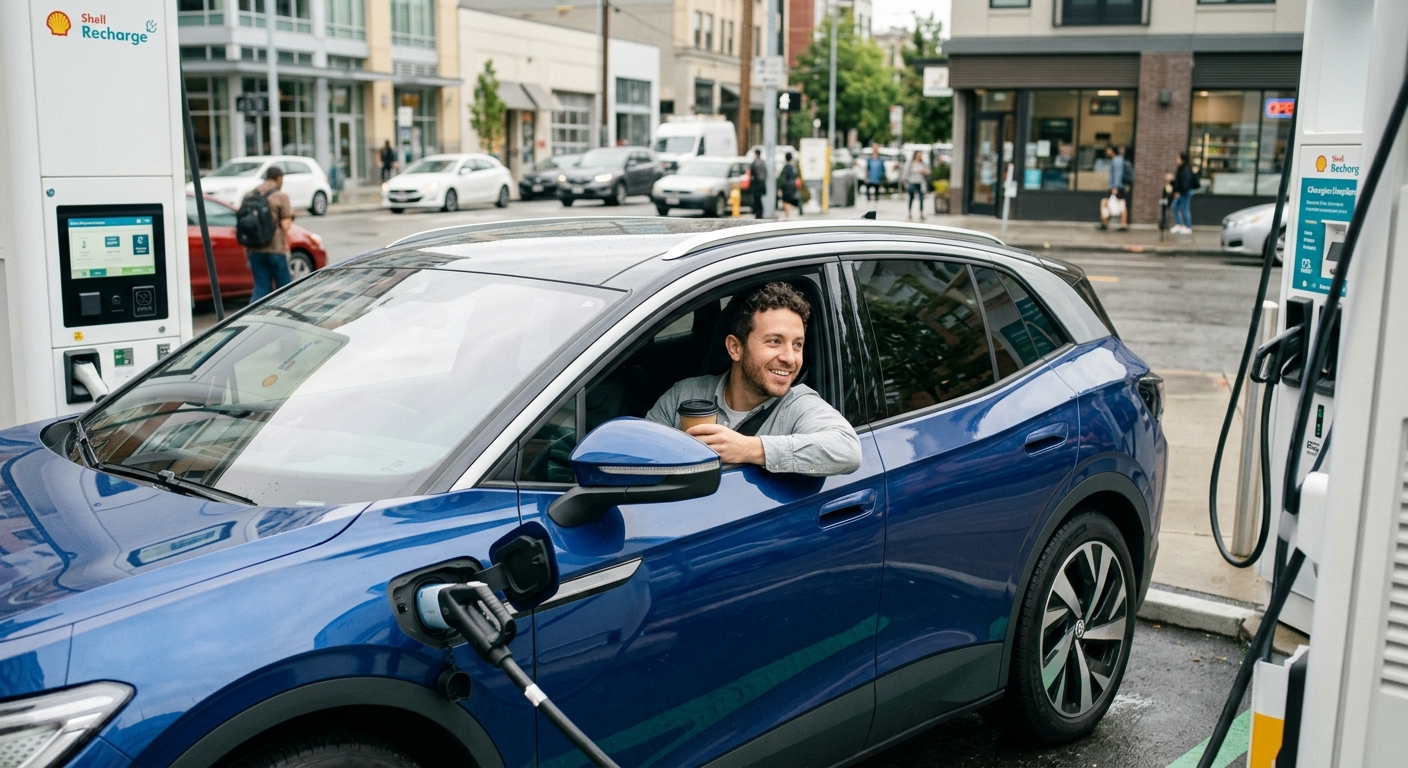
The short answer is yes, you can comfortably own and operate an EV without a home charger. However, doing so successfully requires shifting your mindset from charging overnight while you sleep to relying on alternative charging channels—such as workplace charging, public Level 2 destination charging, and commercial DC fast-charging networks.
While non-home charging demands more deliberate routine planning and routine management, tens of thousands of urban EV drivers operate without private home charging hardware.
For comprehensive hardware breakdowns and public charging navigation guides, visit EV Charger Advisor.
4 Main Charging Strategies for EV Owners Without Home Wallboxes
If you cannot install a wallbox at your residence, you can utilize four practical charging alternatives to maintain your battery’s state of charge:
1. Workplace & Commercial Office Charging
Plugging in at your workplace is the most effective substitute for home charging. Many employer parking structures offer Level 2 AC chargers ($7.2\text{ kW} – 11.5\text{ kW}$) that fully replenish your vehicle’s battery over an 8-hour workday, often at free or subsidized rates.
2. Public DC Fast Charging (DCFC) “Top-Up” Sessions
Utilizing high-power public DC fast chargers ($50\text{ kW} – 350\text{ kW}$) while running weekly errands (at grocery stores, shopping centers, or highway service hubs) can add $60\% \text{ to } 80\%$ battery charge in $20 \text{ to } 40\text{ minutes}$.
3. Retail & Destination Level 2 Charging
Many public parking garages, gyms, movie theaters, and shopping malls feature Level 2 chargers. Plugging in during a 2-hour workout or movie session provides $30 \text{ to } 50\text{ miles}$ of added range.
4. Standard 120V Level 1 “Trickle” Charging
If you have access to a standard household 120V wall outlet near a shared parking space or rental driveway, using a portable Level 1 cable adds $3 \text{ to } 5\text{ miles}$ of range per hour. Over a 12-hour overnight park, this delivers $36 \text{ to } 60\text{ miles}$—enough to cover average daily urban commutes.
To learn more about how charger speeds and voltage levels compare, check out our guide on EV charging types.
Step-by-Step Mathematical Example: Planning a Weekly Public Charging Strategy
To see how owning an EV without a home charger functions in real life, let us calculate the weekly charging needs for an apartment dweller commuting 300 miles per week in an EV with a 75 kWh battery pack and an efficiency of 3.5 miles per kWh.
Given Parameters:
-
Weekly Driving Distance: $300 \text{ miles}$
-
Vehicle Efficiency: $3.5 \text{ miles per kWh}$
-
Battery Capacity: $75 \text{ kWh}$
-
Public Fast Charging Rate (Commercial DCFC): $\$0.45 \text{ per kWh}$
Calculation 1: Total Weekly Energy Required
Calculation 2: Number of Battery Charges / Sessions Needed
Since total weekly consumption ($85.7\text{ kWh}$) is slightly more than the $75\text{ kWh}$ total battery capacity, the driver needs roughly 1.15 full battery charges per week.
-
Strategy Option A: One 35-minute DC Fast Charge session per week while grocery shopping (replenishing $50\text{ kWh}$ or $\approx 58\%$) PLUS two 2-hour Level 2 destination charges while at the gym (adding $36\text{ kWh}$).
-
Strategy Option B: Two 25-minute DC Fast Charge sessions per week, keeping the battery operating comfortably between $20\%$ and $80\%$ state of charge.
Calculation 3: Total Weekly Fuel Cost
Result Breakdown: Relying entirely on public charging requires just two short 25-minute fast-charging stops per week, costing $167 per month—which remains competitive with or lower than fueling a comparable gasoline SUV.
Pros & Cons of Owning an EV Without a Home Charger
Advantages:
-
Zero Upfront Installation Costs: Avoid spending $800 to $2,500+ on electrical panel upgrades, wiring, and wallbox equipment.
-
Property Independence: Ideal for renters who move frequently or lack permission from landlords to modify property wiring.
-
Flexible Battery Routine: Incorporates charging naturally into existing routines like shopping, working out, or working at an office.
Disadvantages:
-
Higher Cost Per Kilowatt-Hour: Public DC fast charging rates ($0.35 – $0.60/kWh) are significantly higher than off-peak home residential electricity ($0.08 – $0.16/kWh).
-
Time Commitment: Requires sitting at public charging hubs or planning around station availability.
-
Public Station Congestion: Popular urban fast chargers can experience wait times during peak evening hours.
To explore smart portable charging cables that adapt to available outlets, read our guide on smart chargers.
Comparison Table: Home Charging vs. Non-Home Charging Strategies
| Feature | Dedicated Home Level 2 | Workplace Charging | Public DC Fast Charging | Public Level 2 Destination |
| Upfront Cost | $500 – $2,500+ | $0 | $0 | $0 |
| Average Electricity Cost | $0.08 – $0.16 / kWh | $0 – $0.20 / kWh | $0.35 – $0.60 / kWh | $0 – $0.30 / kWh |
| Charge Time (20%-80%) | $6 – 8 \text{ Hours}$ | $6 – 8 \text{ Hours}$ | $20 – 40 \text{ Minutes}$ | $3 – 5 \text{ Hours}$ |
| Convenience Rating | Maximum (Overnight) | High (While working) | Moderate (Requires stop) | High (While running errands) |
Summary & Key Takeaways
-
Entirely Feasible: You can easily own an EV without home charging if you have access to workplace charging, nearby DC fast chargers, or retail destination plugs.
-
Predictable Routine: Most urban commuters with moderate driving habits ($300\text{ miles/week}$) only need 1 to 2 public charging stops per week.
-
Use Live Charger Apps: Utilize apps like PlugShare, ChargePoint, or Tesla Supercharger maps to check real-time station availability and avoid long queues.
-
Consider Level 1 Trickle Charging: If you have access to a standard 120V outlet near your vehicle, Level 1 trickle charging can cover $30 – 50\%$ of daily driving energy needs without special hardware.













Leave a Reply