
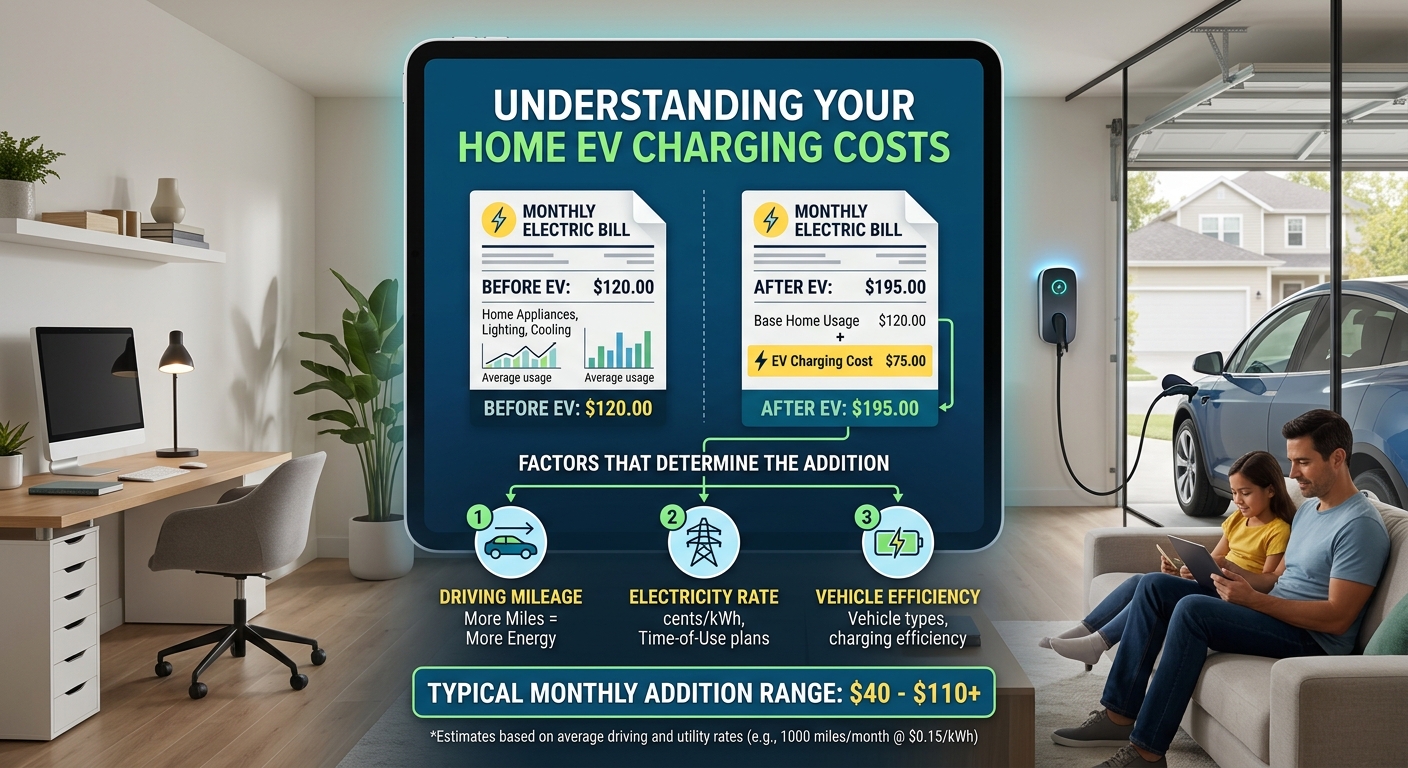
Setting up a home Level 2 charging station is one of the most convenient and cost-effective decisions an electric vehicle (EV) owner can make. However, transitioning from filling up at a gas station to charging overnight at home introduces a new recurring expense: an increase in your monthly residential electricity bill.
Understanding how much a home EV charger adds to your electric bill depends primarily on three variables: how many miles you drive, your vehicle’s efficiency rating, and your local utility company’s electricity tariff rates (per kWh).
For most drivers covering approximately 1,000 miles (1,600 km) per month, adding a home EV charger increases their monthly electric bill by $40 to $70. While your electricity costs will go up, this added expense is almost always offset by eliminating $120 to $200+ in monthly gasoline spending.
For complete hardware guides and installation breakdowns, visit EV Charger Advisor.
Key Factors Determining Your Monthly Charging Cost
Your overall electricity bill increase is controlled by electrical consumption metrics rather than the charger hardware itself.
1. Local Electricity Tariff Rates ($/kWh)
Electricity is billed by the kilowatt-hour (kWh). In North America, residential rates average roughly $0.15 to $0.17 per kWh. Taking advantage of off-peak or Time-of-Use (TOU) rates offered by power utilities can lower this rate to as little as $0.05 to $0.08 per kWh.
2. Vehicle Efficiency (Miles per kWh)
An EV’s energy economy determines how much electricity is required to cover a set distance:
-
Efficient Sedans: Average $3.5 \text{ to } 4.0 \text{ miles per kWh}$.
-
Midsize SUVs & Crossovers: Average $3.0 \text{ to } 3.4 \text{ miles per kWh}$.
-
Heavy Trucks & Performance EVs: Average $2.0 \text{ to } 2.5 \text{ miles per kWh}$.
3. Monthly Driving Distance
The more miles driven per month, the more kilowatt-hours your charger must supply to keep the battery replenished.
To learn more about how different charger power outputs perform, check out our guide on EV charging types.
Step-by-Step Mathematical Example: Calculating Monthly Electricity Increase
To see how driving habits convert into exact numbers on your power bill, let us calculate the monthly increase for an EV driver covering 1,200 miles per month in a crossover averaging 3.2 miles per kWh.
Given Parameters:
-
Monthly Driving Distance: $1,200 \text{ miles}$
-
Vehicle Efficiency: $3.2 \text{ miles/kWh}$
-
Standard Residential Electricity Rate: $0.16 \text{ per kWh}$
-
Discounted Off-Peak TOU Electricity Rate: $0.08 \text{ per kWh}$
Calculation 1: Monthly Kilowatt-Hours Required
Calculation 2: Standard Rate Monthly Bill Increase
Calculation 3: Off-Peak Rate Monthly Bill Increase
Result Breakdown: Charging at standard rates adds $60.00 to your monthly power bill. Switching to off-peak overnight charging cuts that addition in half to just $30.00 per month.
Smart Strategies to Minimize Your EV Charging Bill
You can easily reduce the financial impact of home charging by adopting smart energy management habits:
1. Enroll in Time-of-Use (TOU) Rates
Many utility providers offer specialized TOU rate plans designed for EV owners. These plans offer deeply discounted electricity during overnight off-peak hours (typically 11:00 PM to 6:00 AM) when overall grid demand is lowest.
2. Use Smart Charger Scheduling
Modern Wi-Fi-enabled Level 2 wallboxes allow you to program automatic charging schedules using a smartphone app. You can plug in your vehicle as soon as you get home, but the charger will wait until off-peak hours begin to draw power.
3. Leverage Solar Energy
If your home is equipped with a solar PV system, you can charge your vehicle using clean, self-generated electricity, effectively reducing your marginal grid charging costs down to zero during peak sunlight hours.
To explore Wi-Fi-enabled smart chargers that support off-peak scheduling, read our guide on smart chargers.
Cost Comparison Table: Home Charging vs. Gasoline vs. Public Charging
| Fuel Source | Unit Cost Metric | Monthly Cost (1,000 Miles) | Annual Expense |
| Home EV Charger (Off-Peak) | $0.08 / kWh | $25 – $35 | $300 – $420 |
| Home EV Charger (Standard Rate) | $0.16 / kWh | $50 – $70 | $600 – $840 |
| Public DC Fast Charging | $0.45 / kWh | $135 – $160 | $1,620 – $1,920 |
| Gasoline Vehicle (30 MPG) | $3.60 / Gallon | $120 – $150 | $1,440 – $1,800 |
Summary & Key Takeaways
-
Predictable Increase: Expect a monthly electric bill increase of $40 to $70 for average daily driving.
-
Major Net Savings: The $40 to $70 electric bill increase replaces a typical $120 to $200+ monthly gas bill, resulting in net savings of over $1,000 per year.
-
Off-Peak Advantage: Charging overnight on TOU rates can cut your added electricity expenses by 50% or more.
-
Cheaper Than Fast Charging: Home charging is roughly 3x to 4x cheaper per kWh than using commercial public fast chargers.













Leave a Reply