
When buying or leasing an electric vehicle (EV), setting up home charging is often the top priority. While public charging stations offer fast top-ups, charging overnight at home remains the most convenient and cost-effective way to power an EV. However, purchasing a Level 2 home charger and paying for electrical installation can cost anywhere from $500 to over $2,000.
This leads many new EV owners to ask: Can I get a free EV home charger?
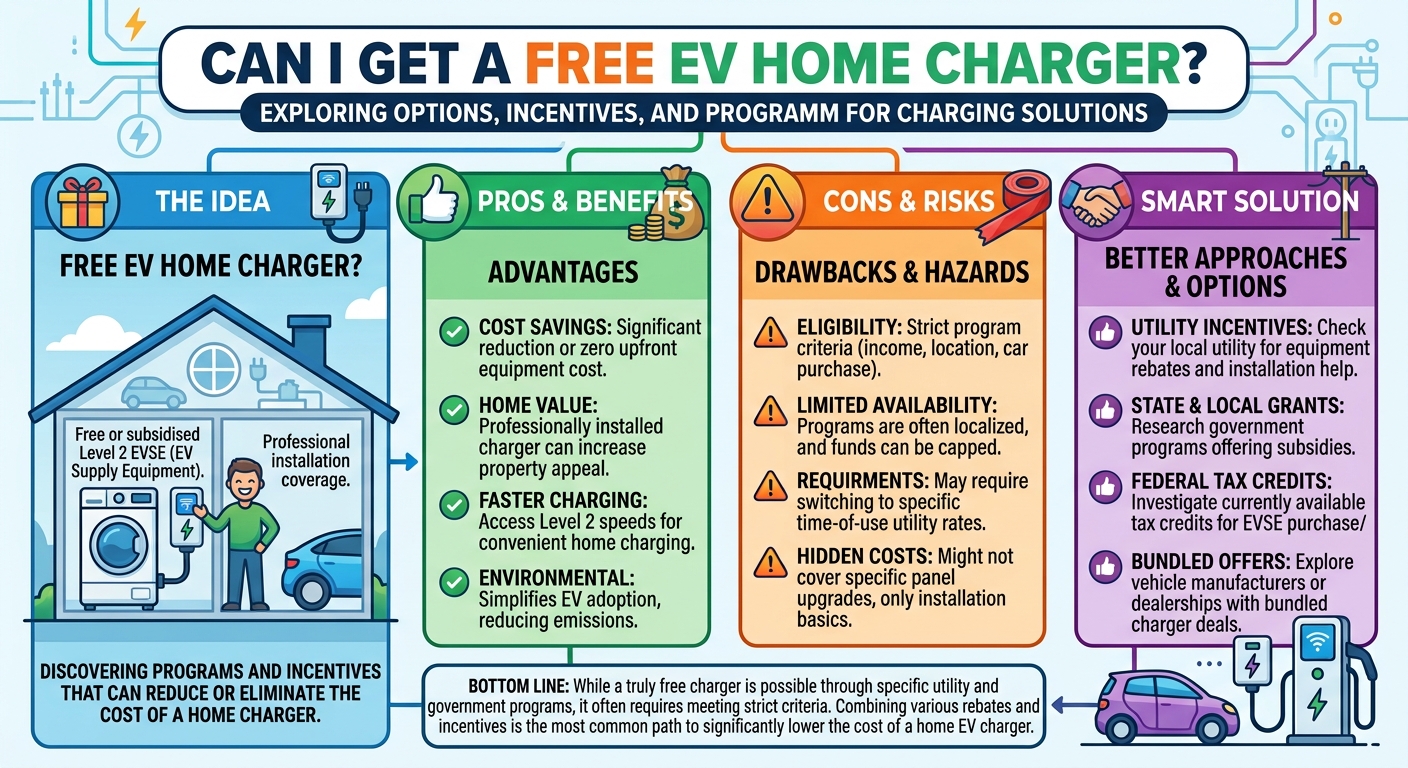
The short answer is yes, you can sometimes get a free EV home charger. While chargers are rarely handed out with zero conditions, automakers, electric utility companies, and state or regional government programs frequently offer free charging hardware, direct rebates, or full installation subsidies.
For comprehensive hardware reviews and cost-saving installation guides, visit EV Charger Advisor.
4 Main Ways to Get a Free or Subsidized EV Charger
Understanding where to look for EV charger incentives can save you hundreds of dollars upfront.
1. Automaker Promotions & Purchase Perks
Automakers frequently offer incentives to encourage EV adoption. When you buy or lease certain new EV models, manufacturers often include:
-
Free Level 2 Home Charger Units: Free branded wallboxes provided at vehicle delivery.
-
Installation Credits: Direct credits (often ranging from $500 to $1,500) applied toward professional electrician installation through partner networks.
-
Alternative Public Charging Credits: Option to choose free public fast-charging credits if home charging is not feasible.
2. Electric Utility Company Rebate Programs
Local electric utility providers are among the largest sources for free or discounted EV chargers. To balance grid demand, power companies offer programs such as:
-
100% Hardware Rebates: Full reimbursement for purchasing specific smart Level 2 chargers.
-
Managed Charging Subsidies: Free smart chargers given in exchange for enrolling in off-peak charging programs, where charging automatically occurs during low-demand nighttime hours.
3. State, Provincial, and Municipal Grants
Regional energy offices and local government agencies offer clean-energy grants to reduce home electrification costs. These programs often provide income-qualified rebates or direct subsidies that cover both hardware and electrical panel upgrade expenses.
4. Federal Tax Credits (IRS Section 30C)
While not a direct free giveaway, the U.S. federal Section 30C tax credit allows qualified homeowners to claim up to 30% of the total cost (up to $1,000) for EV charger hardware and installation on their tax return.
To learn more about charger types and compatibility, read our detailed guide on EV charging types.
Step-by-Step Mathematical Example: Calculating Net Costs with Rebates
To see how combining manufacturer incentives, utility rebates, and tax credits can reduce your out-of-pocket expenses down to zero, let us look at a real-world calculation example.
Given Setup Costs:
-
Smart Level 2 Home Charger Unit: $600
-
Dedicated 240V Circuit Installation & Labor: $900
-
Total Initial Investment: $\$600 + \$900 = \mathbf{\$1,500}$
Applied Rebates & Incentives:
-
Automaker Installation Credit: $500
-
Electric Utility Smart Charger Hardware Rebate: $600 (Full charger cost)
-
Federal IRS Section 30C Tax Credit (30% of remaining cost): $120
Calculation: Step-by-Step Savings Breakdown
Result Breakdown: By combining a utility hardware rebate, automaker credit, and tax credit, an initial $1,500 home charging installation is reduced by over 80%, leaving a net out-of-pocket expense of just $280 (or completely $0 if full installation grants apply).
Important Terms and Conditions to Watch Out For
While getting a free EV charger is achievable, programs usually come with specific eligibility requirements:
1. Approved Hardware Lists
Utility rebates often require you to buy a specific brand or model of smart Level 2 charger that supports Wi-Fi connectivity and dynamic load scheduling.
2. Managed Charging & Time-of-Use (TOU) Enrollment
To receive a free charger from your power company, you may need to participate in Time-of-Use (TOU) rate plans. This requires charging during off-peak hours (typically 11:00 PM to 6:00 AM) to help keep grid demand balanced.
3. Licensed Installation Requirements
Most incentive programs require installation by a licensed electrician and valid municipal electrical permits to process rebate claims.
To explore smart chargers that qualify for utility rebate programs, read our guide on smart chargers.
Incentive Comparison Table: Free EV Charger Options
| Incentive Source | What Is Covered? | Typical Value | Key Requirement |
| Automaker Perk | Hardware or Installation | $500 – $1,500 | Purchase/Lease of new EV model |
| Utility Rebate | Smart Charger / Panel Upgrades | $500 – $1,000 | Enrollment in Off-Peak charging |
| State / Local Grants | Hardware & Electrical Labor | $300 – $1,200 | Income or Geographic eligibility |
| Federal IRS Credit | Hardware & Installation | Up to 30% ($1,000) | Form 8911 / Qualified Census Tract |
Summary & Key Takeaways
-
Multiple Savings Pathways: Free or low-cost home EV chargers are available through automaker promotions, utility rebates, and government grants.
-
Combine Incentives: Stacking utility hardware rebates with federal tax credits can eliminate up to 100% of equipment costs.
-
Choose Approved Smart Chargers: Ensure you select a Wi-Fi-enabled smart charger that meets your utility company’s incentive requirements.
-
Verify Before Buying: Check your local electric utility website and state energy portal before purchasing hardware to ensure full rebate eligibility.













Leave a Reply