
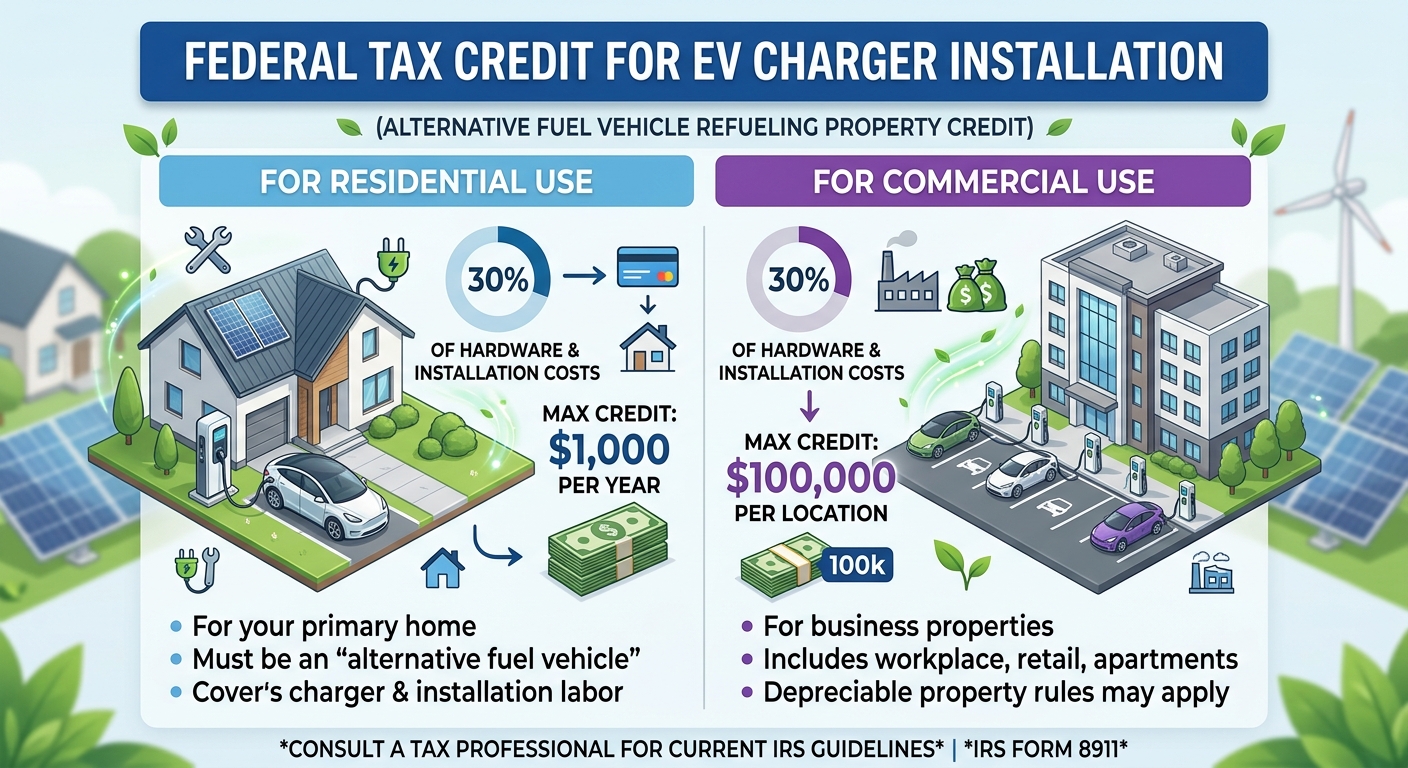
As electric vehicle (EV) adoption continues to grow across the United States, homeowners and commercial business owners frequently look for ways to offset the cost of purchasing and installing Level 2 EV charging equipment. A major financial incentive available is the federal IRS tax credit for EV charger installation.
The short answer is yes, there is an official IRS tax credit available under Section 30C of the Internal Revenue Code, officially named the Alternative Fuel Vehicle Refueling Property Credit.
Expanded and extended under the Inflation Reduction Act (IRA), Section 30C allows eligible individuals and businesses to claim a substantial tax credit for purchasing and installing qualified EV charging equipment at their properties.
For full breakdowns of home charging hardware, installation guides, and cost-saving resources, visit EV Charger Advisor.
Understanding Section 30C: Credit Amounts & Limits
The IRS Section 30C tax credit applies differently depending on whether the installation is for personal residential use or commercial business property:
1. Residential Property Installations
-
Credit Percentage: 30% of the total cost of eligible hardware and labor.
-
Maximum Credit Cap: Up to $1,000 per home installation.
-
Eligible Costs: Covers the EV charger unit (Level 2 wallbox), electrical wiring, circuit breakers, conduit, dedicated junction boxes, and professional electrician installation labor.
2. Commercial & Business Installations
-
Credit Percentage: 6% base credit rate, which increases to 30% if prevailing wage and registered apprenticeship requirements are met during construction.
-
Maximum Credit Cap: Up to $100,000 per individual item of refueling property.
-
Eligible Properties: Fleet yards, commercial parking garages, multi-family apartment buildings, and workplace employee charging stations.
To explore how home charger models compare, check out our guide on EV charging types.
IRS Location & Geographic Eligibility Rules
To qualify for the Section 30C tax credit for installations placed in service after December 31, 2022, the property must meet strict geographic census tract location requirements.
1. Low-Income Communities
The EV charger must be installed in an eligible census tract classified as a low-income community under Section 45D(e) of the Internal Revenue Code.
2. Non-Urban (Rural) Census Tracts
Alternatively, the installation site can qualify if it is located in a census tract that is not classified as an urban area according to the latest U.S. Census Bureau data.
Before purchasing hardware, homeowners and business managers should verify their property address using the official IRS / CDFI Fund mapping tools to confirm that their census tract qualifies for Section 30C.
Step-by-Step Mathematical Example: Calculating Your IRS Tax Credit
To see how the Section 30C tax credit reduces total out-of-pocket costs, let us calculate the net installation expense for a homeowner setting up a hardwired 48A Level 2 charger on an eligible residential property.
Given Expense Parameters:
-
Level 2 Charger Hardware: $650
-
Dedicated 60A Circuit Breaker & Heavy Gauge Wire: $250
-
Licensed Electrician Labor & Permit Fees: $1,100
-
Total Gross Installation Cost: $\$650 + \$250 + \$1,100 = \mathbf{\$2,000}$
Calculation: 30% IRS Section 30C Credit
Since $600 is below the residential maximum limit of $1,000, the homeowner claims the full $600 as a direct tax credit on their federal tax return.
Net Cost Calculation:
Result Breakdown: Claiming the 30% tax credit saves $600 directly, reducing total home Level 2 charging installation costs down to $1,400.
How to Claim the Tax Credit: IRS Form 8911
To claim the EV charger installation credit on your annual federal income tax return, follow these step-by-step procedures:
1. File IRS Form 8911
Complete IRS Form 8911 (Alternative Fuel Vehicle Refueling Property Credit) and attach it to your primary federal tax return (Form 1040 for individual homeowners).
2. Save Itemized Receipts & Invoices
Retain detailed, itemized receipts showing hardware purchase prices, electrical components, permits, and electrician labor fees. Invoices must clearly show that the equipment was purchased and installed within the tax year claimed.
3. Verify Personal Tax Liability
The residential Section 30C credit is a non-refundable tax credit. This means it can reduce the amount of federal income tax you owe down to zero, but any excess credit amount above your tax liability for that year will not be refunded as extra cash.
To explore smart charging options that qualify for energy rebate programs, read our guide on smart chargers.
Comparison Table: Residential vs. Commercial IRS Section 30C Credit
| Feature | Residential (Homeowner) | Commercial (Business / Fleet) |
| IRS Tax Form | IRS Form 8911 | IRS Form 8911 |
| Maximum Credit Rate | 30% of Total Project Cost | 30% (With Prevailing Wage Rules) |
| Maximum Dollar Cap | $1,000 Per Property | $100,000 Per Property Unit |
| Eligible Equipment | Level 2 Chargers & Wiring | Level 2 & DC Fast Charging Hardware |
| Geographic Requirement | Qualified Census Tract Required | Qualified Census Tract Required |
| Carryforward Rules | Cannot Be Carried Forward | Can Be Carried Back / Forward |
Summary & Key Takeaways
-
30% Tax Credit: Section 30C provides up to a 30% credit for purchasing and installing EV charging infrastructure.
-
Cap Limits: Homeowners can claim up to $1,000, while commercial businesses can claim up to $100,000.
-
Census Tract Rules: Installations must be located in low-income or non-urban census tracts to qualify under updated IRA rules.
-
File Form 8911: Claim the credit on your tax return using IRS Form 8911 along with itemized installation invoices.













Leave a Reply